Quick Answer
The Thunderbolt 2 to modern 4K monitor bottleneck resolves at 4K at 60Hz using an active Thunderbolt 2 to DisplayPort 1.2 adapter and an HBR2-rated DisplayPort cable. Thunderbolt 2's 20Gbps shared bandwidth handles 4K at 60Hz in display-only mode; the bottleneck only reappears when simultaneously driving a daisy-chained Thunderbolt storage device on the same port.
Why Thunderbolt 2 Struggles With Modern Monitor Connections 🔧
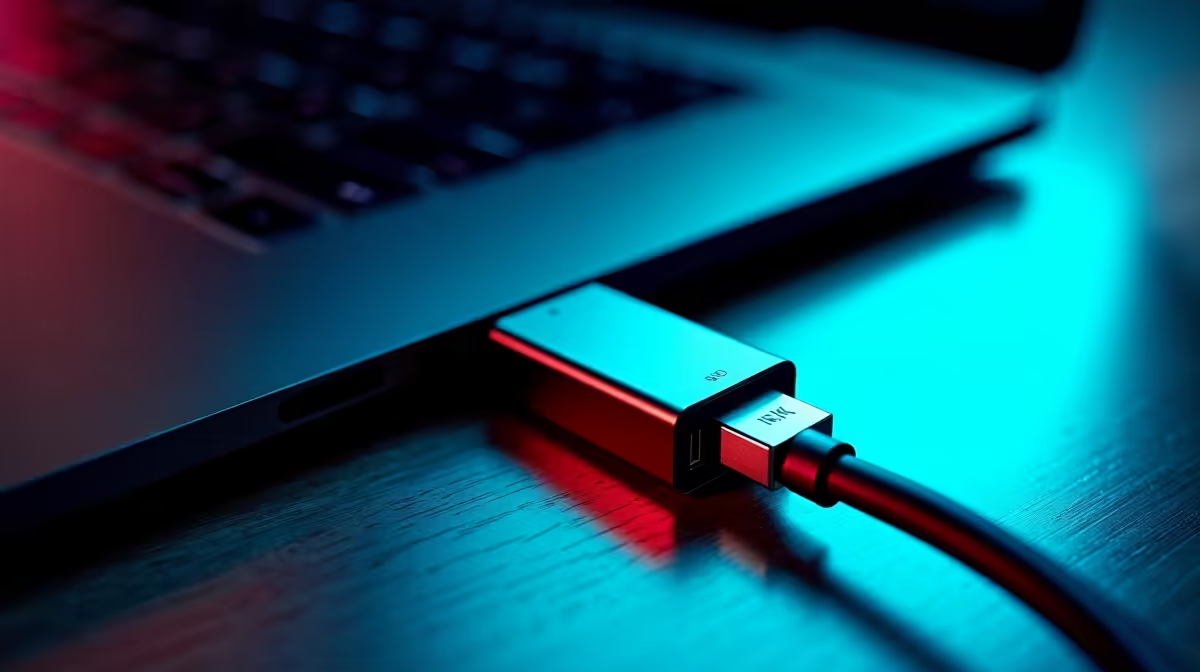
Thunderbolt 2 predates the widespread adoption of DisplayPort 1.2, and its protocol negotiation requires an active adapter to correctly establish a 4K connection. Modern 4K monitors use DisplayPort 1.2, 1.4, or HDMI 2.0 inputs, none of which speak Thunderbolt 2 natively. The adapter must translate Thunderbolt 2's Intel protocol into a signal the monitor understands. Passive Mini DisplayPort cables that physically fit the Thunderbolt 2 port often succeed at 1080p or 1440p because those resolutions fall within DisplayPort 1.0 bandwidth, but 4K at 60Hz typically falls back to 30Hz without an active adapter.
Choosing the Right Adapter for 4K at 60Hz Output 📡
An active Thunderbolt 2 to HDMI adapter specifying HDMI 2.0 on the output, or an active Thunderbolt 2 to DisplayPort 1.2 adapter, resolves the connection for 4K at 60Hz. In SA, these adapters are stocked at R400 to R900 locally. Third-party adapters certified for Thunderbolt 2 perform equivalently at R400 to R600. Pair the adapter with a quality HBR2 cable on the monitor side: a DisplayPort 1.2 cable rated for 21.6Gbps costs R180 to R350 at Evetech. The total adapter and cable cost of R600 to R1,250 extends the useful life of a Thunderbolt 2 Mac workstation connected to a modern 4K display, a fraction of the cost of replacing the workstation.
Managing Bandwidth When Daisy-Chaining Devices 💰
Thunderbolt 2's 20Gbps link is shared between display data and PCIe data channels. When only a monitor is connected, the full 20Gbps is available to display, handling 4K at 60Hz cleanly. Adding a Thunderbolt 2 external SSD to the chain reduces available display bandwidth and can cause the monitor to drop to 4K at 30Hz during heavy disk reads. For SA creative professionals using a Thunderbolt 2 Mac with both external storage and a 4K monitor: connect the monitor to one Thunderbolt 2 port and storage to a separate port if the machine has two independent controllers. Mac Pro (Late 2013) has two separate controllers that truly isolate the bandwidth.
Use Separate Thunderbolt Ports for Display and Storage ⚡
On a Mac with two Thunderbolt 2 ports, always connect the 4K monitor to one port and Thunderbolt storage devices to the other. If both devices share the same port in a daisy chain, storage bandwidth competes with the display signal and can cause 4K at 60Hz instability.
FAQ
Can I run two 4K monitors from Thunderbolt 2 ports simultaneously?
Not at 4K at 60Hz on both. Thunderbolt 2's 20Gbps per port cannot sustain two 4K at 60Hz display streams. Dual monitors at 1080p at 60Hz or one 4K at 30Hz and one 1080p at 60Hz are achievable depending on the adapter and port configuration.
Is it worth upgrading from a Thunderbolt 2 Mac to Thunderbolt 4 for 4K use?
For 4K at 60Hz as the sole display requirement, Thunderbolt 2 is adequate and the upgrade is not justified on display capability alone. The case strengthens if you also need faster Thunderbolt storage, USB4 compatibility, or 4K at 120Hz support.
What happens if I use a passive Mini DP cable instead of an active Thunderbolt 2 adapter?
At 1080p and 1440p, a passive Mini DP cable often works. At 4K at 60Hz, protocol negotiation typically fails or falls to 4K at 30Hz without the active adapter's protocol translation. An active adapter is the reliable solution for 4K.
Connecting a legacy Thunderbolt 2 Mac to a modern 4K monitor in South Africa?
Evetech stocks display adapters and HBR2 DisplayPort cables to complete the connection reliably, with local stock available for quick turnaround.