Staring at another loading screen… again? We’ve all been there. Your PC is a beast, but launching Starfield feels like it takes an eternity. The culprit is often your storage drive. The age-old debate of SSD vs HDD for gaming isn't just tech jargon; it's the difference between jumping straight into the action and going to make a sandwich while you wait. Let's settle this once and for all for South African gamers.
The Old Guard: What Exactly is an HDD?
Think of a hard disk drive (HDD) like a tiny record player. It uses a spinning magnetic platter and a mechanical arm that reads and writes data. For decades, this was the standard.
Their main advantage? Capacity for cost. You can get massive amounts of storage for a relatively low price in ZAR, making traditional hard disk drives (HDDs) brilliant for storing your huge library of games, movies, and backups. For gaming, however, that mechanical nature is a bottleneck. The physical movement takes time, which translates directly into those painfully long load times.
The New Challenger: How SSDs Changed the Game 🚀
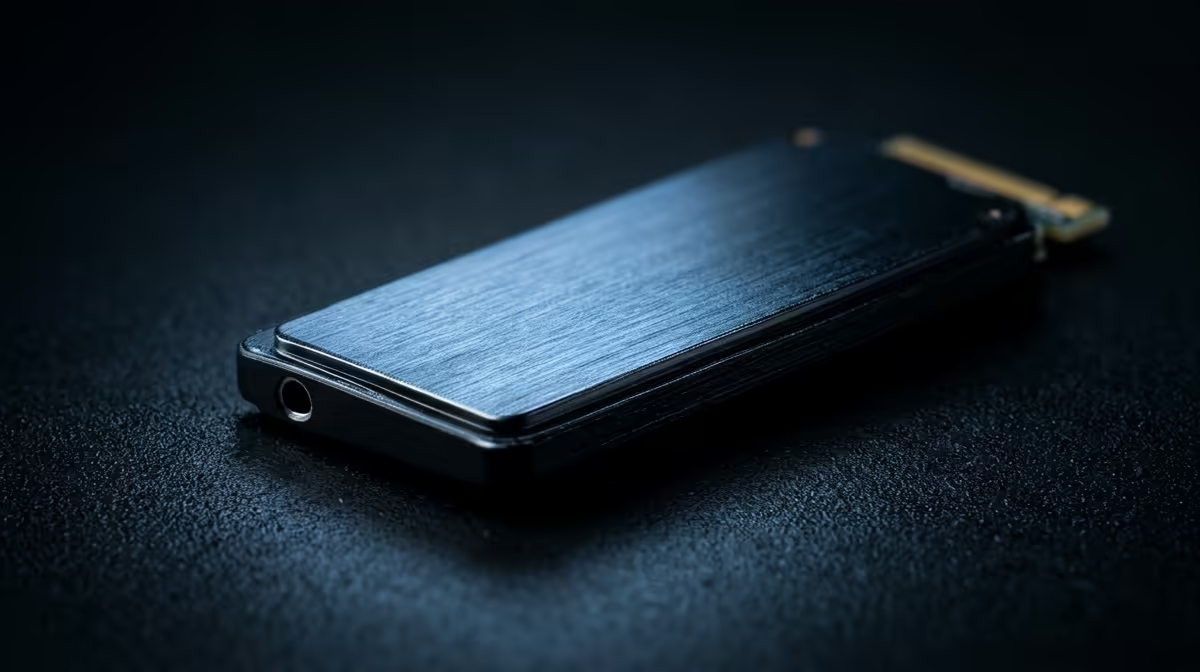
A solid-state drive (SSD) has no moving parts. It uses flash memory—similar to a USB stick, but much faster and more sophisticated. Data access is nearly instantaneous.
This is where the SSD vs HDD for gaming discussion gets interesting. With an SSD, your operating system boots in seconds, applications launch instantly, and most importantly, games load dramatically faster. This upgrade is one of the most noticeable performance boosts you can give any PC. You'll find a huge selection of modern solid-state drives (SSDs) that can breathe new life into an older machine.
SSD vs HDD for Gaming: The Head-to-Head Breakdown
So, how do they stack up in the real world when you're deep in a gaming session? Let's break it down.
Load Times: There's No Competition
This is the SSD's knockout punch. A game that takes a minute or more to load on an HDD might be ready in 10-15 seconds on an SSD. This applies to loading new levels, fast-travelling in open-world games, and respawning. It means less waiting and more playing. ✨
In-Game Experience & Performance
It's not just about loading. Modern games like Cyberpunk 2077 or Alan Wake 2 constantly stream textures and assets from your drive. An HDD can struggle to keep up, causing annoying texture pop-in or even micro-stutters. An SSD delivers that data smoothly, creating a more seamless and immersive world.
For the absolute best performance, nothing beats the speeds of blazing-fast NVMe SSDs, which plug directly into your motherboard. However, even a budget-friendly upgrade to one of these versatile 2.5-inch SATA SSDs will feel like a night-and-day difference from an old hard drive.
Pro Gamer Tip 💡
Don't have space for all your games on your new SSD? Install your most-played titles on the SSD for speed and use Steam's 'Storage Manager' to easily move less-played games to your larger HDD. You get the best of both worlds without constantly re-downloading!
Price and Capacity: The Big Trade-Off
Here's where HDDs still have a place. On a price-per-gigabyte basis, HDDs are significantly cheaper. A 4TB HDD might cost less than a 1TB SSD. This makes them the undisputed king for bulk storage. The best storage for gaming often isn't about choosing one or the other, but using them both intelligently.
The Winning Strategy: A Hybrid Approach 🔧
For most South African gamers, the ultimate setup is a hybrid one. Use a fast SSD as your primary drive and a large HDD as your secondary.
- Your SSD (250GB - 1TB): Install your Windows operating system, your most-played games, and essential programmes here. You'll benefit from lightning-fast boot times and loading screens.
- Your HDD (1TB+): Use this as a massive digital garage for the rest of your Steam library, documents, videos, and game captures.
This balanced approach gives you elite performance where it counts without breaking the bank. To make this upgrade even easier on your wallet, it's always worth checking out the latest SSD deals in South Africa for some incredible value.
Ready to Banish Loading Screens for Good?
The SSD vs HDD debate for gaming has a clear winner for performance. An SSD is the single most impactful upgrade for faster load times and a smoother experience. Explore our massive range of high-speed SSDs and find the perfect drive to supercharge your rig.