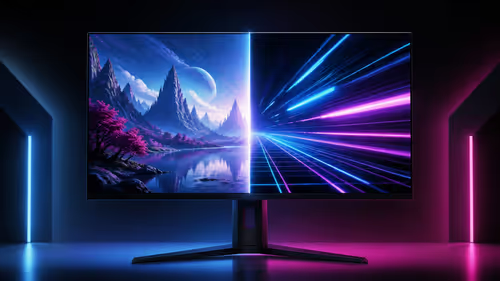
Stream engagement is not just a number you chase after a broadcast. It is built into the choices you make before you go live: the layout, the platforms you target, and whether your camera setup can serve all of them from the same seat. Landscape and portrait mounting turns a single webcam into a two-format production tool, letting you deliver widescreen streams to desktop viewers and vertical clips to phone audiences without a second camera or a second session.
Quick Answer
A ball head or rotating bracket that flips between landscape 16:9 and portrait 9:16 lets you serve widescreen stream layouts and vertical social clips from one setup. The orientation swap takes seconds by hand, and each format reaches the viewers who watch in that ratio most naturally.
📺 Why Format Is an Engagement Variable, Not Just an Aesthetic
Resolution and frame rate get most of the attention when creators talk about stream quality, but aspect ratio is arguably the more direct engagement lever. A viewer watching on a phone holds the device upright. A 16:9 video on that screen appears as a small, letterboxed rectangle flanked by empty space. A 9:16 video fills the same screen edge to edge, and that full-screen presence changes how the content feels: closer, more immediate, harder to scroll past.
Desktop and laptop viewers read it the other way. A widescreen stream fills their monitor correctly in 16:9. Rotate to portrait on a desktop display and the picture becomes a narrow column, wasting the screen width and making the layout look broken.
South African audiences sit at this split more sharply than many markets. Roughly 85 percent of local web traffic is mobile, which means the majority of people who find your content through a social platform are seeing it on a portrait screen. A creator whose workflow can produce both orientations reaches both ends of that split without choosing one over the other.
🔧 Hardware That Rotates Without Unscrewing
The practical barrier to shooting in both orientations used to be the mount itself. Standard tripod heads tilt forward and backward, and rotating a camera 90 degrees into portrait required removing it from the mount, turning it, and reattaching it. Every swap was a 30-second interruption.
A ball head removes that barrier. The ball articulates in any direction, so rolling it 90 degrees along its lateral axis brings the camera into portrait in a single motion. Turn the friction collar to open, roll to the portrait orientation, tighten the collar. The whole action takes about three seconds.
Notched rotating brackets go a step further. Designed specifically for orientation switching, they include positive detents at 0 degrees for landscape and 90 degrees for portrait. The click as the bracket seats means the camera lands at exactly the right angle every time without fine-tuning by eye. For creators who switch orientations frequently during a session, the detent click makes the process fast and repeatable.
The quick-release plate standard matters here too. If your camera sits on an Arca-Swiss plate, swapping it to a vertically oriented arm is a one-lever operation. You can keep one arm set permanently to landscape for live streams and a second set to portrait for social clips, with the camera moving between them as needed.
Pro Tip ⚡
Record your vertical social clips immediately after your widescreen stream while the lighting and background are still set up. One session, two deliverables. Keep a reference mark on the camera mounting plate so the portrait position lands consistently across sessions without re-aiming from scratch.
🎙️ Structuring Content Around Dual Orientation
The content strategy around dual-orientation mounting is as important as the hardware. A live stream on a gaming or tech channel is almost always consumed in landscape on a desktop or TV. That same stream's most shareable moment, whether a reaction, a key announcement, or a product reveal, will travel further as a vertical short-form clip on social platforms.
Planning for this means noting the moments during a widescreen stream that have short-form potential, then flipping to portrait to re-record or extend them as a dedicated clip straight after. The background and lighting are already arranged. Your energy is still up from the live session.
After a 90-degree flip, headroom needs checking. The subject sitting at the horizontal centre of the 16:9 frame lands at the correct vertical centre of the 9:16 frame, but the aspect ratio change means the top and bottom of the frame shift. Set a reference mark on your stand's column at the landscape height and a second at the portrait height. After a few test shots, the re-centre after each flip takes five seconds rather than two minutes.
✨ Platform Matching: Serving the Right Ratio to the Right Audience
Different platforms weight the two formats differently, and matching your output to each platform's native format puts the algorithm on your side.
Widescreen 16:9 remains the standard for live streaming platforms, long-form video hosts, and desktop-first content. Portrait 9:16 is the native format for phone-first short-form feeds. Content uploaded in the wrong ratio is either cropped automatically or displayed with black bars. Both outcomes reduce visual impact and signal to the algorithm that the upload was not optimised for the platform.
A mount that handles both orientations without tools means your camera setup is not the constraint. You are choosing orientation deliberately to match the platform, rather than defaulting to whichever angle your fixed mount happens to force.
Frequently Asked Questions
How does flipping between landscape and portrait actually lift stream engagement?
Each orientation serves a different viewing context. Widescreen 16:9 fills a desktop or TV screen correctly, which is where live stream viewers watch. Portrait 9:16 fills a phone screen, which is where most short-form social content is consumed. Serving the right ratio to each platform reduces friction between your content and the viewer, and less friction means longer watch time and more shares.
Can a standard ball head rotate the camera to portrait without unscrewing it?
Yes. Rolling the ball 90 degrees along its lateral axis brings the camera into portrait orientation. The motion is a single rotation on the ball's sphere rather than a threading operation. Set the friction collar to the tension that allows the move with light hand pressure, roll to portrait, then re-lock. The whole action takes about three seconds once practised.
What needs re-adjusting after a 90-degree orientation flip?
The main adjustment is headroom. In landscape the subject sits at the horizontal midpoint of a wide frame. After flipping to portrait, the frame is now taller than it is wide, so vertical centring of the subject changes. Check that the top of the subject's head has adequate space and that the face is not cut off at the bottom. A slight height adjustment on the stand usually resolves it.
Why does portrait format matter specifically for SA content creators?
South African web traffic is predominantly mobile, so most local viewers hold their phone upright when encountering content on social feeds. A 9:16 portrait clip occupies the entire phone screen. A 16:9 landscape clip on the same phone appears as a small horizontal strip with large bars above and below it. The engagement difference between those two viewing experiences is substantial on short-form platforms.
Is it worth buying a dedicated rotating bracket rather than just using a ball head?
For creators who switch orientations multiple times per session, a notched rotating bracket is the better choice. The physical detents click the camera into exactly 0 degrees or 90 degrees every time. A ball head requires a manual tilt that can land slightly off if you rush, which is obvious on a portrait shot. If you only flip orientations between sessions rather than mid-session, a ball head is sufficient.
Ready to produce widescreen streams and vertical clips from the same setup?
Browse the camera mount and ball head range to build a dual-orientation rig that covers every platform your audience watches on.