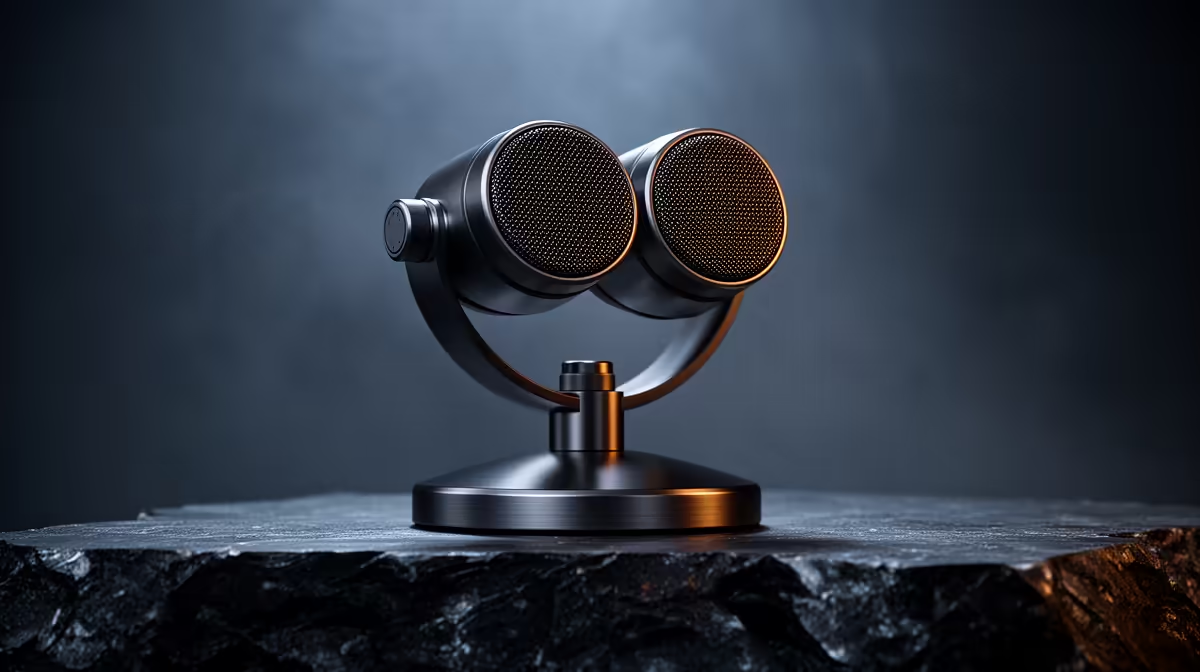
Pickup pattern is the spec that most voice communication setups ignore until something goes wrong. You buy the microphone, set it up, and only discover the pattern matters when your co-host's voice bleeds across a shared mic, your keyboard drowns the stream, or your flatmate's television ruins a call recording. Supercardioid and omnidirectional patterns solve fundamentally different voice communication problems, and the right choice depends entirely on how many people are speaking and what the recording environment looks like.
Quick Answer
Use supercardioid for solo voice work in any space: its tight 115-degree front zone isolates one speaker and rejects keyboard, fan and room noise well. Use omnidirectional when multiple people share a single mic or when natural room coverage matters more than noise rejection. Omni needs a quiet, treated space to stay clean.
🎙️ How a Supercardioid Pattern Isolates a Single Voice
A supercardioid microphone captures from a frontal zone approximately 115 degrees wide, measured from directly in front of the capsule. Outside that zone, especially at the sides and rear, the pattern applies significant attenuation. Sound arriving from 90 degrees off the front axis, directly to the side, drops by approximately 20 to 25 decibels relative to on-axis sound. That is a large difference in practice: a mechanical keyboard at normal gaming distances, sitting beside the mic rather than in front of it, lands in that rejection zone and its contribution to the recording falls sharply.
The comparison with a standard cardioid is instructive. A cardioid captures from roughly 130 degrees at the front, giving it a wider listening window. The extra 15 degrees of width is not always useful; it means more of the room's reflections and side noise enter the signal. Supercardioid sacrifices that extra width for stronger side rejection, which is the right trade for a single voice trying to stand apart from a noisy environment.
The 115-degree front zone is still broad enough for normal on-axis placement during extended use. You do not need to speak into a narrow beam. The tighter zone means you should position the mic consistently in front of your mouth rather than occasionally to the side, which is standard technique regardless of pattern type.
🌐 Omnidirectional: Equal Pickup, No Rejection Zones
An omnidirectional microphone captures sound from all directions with approximately equal sensitivity. There is no front, rear or side preference; the capsule hears a 360-degree sphere around the microphone body at roughly the same level. This property makes omnidirectional mics ideal for applications where a single mic needs to cover multiple speakers, or where the natural acoustic character of a room is part of the recording goal.
Group calls are the strongest use case. When three or four people are seated around a conference table or a gaming desk and one microphone needs to pick up all of them clearly, omni provides even coverage regardless of speaker position. Each person gets the same volume level, no one needs to lean in, and there is no dead zone where a participant's voice drops. A supercardioid in the same scenario would require everyone to sit within its front zone and would attenuate voices from the sides significantly.
Room recording is the second strong use case. For capturing ambient sound, recording a live acoustic space, or producing audio where the room's reverb is intentional, omni's unbiased capture represents the acoustic truth of the environment. Podcasts recorded in well-treated studios sometimes use omni specifically to capture the room alongside the voice.
The trade-off is absolute. Omnidirectional mics have no rejection zones. Background noise enters from every direction with the same sensitivity as the voice source. This is not a design flaw; it is the inherent property of the pattern. An omni mic in a noisy environment captures that noise uniformly. For a South African home setup near a busy road, in a flat with street noise and neighbouring units, an omni mic requires significant room treatment and quiet to sound clean.
Pro Tip ⚡
Test your pattern choice before committing to a setup by recording in the same room at the same time of day you would normally broadcast. Play back the omni recording and supercardioid recording at the same level and compare how much background the room adds. If the omni recording requires heavy processing to sound clean, your environment needs either more treatment or the narrower pattern of a supercardioid.
🔧 The Noise Rejection Advantage in South African Homes
South African residential environments tend toward characteristics that favour supercardioid for solo voice work. High-density urban areas in Joburg and Cape Town, and coastal suburbs in Durban, sit close to road noise and other household sounds. Older apartment buildings often have minimal acoustic separation between units. Student residences built for density rather than acoustic comfort are notoriously difficult recording spaces.
In all of these conditions, the 10 to 15 decibels of extra rejection that a supercardioid provides over an omnidirectional at the sides translates directly into a cleaner recording. The rejection is not processing applied after capture; it is a physical property of how the capsule is shaped and mounted. That noise never enters the signal. Software noise reduction applied to an omni recording works after the fact, and it degrades voice quality alongside reducing noise.
The proximity benefit reinforces this. A supercardioid mic at 8 to 10 centimetres from the mouth keeps the voice signal significantly louder than any ambient source at the capsule. The inverse square law means the voice at 10 centimetres dominates over a noise source at two metres, and the pattern rejection compounds that advantage. For a solo streamer in a shared Joburg flat, this combination is the most practical approach short of a treated booth.
💰 Choosing Based on Your Actual Communication Scenario
The decision framework is simple once you are honest about how you use the microphone.
Solo gaming voice chat and streaming: supercardioid. One voice, keyboard nearby, environment not fully treated. The tight pattern and proximity advantage handle the noise without room treatment as a prerequisite.
Solo podcasting from a dedicated space: either pattern works. A supercardioid remains the safer choice in any untreated room. An omnidirectional is valid if the room is quiet and you want to include natural room ambience or capture a relaxed, slightly distant vocal character.
Two to four people on one microphone: omnidirectional. The even coverage across all positions is necessary, and everyone in the group takes responsibility for keeping the shared environment quiet during recording.
Work-from-home calls, solo: supercardioid. Household noise, traffic, and ambient sound are the enemies of professional-sounding call audio, and the pattern's rejection handles these without requiring the microphone to be placed in a treated corner.
One note for multi-person scenarios: a co-host seated beside you will be significantly attenuated by the side rejection. That is the pattern working correctly. Position both people within the front zone or use two microphones rather than sharing one supercardioid between side-by-side speakers.
Frequently Asked Questions
Which pickup pattern is better for solo voice chat and gaming?
Supercardioid is the better pattern for solo voice work in any environment that is not fully treated. Its 115-degree front zone captures your voice directly while the strong side rejection attenuates keyboard noise, fan sound and room ambience. For a solo gamer or streamer, this focused capture keeps the voice clear without requiring significant acoustic treatment of the room.
When is an omnidirectional pattern better than supercardioid?
Omnidirectional is better when multiple people are sharing a single microphone, since it provides equal pickup in all directions without requiring everyone to position themselves within a specific front zone. It is also preferable for capturing a room's natural acoustic character or for recording in a genuinely quiet, well-treated space where background noise rejection is not a concern.
Does an omnidirectional mic pick up significantly more background noise?
Yes. Without a rejection zone, an omnidirectional capsule captures sound from all directions with equal sensitivity. Background noise, traffic, appliances, neighbouring rooms and ambient chatter all enter the signal at full level alongside the voice. In a noisy South African home, this makes the omni much harder to use without either heavy room treatment or post-processing that affects voice quality.
How tight is the supercardioid front zone compared to a standard cardioid?
A supercardioid captures from approximately 115 degrees at the front, compared to roughly 130 degrees for a standard cardioid. The supercardioid's narrower window produces stronger rejection at the sides, about 20 to 25 decibels of attenuation at 90 degrees off-axis compared to roughly 15 to 20 decibels for a cardioid. For a single speaker staying reasonably centred on the mic, this narrower zone provides better noise rejection without requiring unusual technique.
Can a supercardioid microphone work for a two-person setup?
Only if both people are positioned within the front zone, meaning both facing the mic from in front at roughly the same distance. If one person sits beside the other and both try to share a supercardioid, the side-facing speaker will be significantly attenuated. For a reliable two-person setup, two separate microphones, one each, is the correct approach regardless of pattern type.
Ready to match your microphone pattern to your communication setup?
Browse the supercardioid and omnidirectional microphone range at Evetech to find the pattern that fits how many people you record with and where you record.