Quick Answer
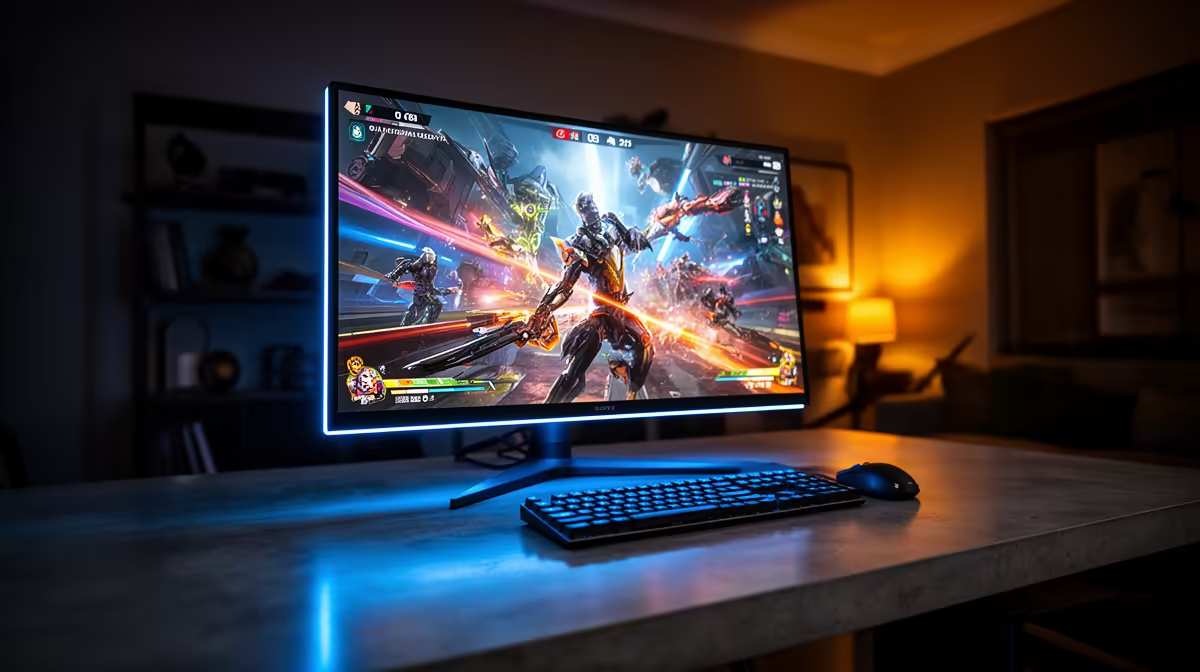
For a South African work-from-home and gaming setup, the most valuable monitor features are a 27-inch QHD IPS panel with 144Hz or higher, USB-C connectivity for laptop docking, and at least 95% sRGB or wide-gamut coverage for daylight productivity. These traits allow seamless switching between video calls, document work, and evening gaming without compromises on either side.
Resolution and Size for Dual-Purpose Use 🖥️
A 27-inch 2560x1440 QHD monitor is the standard recommendation for WFH-plus-gaming in South Africa for good reason. At that size, QHD delivers 109 PPI, sharp enough that text requires no scaling on Windows 11 at 100% or 125%, which avoids blurry font rendering common on 4K monitors set to 150% scaling on smaller screens. Pricing for QHD 165Hz IPS monitors sits in the R4,500 to R8,000 range locally, making them accessible without cutting corners. For productivity, the extra vertical space over 1080p is immediately valuable in Excel, browser workflows, and video calls. For gaming, QHD is significantly more demanding than 1080p but manageable on GPUs from the RTX 5060 Ti tier upward.
Connectivity That Simplifies a WFH Desk 🔌
USB-C with 65W or higher Power Delivery lets you connect a work laptop with one cable, carrying video and charging simultaneously. This cuts the desk cable count significantly. A built-in USB hub with two to four USB-A ports and a USB-C port covers keyboard, mouse, webcam, and a phone, all through the monitor rather than the laptop. HDMI 2.0 or 2.1 provides the gaming input for a desktop, while DisplayPort is preferred for adaptive sync and high-refresh-rate reliability. KVM-capable monitors, available in the R7,000 to R12,000 range, let you share one keyboard and mouse between a work laptop and a gaming PC, removing peripheral clutter entirely.
Ergonomics and Eye Comfort for Long SA Work Days 🌟
A stand with full height, tilt, pivot, and swivel adjustment matters more for WFH users than for gaming-only setups. Many SA professionals work eight to ten hours at the desk before gaming in the evening, so a monitor locked at a fixed angle causes neck and shoulder strain over time. Flicker-free backlighting and a low-blue-light mode (marketed as Eye Care, TUV Rheinland certified, or similar) reduce fatigue during long document sessions. These features are standard on most modern IPS panels above R4,000. Matte screen coatings reduce glare from SA daytime windows, which is especially relevant in north-facing home offices.
Match Refresh Rate to Your GPU ⚡
240Hz monitor paired with a mid-range GPU that cannot sustain 200 fps in your games wastes the refresh upgrade budget. For WFH-gaming setups on GPUs like the RTX 5060 or RX 9060, a 165Hz QHD panel is the sweet spot: affordable, capable, and leaves GPU headroom for quality settings.
FAQ
Is a curved monitor good for work and gaming combined?
Moderately curved panels (1500R to 1800R) reduce edge distortion in spreadsheets and feel immersive in single-player games. Very tight curves (1000R) can distort straight lines in documents and are better suited to gaming-only use.
How important is colour accuracy for WFH productivity in South Africa?
For general office work, email, and video calls, standard sRGB coverage is sufficient. Content creators, designers, or marketers working with brand assets benefit from wide-gamut panels. Look for Delta-E below 2 if colour fidelity matters for your job.
Can I use one monitor for both a work laptop and a gaming desktop?
Yes. Use two separate inputs, such as USB-C for the laptop and DisplayPort for the desktop, and switch via the OSD input selector or a KVM. Many current gaming monitors include Picture-by-Picture or Picture-in-Picture modes for running both simultaneously.
Building a setup that handles work and gaming equally well?
Evetech stocks dual-purpose gaming monitors with IPS panels, USB-C docking, and ergonomic stands, all available for delivery across South Africa.