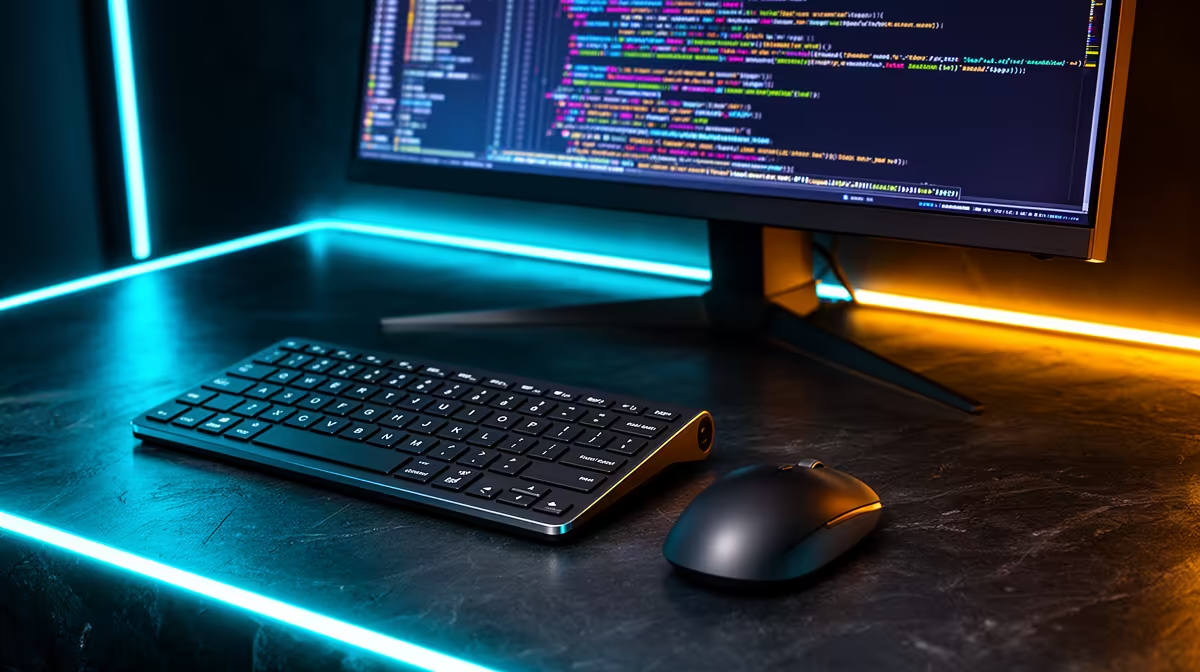
The temptation when you start coding with AI is to assume you need a GPU monster on your desk. You do not. Tools like Claude Code do every bit of model thinking in the cloud, so the machine in front of you is just running a lightweight client. That reframes the whole budget: the cheapest cloud-first setup spends nothing on graphics horsepower and everything on a reliable connection and enough RAM to keep your editor smooth.
Quick Answer
A cloud-first AI coding setup needs no GPU at all. The client itself runs in a few hundred megabytes of RAM on basically any modern CPU, with the model inference happening on the provider's servers. Spend your budget on a stable internet line and a 16GB machine rather than chasing local GPU specs you will never use.
Where the work actually happens
This is the single fact that changes everything. When you use a cloud AI coding tool, your laptop sends your prompt and code context over an encrypted connection, the heavy model runs in a remote data centre, and the response streams back. The client on your side is doing ordinary software things: rendering text, managing files, talking to an API. It is not loading a multi-gigabyte model into memory. That is why no GPU, no 32GB of RAM, and no specialised hardware is required.
Compare that to running a local model, which demands serious VRAM and a capable card. Cloud-first deliberately offloads that cost to someone else's hardware, which is the whole point of the approach for anyone on a budget.
What the local machine genuinely needs
Three things actually matter for a smooth cloud-first experience.
First, RAM. The AI client is tiny, but your editor, browser tabs, and the project itself are not. On a large codebase, a 4GB machine starts to drag, and moving to 8GB or, better, 16GB clears it up. Aim for 16GB and you have comfortable headroom for the editor, several browser tabs of documentation, and the project all at once.
Second, a stable internet connection. Because the model lives in the cloud, there is no offline mode. Latency and reliability of your line directly shape how snappy the assistant feels. A solid fibre connection makes responses feel instant; a flaky link makes the same tool feel sluggish even on a fast laptop. This is where your money does the most good.
Third, a current CPU and an SSD. Any modern processor handles the client comfortably, and an SSD keeps the editor and project loading quickly. Neither needs to be high-end.
What you can safely skip
You can skip the discrete GPU entirely for cloud coding. You can skip 32GB-plus RAM unless you run heavy local tooling alongside. You can skip the workstation-class CPU. Every rand you do not spend on graphics is a rand you can put toward a faster connection or simply keep.
Building the cheapest sensible setup
The order of priorities for a budget cloud-first build is connection first, RAM second, storage third, everything else last. A reliable fibre line, a machine with 16GB of RAM and an SSD, and a current mid-range CPU is the whole recipe. You do not need an AI-branded GPU rig, though if your work later expands into running local models or heavy data tasks, the AI PC range at Evetech is where that upgrade path leads.
For most people getting started, though, a capable everyday laptop or desktop is plenty. Browsing the most popular PC builds with Evetech buyers gives a feel for well-balanced machines around the 16GB mark that handle cloud-first coding without a GPU in sight. Match the spec to your editor and browser habits, not to a model you will never run locally.
Laptop or desktop for cloud-first coding?
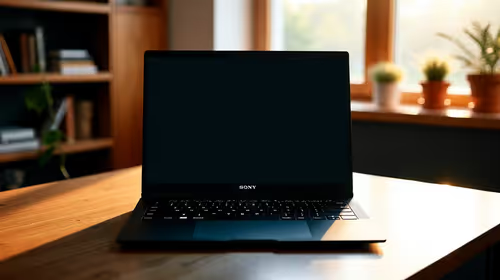
Either works, and the choice comes down to how you like to work rather than to AI requirements. A laptop gives you portability, which matters if you code from different rooms, coffee shops, or a client's office, and a mid-range 16GB laptop with an SSD handles cloud coding comfortably. The only laptop-specific consideration is your connection on the move: tethering to a phone or relying on public Wi-Fi reintroduces the reliability question, so a stable line wherever you settle still matters most.
A desktop gives you more performance per rand and easier future upgrades. If you mostly code in one place and might later add local tooling, heavier data work, or eventually a GPU, a desktop is the more flexible base. For pure cloud-first AI coding, neither has an inherent edge, so pick the form factor that suits your life and spend the saved GPU budget on RAM, storage, and connection quality.
A note on screen and comfort
Because the machine itself is doing light work, the parts of the experience you actually feel are the screen, keyboard, and how cool and quiet the machine stays during long sessions. A decent display and comfortable input do more for your day-to-day coding than any spec the AI never touches. It is worth weighting your budget toward those tangible quality-of-life factors once the modest RAM, SSD, and connection boxes are ticked, because they are what you live with hour after hour.
The honest trade-off
Cloud-first means you depend on your connection and on a service. If your internet drops, your assistant stops, and there is no local fallback unless you also set up a small local model, which reintroduces the GPU cost you were avoiding. For the vast majority of people on a reliable line, that dependency is a fair trade for spending nothing on graphics hardware. If you genuinely need offline AI, that is a different build with a different budget.
Frequently Asked Questions
Do I really not need a GPU for AI coding?
Correct, not for cloud-based tools. All the model inference runs on the provider's servers, so your machine only runs a lightweight client. A GPU only becomes necessary if you decide to run models locally, which is a separate, more expensive setup.
How much RAM is enough?
8GB works, but 16GB is the comfortable target. The AI client uses only a few hundred megabytes; the RAM goes to your editor, browser, and the project itself. On large codebases, more RAM noticeably smooths things out.
Does my internet speed affect the AI?
Yes, directly. Because there is no offline mode, the reliability and latency of your connection determine how responsive the assistant feels. A stable fibre line is the single best thing you can spend on for a cloud-first setup.
Can I use a cheap laptop for this?
A capable everyday laptop with 16GB of RAM and an SSD is perfectly adequate. You are paying for a smooth editor and a good connection, not for a graphics card. Avoid the very bottom of the market mainly for RAM and storage reasons, not for AI horsepower.
What if I want to run models locally later?
Then your build changes substantially: you would need a GPU with significant VRAM and more system RAM. That is a deliberate, pricier path. The cloud-first setup is specifically the budget route that avoids all of that.
Want to start coding with AI without overspending on hardware? Pick a well-balanced 16GB machine from the PC best sellers at Evetech and put your budget where it counts.