Quick Answer
A 360mm AIO is the minimum recommended liquid cooler for any current-gen CPU with 16 or more cores under sustained workload. The Ryzen 9 9950X and Core Ultra 9 285K both exceed 200W TDP under all-core load, and a 360mm radiator with three 120mm fans provides enough thermal mass to absorb that heat without throttling. Smaller AIOs or air coolers struggle to maintain boost frequencies continuously on these processors.
What Makes High-Core-Count CPUs Run Hotter 🔥
High-core-count CPUs generate significantly more waste heat per unit time than quad or hexa-core parts. The Ryzen 9 9950X has a 170W TDP at stock, but modern AMD power algorithms can push package power to 230W in short workloads and sustain 200W in prolonged rendering or compilation tasks. Intel's Core Ultra 9 285K runs even hotter in multithread, with package power exceeding 250W under AVX-512 vector workloads.
A 240mm AIO dissipates roughly 200W to 220W continuously before coolant temperature rises enough to trigger throttle.
Key Specs to Check Before Buying 🔧
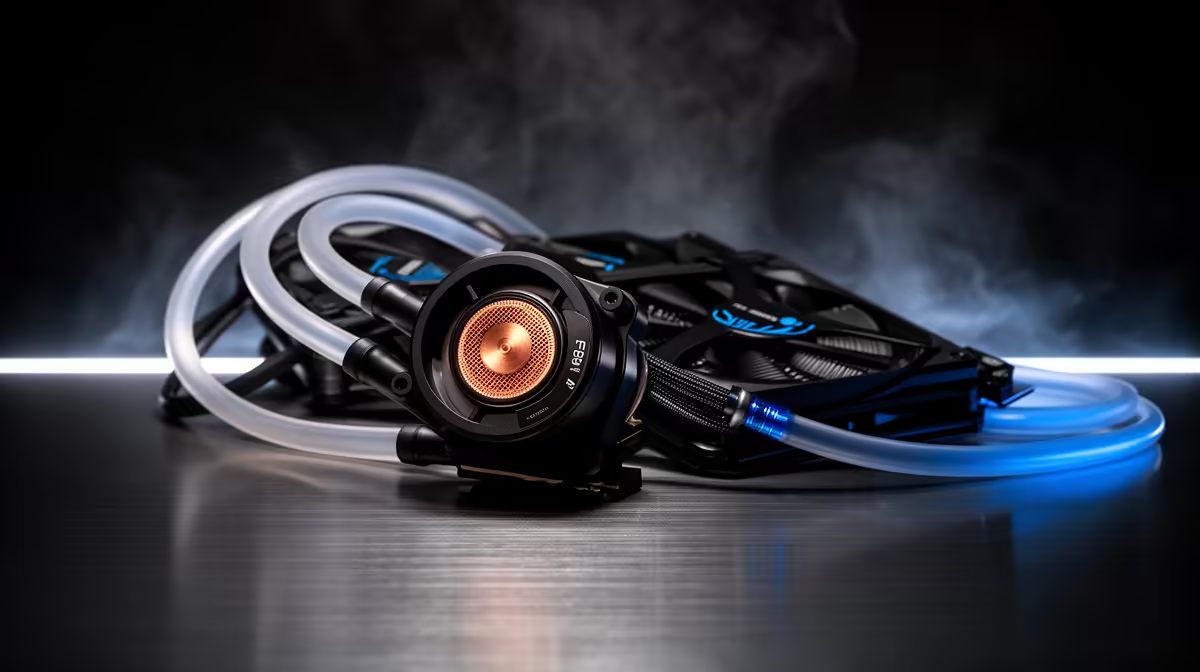
When evaluating a 360mm AIO for a high-core-count build, check these specifications. First, pump generation: Asetek Gen 7 and Gen 8 pumps are the industry benchmark, delivering 1.2 to 1.7 LPM flow rates that keep the cold plate efficiently refreshed even under peak heat loads.
For the pump block display, look for OLED or IPS LCD screens on premium models in the R3,500 to R6,000 range at Evetech. These show real-time CPU temperature and coolant temperature, which is useful for monitoring during long video encodes or 3D renders on a workstation.
Installation Considerations for SA Builders 🚀
Most full-tower and large mid-tower cases accept a 360mm radiator at the top or front. Confirm clearances before purchasing: top-mounted radiators in cases with tall GPU coolers may conflict if VGA cooler height exceeds 50mm above the PCIe slot. Front-mounted radiators require at least 35mm of clearance between the radiator and drive cage or front panel mesh.
For AM5 socket builds, ASUS, MSI, Gigabyte, and ASRock all include the correct AM5 mounting hardware in their AIO cooler boxes. For LGA1851, Intel's mounting system changed from LGA1700, so verify the included bracket list before ordering. AIO coolers stocked at Evetech in the R2,800 to R5,500 range typically include mounting kits for both current platforms.
Orient the Pump Block Tubes Down ⚡
For quietest operation and longest pump life, mount the radiator so the pump block's tubes exit from the bottom. This keeps the pump submerged in coolant and prevents air migrating into the pump chamber over time. Tubes-down orientation is especially important in top-mounted radiator configurations.
FAQ
Is a 360mm AIO overkill for a 12-core CPU?
Not really. A Ryzen 9 7900X or Core i9-13900K at 12 or 24 cores benefits from the thermal headroom of a 360mm unit, especially if overclocking. The price premium over a quality 240mm AIO is typically R400 to R800 at SA pricing, and the benefit in sustained workloads is measurable.
How long does an AIO cooler last before it needs replacing?
Most retail AIOs use low-permeability tubing and sealed, pre-mixed coolant designed for a five to seven year service life. The pump bearing is usually the first failure point. Running at moderate pump speeds (around 2,000 RPM) extends pump life significantly compared to running at maximum speed continuously.
Does mounting orientation affect 360mm AIO performance?
Yes. Radiator position and tube routing affect both performance and noise. Top exhaust with tubes routing downward to the CPU socket is the most common efficient configuration. Front intake setups work well in cases with unrestricted front panels but require the CPU block to sit higher for tidy routing.
Cooling a high-core-count build?
Browse 360mm AIO coolers at Evetech, with options from Asetek pump platforms and ARGB fan sets, to match your Ryzen 9 or Core Ultra 9 processor.