Quick Answer
A 360mm radiator cooler makes sense when your CPU sustains more than 125W under load, when your case supports the mount position, and when ambient temperatures in your environment push above 25 degrees Celsius regularly. For South African gaming builds on Ryzen 9000-series or Intel Core Ultra 200-series chips, it is the standard recommendation above the mid-range tier.
How a 360mm Radiator Dissipates Heat 🌡️
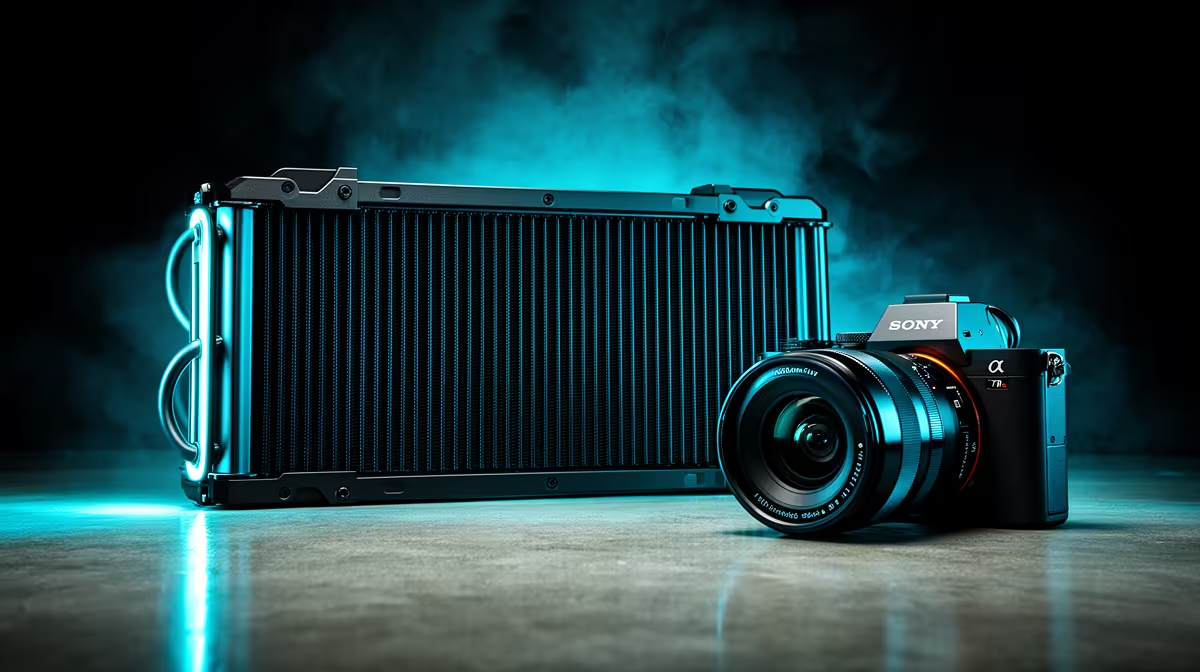
The radiator in a 360mm AIO is an aluminium matrix measuring approximately 360mm by 120mm by 27mm, containing dozens of thin fin stacks through which coolant flows. Three 120mm fans mount to the radiator face, pulling or pushing air through the fins to carry heat away from the coolant. At typical gaming loads, a quality 360mm radiator with three 120mm fans running at 1,200 to 1,400 RPM handles 180 to 200W of CPU heat without the coolant temperature climbing above 38 to 42 degrees Celsius above ambient.
When a 360mm Radiator Is Clearly the Right Choice 🔧
Five build scenarios make a 360mm radiator the clearly correct choice. First: CPUs above 125W sustained, including Ryzen 9 9900X, 9950X, Core Ultra 9 285K, and Core i9-14900K. Second: builds in South African regions with summer ambient temps above 28 degrees, which describes most of Gauteng, Limpopo, and Mpumalanga from October to February. Fifth: showcase builds in windowed cases where the radiator and fans are visible and form part of the build's aesthetic.
When a 240mm or Air Cooler Is Sufficient 🖥️
A 360mm radiator is not universally necessary. For CPUs below 100W sustained, including the Ryzen 7 9700X at stock, Core i5-14600K, and Core Ultra 5 245K, a quality 240mm AIO (R1,400 to R2,000) keeps temps safely below throttle thresholds under gaming in most SA home conditions. The decision to move to 360mm is driven by the combination of CPU TDP, ambient conditions, and workload type, not by a default assumption that bigger is always better.
Fin Spacing Affects Dust Accumulation ⚡
Radiators with tightly packed fins accumulate dust faster than those with wider spacing, reducing airflow and cooling efficiency over time. In South Africa's dusty dry seasons, cleaning the radiator fins every 3 to 4 months with compressed air maintains full cooling performance. Do this with the system powered off and the fans removed if possible, blowing dust out through the fin rows rather than compressing it deeper.
FAQ
Can I mount a 360mm radiator in the front of my case instead of the top?
Yes, and in some cases this is preferable. Cases designed for front radiator mounting (like the Fractal Torrent or Lian Li O11 Dynamic) provide better front-to-back airflow with a front-mounted radiator acting as intake. In cases with restricted front panels that limit airflow, top exhaust mounting is typically more effective. Check your specific case's airflow design before deciding on radiator placement.
Does a 360mm AIO require any special case preparation before installation?
No tools or modifications are needed beyond what the cooler and case ship with. You need the mounting hardware from the AIO box, the correct backplate for your CPU socket, thermal paste, and access to a top or front mount position with 120mm fan spacing. The installation process takes 15 to 30 minutes for a first-time builder.
What happens if the 360mm radiator is installed as intake instead of exhaust?
Mounting the radiator as intake means warm air from the radiator flows into the case toward the CPU and GPU. This heats the internal air above ambient, raising GPU temperatures and VRM temperatures alongside the small CPU cooling benefit. Top-exhaust or dedicated front-intake cases handle this correctly by design. In a generic mid-tower, top exhaust is generally safer and cooler for overall system temperatures.
Ready to choose the right radiator size for your build?
Evetech stocks 360mm AIO coolers across the full price range, and the team can help confirm radiator compatibility with your case before you commit.