


PCIe 5.0 vs PCIe 4.0 for Strategy and Sim Games in SA
PCIe 5.0 and PCIe 4.0 differ most in lane support, compatibility, and upgrade value for strategy and sim games. SA buyers should match the choice to their actual hardware and games.
Read moreSpec-first buyer view of complete guide to adjustable graphics card holders and support heights sets ZAR price bands, must-have features and skip-it extras for SA gaming and creator builds. ZAR price bands, SA Evetech stock notes and the gotchas specific to complete gu.
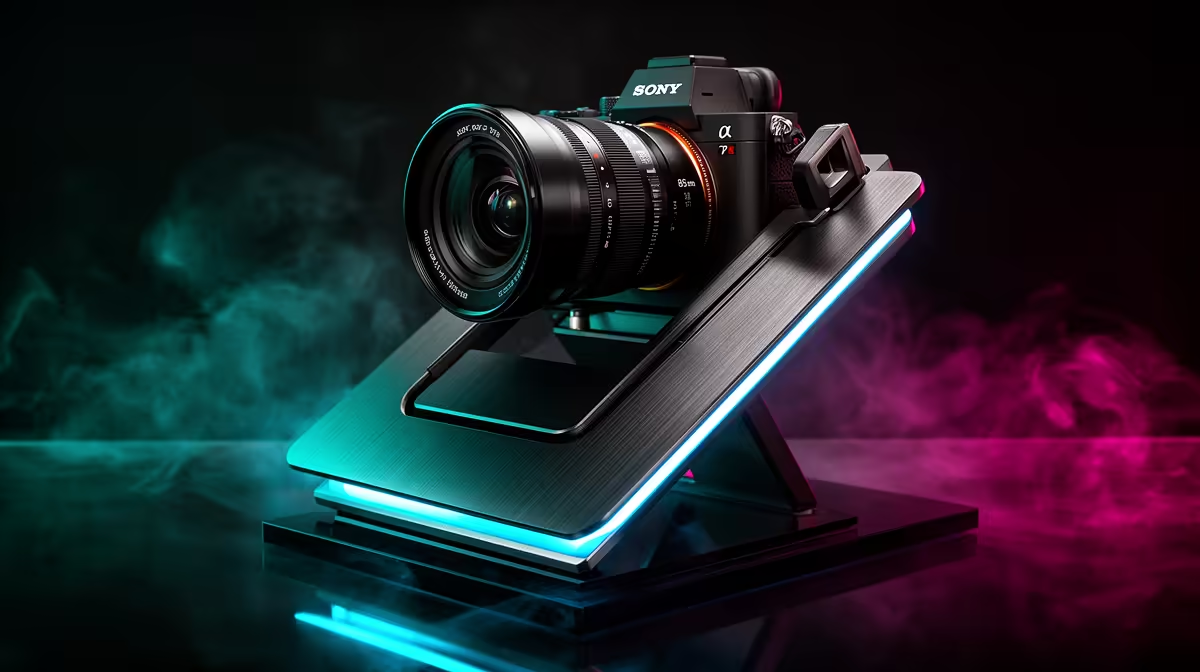
Adjustable graphics card holders use a threaded rod or friction-collar mechanism to set contact height from the case floor to the GPU underside, typically covering 60 mm to 155 mm across different models. For most mid-tower ATX builds the correct height is 85 mm to 115 mm, and for compact mATX builds 75 mm to 100 mm. Measure before buying to confirm the bracket's range covers your specific case and GPU combination.
Two adjustment mechanisms dominate the market.
Standard adjustable holders covering 72 mm to 128 mm fit the majority of ATX mid-tower and mATX compact builds. Holders covering 90 mm to 155 mm are suited to E-ATX full towers and cases with elevated PCIe slot positions. Holders covering 60 mm to 90 mm work in SFF and mini-ITX cases where the PCIe slot is close to the case floor. Before ordering, install the GPU in the case and measure the vertical gap from the interior floor to the card's underside. Note that this measurement changes if you add or remove a PSU shroud extension or a raised cable management floor. For SA builders at Evetech, the product page for each bracket lists the minimum and maximum height in the specifications tab to make direct comparison easy.
Built-in spirit levels on the bracket arm allow alignment verification without a separate tool, costing an extra R50 to R100 over basic models. ARGB light bars on the bracket illuminate the GPU underside and contribute to themed builds at R150 to R250 more than a non-lit equivalent. White or silver-anodised finishes are available for white theme builds, as the bracket arm is visible through the side panel glass. Magnetic bases are a newer design that attach to steel case floors without the bracket shifting during initial positioning, which simplifies setup in tight mATX cases. Dual-post brackets for cards above 1.8 kg, specifically RTX 5090 class hardware, distribute the load across two support points and are available at Evetech in the R300 to R450 range.
Position the bracket contact point at approximately three-quarters of the GPU's length from the PCIe slot end, not at the midpoint or the far tip. This location provides the most effective counter-leverage against the sag moment because it is close to where the maximum deflection occurs on a long cantilever. Placing the bracket at the very tip provides less mechanical advantage and risks the bracket slipping off the card edge during transport.
Quality adjustable holders include a rubber or silicone cup rather than a flat pad, which conforms to minor surface irregularities. If the surface is significantly curved, a wider silicone pad or a custom 3D-printed adapter cap distributes the contact evenly without point pressure.
The bracket base occupies a small area on the case floor, typically 40 mm x 60 mm. Route power cables around the base before tightening them, and position the bracket before finishing cable management rather than after. Most mid-tower and mATX cases have sufficient floor space to accommodate the bracket alongside sleeved cable bundles.
Yes, as long as the height range of the bracket covers both builds' GPU underside heights. A bracket with a 72 mm to 128 mm range is likely transferable across most ATX and mATX builds. Confirm measurements in each new case before assuming compatibility.
Ready to protect your GPU investment with the right holder? Browse Evetech's full range of adjustable GPU support brackets across different height ranges, finishes, and ARGB options, all with South African delivery.
PCIe 5.0 and PCIe 4.0 differ most in lane support, compatibility, and upgrade value for strategy and sim games. SA buyers should match the choice to their actual hardware and games.
Read more
AM5 vs AM4 for video editing in 4K Difference explained is mostly about compatibility, budget, upgrade path, and setup fit. SA buyers should check device support and real needs before expecting a clear win from either option.
Read more
OLED vs QD-OLED for strategy and sim games buyers - what changes is mostly about compatibility, budget, upgrade path, and setup fit. SA buyers should check device support and real needs before expecting a clear win from either option.
Read more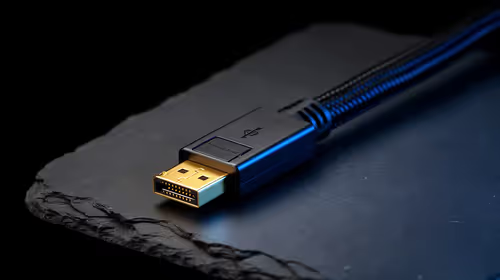
DisplayPort 2.1 and 1.4 differences matter when SA PC builders match GPUs, monitors, and refresh targets. Use this difference between displayport 2 1 and displayport 1 4 explained pc builders guide to avoid mismatched parts.
Read more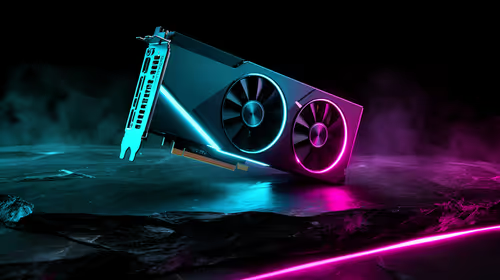
Ray tracing vs Path tracing depends on Strategy and sim games needs, platform limits, and budget fit. Compare compatibility, latency, upgrade path, and real setup constraints before choosing for an SA build.
Read more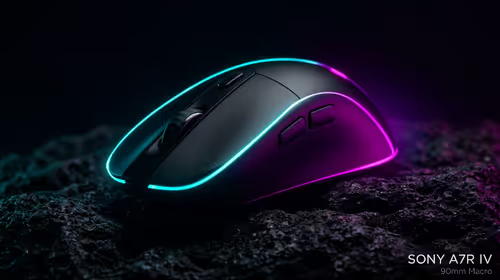
wireless mouse guide for Gqeberha gamers should be shortlisted around the job it must do. South African buyers should compare sensor, shape, weight, and wireless latency, warranty path, and upgrade room before treating any pick as best.
Read more
Windows 11 update KB5121003 is linked to crashes in several multiplayer games on versions 24H2 and 25H2. Check the build, report the fault and avoid risky file or update changes unless the problem is confirmed on your PC.

Sennheiser's Momentum True Wireless 5 adds user-replaceable batteries, 12-hour playback and a $299.95 launch price. There is no confirmed South African date, so compare longevity with live earbuds from R199 to R2,999.

AVerMedia's GC531 and GC535 are professional HDMI capture devices for continuous streaming, with RGB24 capture up to 2K30 and 4K30. South African creators should compare them with live 4K capture cards from R2,099.

From 1 October 2026, WhatsApp Business Platform service replies in South Africa are expected to cost about $0.0076, or 12 cents, per delivered message.
Windows 11 update KB5121003 is linked to crashes in several multiplayer games on versions 24H2 and 25H2. Check the build, report the fault and avoid risky file or update changes unless the problem is confirmed on your PC.

Comsol's standalone 5G network covers about one million Gauteng homes and starts commercial ISP service in September. Early packages range from R275 to R875 a month, but coverage and fair-use rules still decide the real value.
Sennheiser's Momentum True Wireless 5 adds user-replaceable batteries, 12-hour playback and a $299.95 launch price. There is no confirmed South African date, so compare longevity with live earbuds from R199 to R2,999.
AVerMedia's GC531 and GC535 are professional HDMI capture devices for continuous streaming, with RGB24 capture up to 2K30 and 4K30. South African creators should compare them with live 4K capture cards from R2,099.
Windows 11 update KB5121003 is linked to crashes in several multiplayer games on versions 24H2 and 25H2. Check the build, report the fault and avoid risky file or update changes unless the problem is confirmed on your PC.
Comsol's standalone 5G network covers about one million Gauteng homes and starts commercial ISP service in September. Early packages range from R275 to R875 a month, but coverage and fair-use rules still decide the real value.
Sennheiser's Momentum True Wireless 5 adds user-replaceable batteries, 12-hour playback and a $299.95 launch price. There is no confirmed South African date, so compare longevity with live earbuds from R199 to R2,999.
AVerMedia's GC531 and GC535 are professional HDMI capture devices for continuous streaming, with RGB24 capture up to 2K30 and 4K30. South African creators should compare them with live 4K capture cards from R2,099.