Quick Answer
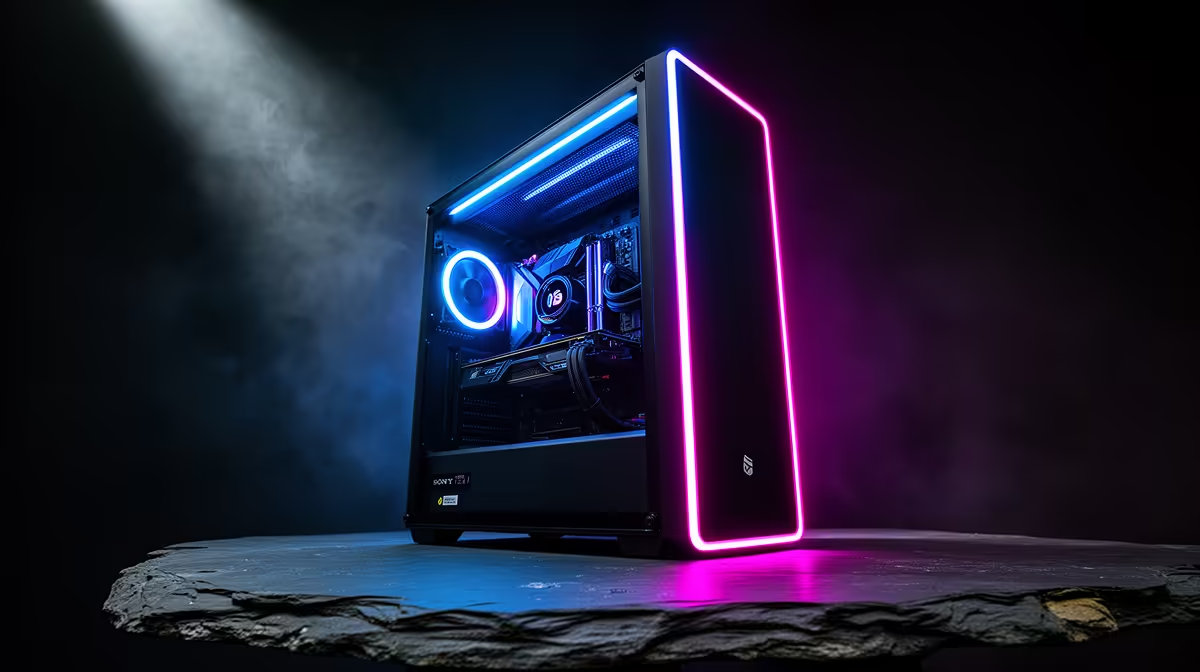
Dual-chamber ATX gaming cases split the interior into two compartments: the main chamber holds the motherboard, CPU cooler, RAM, and GPU, while the secondary chamber hides the PSU, drive cages, and cables. This separation improves airflow by keeping PSU heat out of the primary cooling path and dramatically cleans up cable routing for showcase builds.
How the Dual-Chamber Layout Works 🔧
In a conventional mid-tower, all components share one air volume. The PSU sits at the bottom drawing in air, HDDs sit in mid-cage positions, and cables from both snake across the board tray competing with fan airflow. A dual-chamber design resolves this by mounting the board tray on a dividing panel with grommets for the 24-pin and EPS cables only. The secondary chamber behind the tray uses its own intake, often a filtered vent on the underside or rear panel, so PSU heat cycles through a completely isolated path. Builders who pair a 360mm AIO in the front intake with two 140mm exhaust fans at the rear see CPU temps drop by 4 to 8 degrees Celsius compared to identical hardware in a traditional layout.
Airflow Design Principles for the Main Chamber 🌬️
The main chamber is designed as a straight-line pressure tunnel. Air enters at the front through mesh or perforated panels, passes over the GPU and CPU, and exits through the top and rear. For positive pressure builds, running three 120mm intake fans at the front and one 140mm exhaust at the rear reduces dust ingress, critical in South Africa's drier inland cities like Johannesburg and Pretoria where fine dust accumulates quickly. For high-performance rigs drawing above 400W total, negative pressure with more exhaust than intake pulls heat out faster but requires regular filter cleaning.
Practical Build Considerations 🛠️
Dual-chamber cases typically support full ATX boards and E-ATX boards up to around 280mm wide. GPU clearance is generous, with most designs allowing cards up to 400mm long, covering the RTX 5090 Founders Edition. PSU lengths up to 220mm are standard, and modular PSUs are strongly recommended since cable lengths are shorter when routing through the grommet cutouts. Budget at least R4,000 to R7,500 for a quality dual-chamber case in the SA market; mid-range options under R5,000 often skip pre-installed fans but still deliver the same clean layout.
Route Cables Before Installing the GPU ⚡
In a dual-chamber case, thread all motherboard power and data cables through the rear grommets before fitting the GPU, because the graphics card will block access to the lower grommet openings once seated. Fitting the GPU last also protects the PCIe slot from lateral stress during cable management.
FAQ
Are dual-chamber cases harder to build in than standard towers?
They require a bit more planning since you work across two zones, but most builders find them easier overall because cables go straight to the back. The most common mistake is forgetting to route the 24-pin cable before installing the motherboard.
Can I still use air cooling instead of an AIO in a dual-chamber case?
Absolutely. Tower air coolers up to 170mm tall fit comfortably in most dual-chamber ATX cases. Models like the Noctua NH-D15 and Thermalright Peerless Assassin 120 SE are well within the clearance spec of cases in the R4,500 to R6,000 price bracket stocked locally.
Does the dual-chamber layout actually lower GPU temperatures?
GPU temps improve primarily because PSU exhaust no longer recirculates hot air near the GPU. Real-world tests show a 3 to 6 degree Celsius reduction at GPU junction temps under extended load, which translates to more consistent clock speeds and quieter fans.
Planning a dual-chamber build?
Evetech stocks a wide range of dual-chamber and high-airflow ATX gaming cases to suit builds from the mid-range to the flagship tier. Browse the full selection at Evetech.