Quick Answer
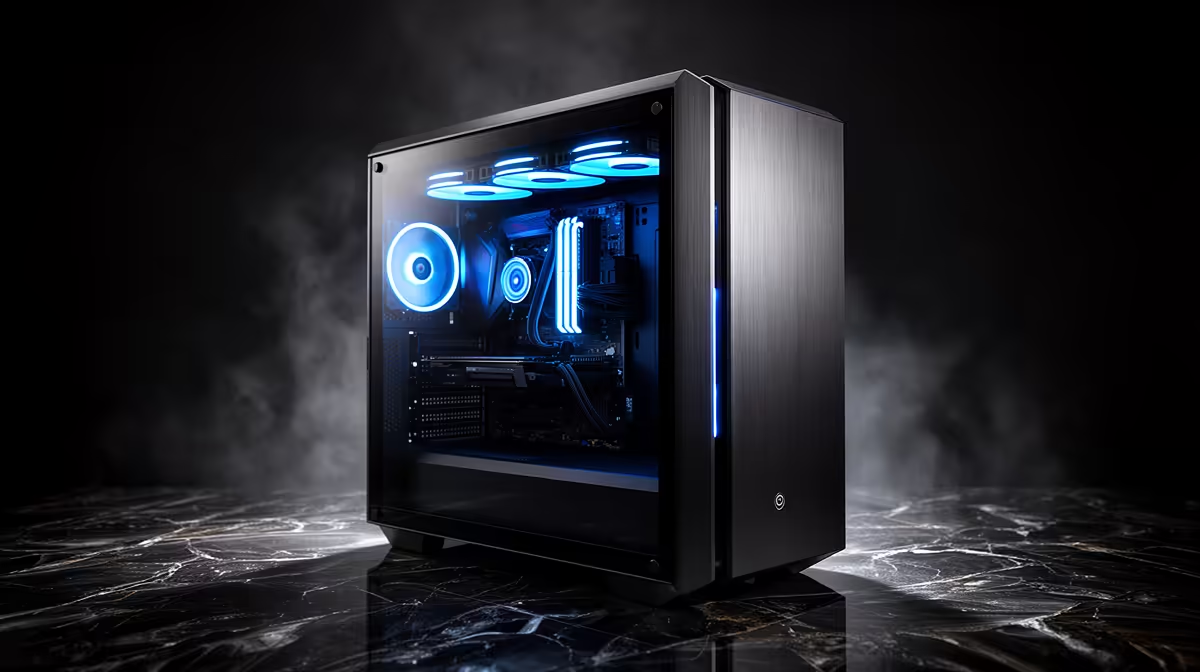
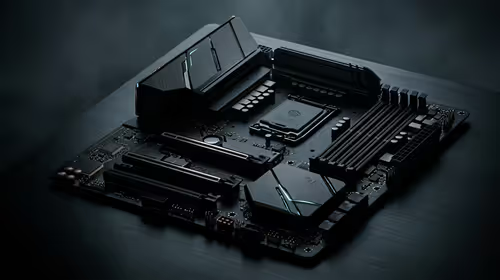
E-ATX cases support motherboards up to 305mm by 330mm and are required for HEDT platforms including AMD Threadripper, Intel Xeon W, and high-end boards with extended VRM heatsinks. Any workstation running a 16-core-plus CPU, dual expansion cards, or four storage devices simultaneously benefits from the additional internal volume.
What Genuine E-ATX Compatibility Requires 📐
Not every case labelled E-ATX supports the full 305mm by 330mm board dimension. Some manufacturers list E-ATX compatibility but only accommodate boards up to 280mm wide, excluding true HEDT platforms. Before purchasing, verify the spec sheet states maximum motherboard support at 305mm by 330mm or larger. Genuine E-ATX enclosures also provide extra stand-off positions beyond the standard ATX grid and deeper cable management channels for the thicker wiring harnesses of 24-pin, dual EPS12V, and multiple PCIe 5.0 GPU connectors. Cases from Phanteks (Enthoo Pro 2) and Fractal Design (Define 7 XL) have verified full E-ATX dimension support and are available locally through Evetech.
Cooling Capacity in E-ATX Enclosures 🌬️
E-ATX cases are engineered for high-heat components and typically support radiators smaller cases cannot. The Phanteks Enthoo Pro 2 accepts a 560mm front radiator (four 140mm fans), the largest standard configuration available. Top panels on full-size E-ATX enclosures commonly accept 420mm or 480mm radiators. For a 32-core Threadripper 7970X, this capacity is necessary to hold package temperatures below 85 degrees Celsius during sustained multi-threaded workloads.
Storage, Expansion, and Cable Management 🗄️
A South African video production studio or architecture firm running four 20TB HDDs plus two NVMe SSDs needs a case with at least four 3.5-inch bays and seven or more PCIe expansion slots. E-ATX cases meet these requirements and provide cable routing channels at least 25mm deep behind the motherboard tray. For 1,000W-plus PSUs used on HEDT platforms, purchasing 150mm ATX and 200mm EPS extension cables is standard practice to reach connectors on boards where the EPS header sits at the top-left corner of a 305mm-wide layout.
Measure Your Desk Space Before Ordering ⚡
E-ATX cases commonly stand taller than 550mm and weigh 12 to 18kg when loaded. Measure the shelf or floor space where you plan to place the workstation before purchasing. A loaded Enthoo Pro 2 or Define 7 XL will not fit under a standard SA home office desk without prior planning.
FAQ
Can I use a standard ATX PSU in an E-ATX case?
Yes. E-ATX cases mount standard ATX PSUs. For HEDT workstations with dual GPUs or a Threadripper platform, choose a PSU rated at 1,000W or higher to ensure stable power delivery under full load.
Do E-ATX cases support standard 120mm and 140mm fans?
All E-ATX cases use standard fan mount dimensions. The additional case volume adds more mount positions, often 10 or more across front, top, rear, and bottom, with stock fans typically being 140mm units.
Is an E-ATX case necessary for dual professional GPUs in South Africa?
For dual-GPU configurations such as two RTX 6000 Ada or RTX 5080 cards, an E-ATX or extended ATX case is strongly advisable. Standard ATX cases do not provide sufficient vertical space for two dual-slot or triple-slot cards plus the required inter-GPU airflow clearance.
Planning a serious workstation build?
Evetech stocks full-tower and E-ATX cases alongside HEDT motherboards and professional-grade cooling, all with local South African warranty support.