Quick Answer
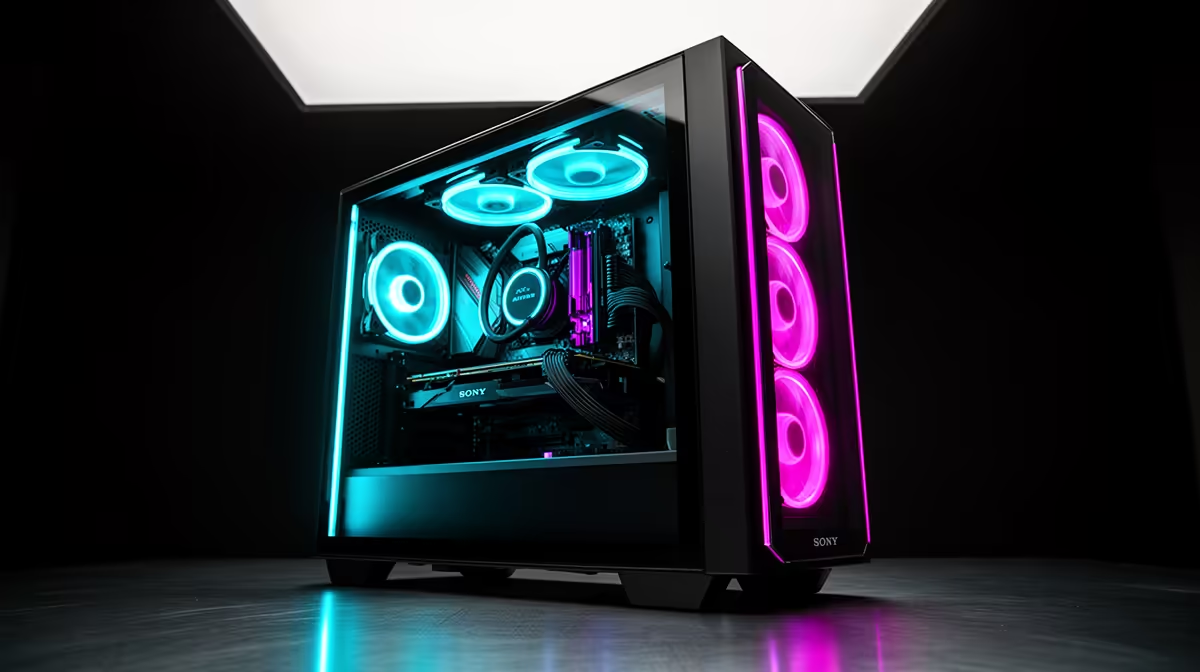
An EATX mid-tower case accommodates a 305 mm wide EATX motherboard in a chassis smaller than a full-tower, striking a balance between component capacity and desk footprint. For premium builds in South Africa, budget R4,500 to R7,500 for a case that fits the board, a 360 mm radiator, a 340 mm plus GPU, and provides proper cable management channels.
Understanding the EATX Mid-Tower Form Factor 🖥️
The EATX mid-tower occupies a specific niche: it is larger than an ATX mid-tower (which stops at a 244 mm wide board) but smaller than a full-tower. Internally, it must accommodate a 305 mm wide board, which means the motherboard tray extends 61 mm wider than in a standard mid-tower. This extra width is the reason these cases run 260 mm to 290 mm in external chassis width, and it is also why their PCIe slot spacing, front radiator clearance, and cable routing must be redesigned rather than simply scaled from ATX. Build a premium EATX mid-tower with at least a Ryzen 9 9950X and RTX 5080 in mind: that combination demands 360 mm AIO clearance at the top, 340 mm GPU clearance at the front, and at least 750 watts PSU mount space.
Key Specifications to Compare When Buying 🔧
When comparing EATX mid-tower cases, prioritise: (1) GPU clearance of 360 mm or more with a front radiator installed, (2) top radiator mount for at least 360 mm after accounting for VRM heatsink clearance, (3) cable routing channels behind the motherboard tray of at least 25 mm depth to accommodate modular PSU cables for an 850 W to 1,000 W unit, and (4) a PCIe bracket system with at least seven positions, three of which remain usable with a triple-slot GPU populated. Secondary considerations include the number of drive bays (two to four 2.5-inch positions minimum for NVMe enclosures) and the front panel USB-C port for 10 Gbps connectivity, now standard on premium builds.
Cooling Configuration in an EATX Mid-Tower 🌡️
The thermal challenge in an EATX mid-tower is that the wider board pushes the CPU socket and VRM zone closer to the side panel, potentially reducing the clearance available for top-mounted AIO cooler tubing. Measure from your specific EATX motherboard's top edge to the top case fan bracket before purchasing. In practice, most EATX mid-towers accommodate 240 mm top radiators without issue, while 360 mm top support varies by model. For a flagship CPU like the Core Ultra 9 285K running at full PL2 of 250 watts, a 360 mm or larger AIO is recommended. Front intake fans should be 140 mm high-static-pressure units rather than the 120 mm fans often bundled with the case.
EATX Mid-Tower vs Full-Tower Decision ⚡
If your EATX mid-tower shortlist does not clearly support a 360 mm radiator and your chosen GPU simultaneously, step up to a full-tower. The full-tower costs R1,000 to R2,000 more but provides the clearance and airflow volume that a constrained mid-tower cannot deliver for premium component combinations. A full-tower also tends to hold resale value better due to broader compatibility.
FAQ
Will an ATX board sit correctly in an EATX mid-tower case?
Yes. EATX cases use the same ATX mounting standoff pattern, so ATX boards install without adapters. You will have unused space in the wider chassis, which is not a problem for performance or stability.
How do I verify GPU clearance with a front radiator installed?
Deduct the radiator thickness (typically 28 mm to 30 mm) and the fan thickness (25 mm) from the stated GPU clearance. If the case lists 400 mm GPU clearance and you mount a 360 mm radiator with 25 mm fans, effective GPU clearance is approximately 345 mm.
Are EATX mid-tower cases readily available in South Africa?
Stock is more limited than ATX mid-towers, but several models are available locally with full South African warranty support. Delivery from local stock typically takes two to five business days.
Building a premium EATX system?
Evetech carries EATX-compatible cases, flagship motherboards, and matching cooling solutions to complete your build without compatibility guesswork.