Quick Answer
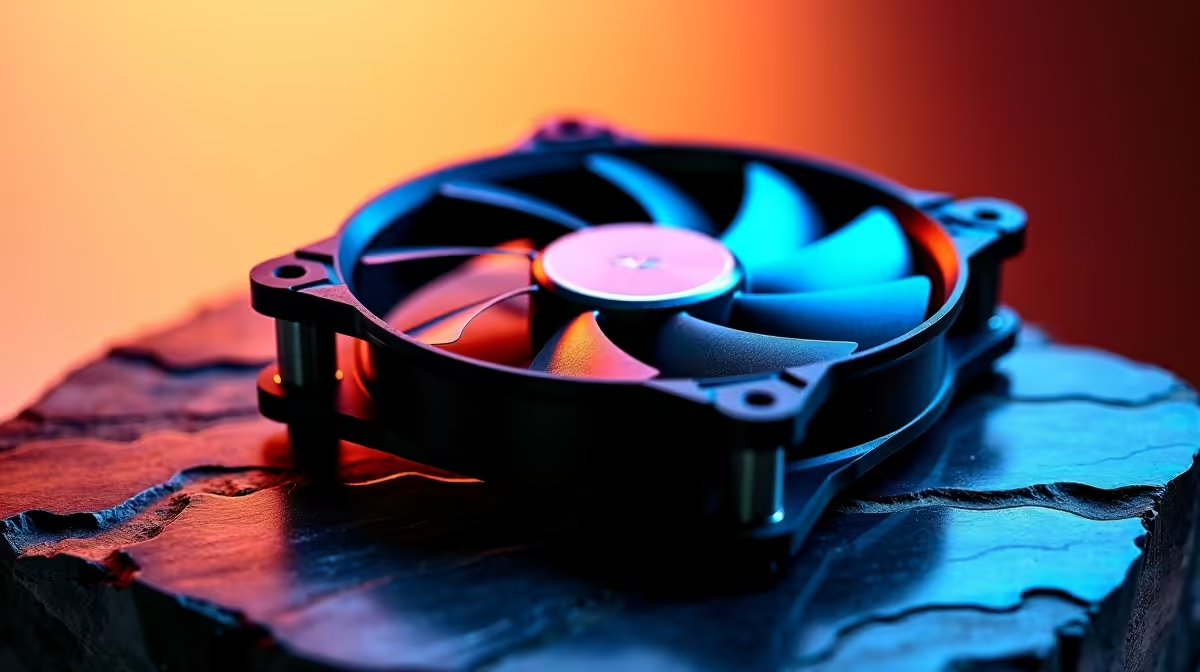
Fluid dynamic bearing fans are rated at 60,000 to 150,000 hours MTBF, translating to 7 to 17 years of continuous operation. In typical PC use at 6 to 10 hours daily, quality FDB fans outlast multiple build cycles and maintain near-original noise and airflow specifications throughout their service life.
What MTBF Actually Means in Practice 🔧
MTBF is a statistical reliability metric, not a guaranteed failure time. A fan rated at 100,000 hours MTBF means statistically that 50 percent of fans from that production batch will still be operational after 100,000 hours of use. In a well-ventilated SA case maintained at reasonable internal temperatures, FDB fans consistently approach or exceed their rated MTBF in real-world use.
The degradation mechanism in FDB fans is gradual lubricant depletion from the sealed reservoir. As the oil film thins over decades, bearing clearance increases slightly and noise begins to rise above the fan's rated figure. This is a slow, predictable process: an FDB fan at 80,000 hours of service may measure 2 to 3 dBA noisier than its original specification, but it will not rattle, seize, or fail suddenly the way a sleeve-bearing fan does.
Heat's Effect on FDB Life in SA Conditions 🌡️
Bearing lubricant viscosity and volatility are temperature-dependent. Higher operating temperatures increase oil evaporation rate from the sealed reservoir, gradually reducing the film's effectiveness. SA summer conditions with case internals reaching 45 to 55 degrees Celsius during sustained gaming accelerate lubricant depletion compared to the European testing environments most MTBF ratings assume (typically 25 degrees Celsius ambient). A conservative estimate is that SA thermal conditions reduce effective FDB lifespan by 10 to 20 percent, meaning a 100,000-hour-rated fan realistically delivers 80,000 to 90,000 hours in SA use. At 8 hours daily, 80,000 hours is still over 27 years of service.
Performance Stability Over Time 💰
FDB fans from Noctua, Lian Li, and Phanteks cost R400 to R700 per fan in South Africa, or R1,200 to R2,000 for a triple pack, currently stocked at Evetech. The performance justification for this premium is acoustic stability. A sleeve-bearing fan new at 26 dBA is 30 to 35 dBA after three years as lubricant depletes. The same spec FDB fan measures within 1 dBA of its original figure after five years. For SA gamers and professionals who keep systems for four to six years, FDB's acoustic stability means no unexpected noise degradation mid-build-cycle.
Clean Your FDB Fan Surroundings, Not the Bearing Itself ⚡
FDB bearings are sealed and self-contained. Never attempt to oil or disassemble the bearing hub. Instead, clean dust off the blades and frame regularly to prevent imbalance-induced vibration, which increases mechanical stress on the bearing over time. In SA's dusty winter conditions, a quarterly blade cleaning is sufficient to protect FDB bearing life.
FAQ
Can I revive a failing FDB fan by adding oil?
Generally no. FDB bearings are sealed at the factory and are not designed for field lubrication. Attempting to add oil risks contaminating the bearing geometry and making performance worse. A fan showing increasing noise after many years should be replaced.
Do higher-RPM FDB fans have shorter lifespans?
Higher RPM increases bearing load and lubricant shear rate, which does accelerate wear slightly. However, premium FDB fans rated for 2,000 RPM are engineered with larger reservoir volumes and refined oil formulations to compensate. Rated MTBF figures already account for operation at maximum RPM.
How does FDB compare to hydrodynamic bearings found in hard drives?
They are essentially the same technology. Hard drive hydrodynamic bearings operate at 5,400 to 7,200 RPM under continuous power, and their decades of reliability in that application validate the same technology's suitability for PC fan use at 600 to 2,000 RPM.
Investing in fans that will outlast multiple SA PC builds?
Explore FDB-bearing case fans and premium cooling options at Evetech, stocked locally.