Quick Answer
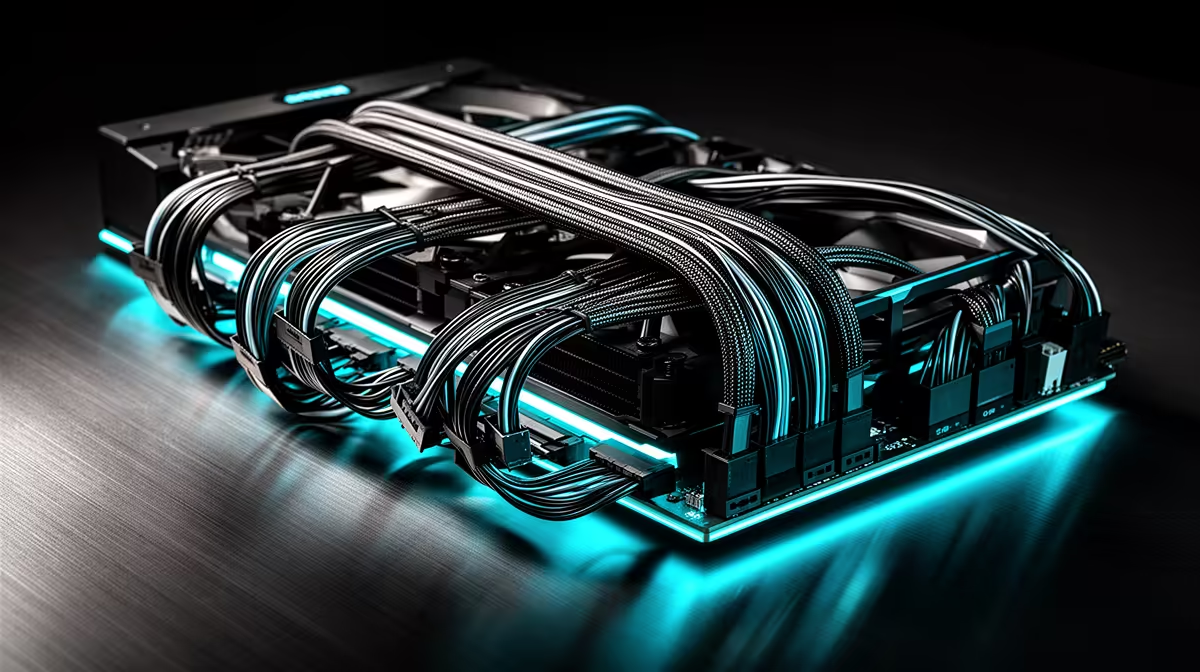
Fully modular PSU cabling improves PC airflow by removing unused cables from the main chamber entirely. In a typical ATX mid-tower, this can reduce GPU operating temperatures by 3 to 7 degrees Celsius and lower overall case ambient by 2 to 4 degrees Celsius compared to a non-modular setup with the same components, fan configuration, and wattage.
How Unused Cables Degrade Case Airflow 💨
A non-modular 850W PSU includes 8 to 12 cable bundles regardless of build requirements. A basic gaming build uses three or four of these: the 24-pin ATX, one 8-pin EPS CPU, one PCIe GPU cable, and two SATA cables for storage. The remaining four to eight cables must be stored somewhere inside the case. When stuffed behind the motherboard tray or bundled in the main chamber, they create physical obstructions that disrupt the laminar airflow from front intake fans toward the GPU and CPU. CFD (computational fluid dynamics) studies of PC cases show that cable bundles in the GPU-to-front-fan zone reduce average airflow velocity by 15% to 25% through that region, which directly raises GPU junction and hotspot temperatures. A fully modular build has none of those obstructions.
Measured Temperature Differences in Practice 🌡️
Switching from a non-modular PSU with cables bundled in the main chamber to a fully modular equivalent reduces GPU average temperatures by 3 to 5 degrees Celsius during gaming, and GPU hotspot temperatures by 4 to 8 degrees Celsius, without changing any fans or coolers. For South African gamers where summer ambient in Johannesburg and Cape Town pushes above 28 degrees Celsius, these airflow gains carry real value.
Cable Management Best Practices With a Fully Modular PSU 🔧
Route all active cables behind the motherboard tray rather than through the main chamber. Use the case cable routing holes to direct the 24-pin, EPS, and PCIe cables in straight runs that avoid the GPU zone. Flat ribbon-style modular cables lie flatter against the tray than round cables and occupy less space in routing channels. Secure all cable runs with cable ties at 100mm to 150mm intervals to prevent loose sections sagging into the fan path.
Route GPU Power Cables Along the Spine, Not Across the Face ⚡
The single biggest airflow obstruction in most ATX builds is a PCIe power cable routed horizontally across the back of the GPU from the PSU shroud to the side connector. Instead, route the cable along the spine of the case floor and up the rear edge of the GPU, keeping the horizontal face of the GPU clear for unobstructed airflow from front case fans.
FAQ
Does full modularity actually improve GPU temperatures by a measurable amount?
Yes, typically 3 to 7 degrees Celsius on average GPU temperature and 4 to 8 degrees on hotspot temperature when the previously unused cables were routed through the main chamber. The improvement is greatest in tightly packed mid-towers with limited front-to-GPU airflow clearance.
Is full modularity only worth it for high-end builds?
It adds value at any build tier, but the benefit is greatest in mid-tower cases where cable routing space is limited and airflow is already restricted. In large full-tower cases with dedicated cable management voids, even non-modular builds can achieve clean routing.
Do flat modular cables make a noticeable difference over round cables?
Yes. Flat ribbon cables lie against case surfaces and tray channels, reducing cable profile by 40% to 60% compared to round equivalents. In tight routing channels adjacent to the GPU zone, the difference is visible and thermal improvement is measurable.
Want cleaner builds with better airflow in your South African gaming PC?
Evetech stocks fully modular PSUs from 650W to 1,600W with flat cable options and full ATX 3.0 support, all with local warranty and detailed specs listed online.