Quick Answer
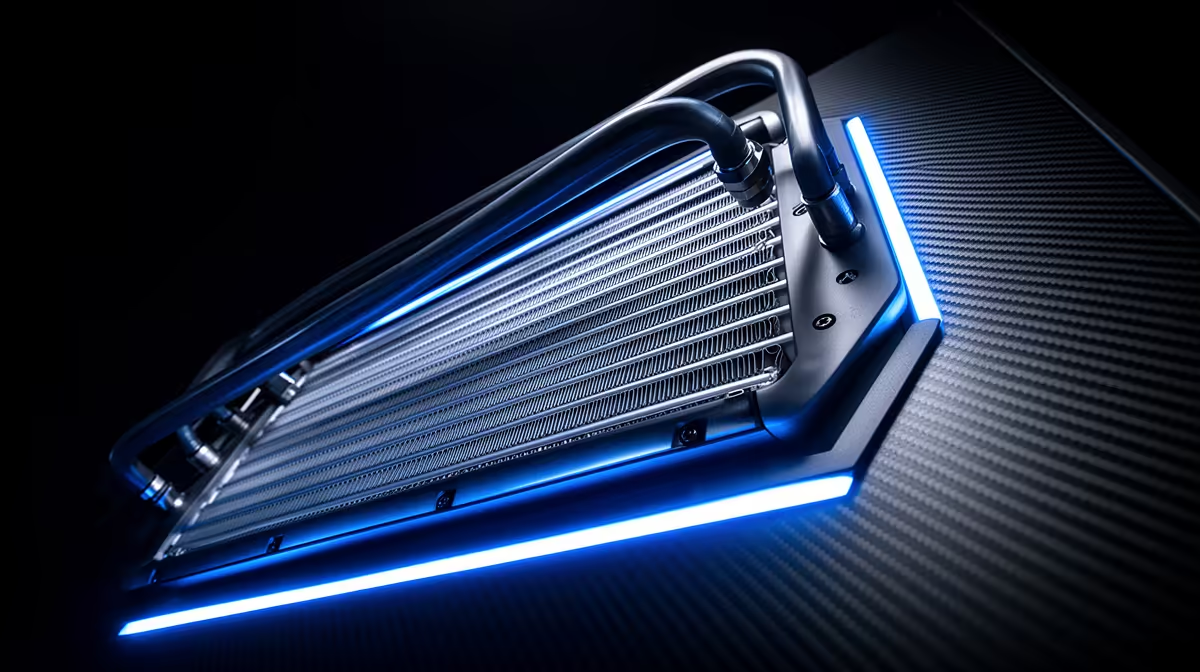
A case with 420mm AIO radiator support can mount a three-fan, 140mm-pitch radiator measuring approximately 420mm by 140mm. This is the largest common consumer AIO size, delivers the best sustained thermal performance for high-TDP processors, and requires a case with an explicitly confirmed 420mm mounting rail at the top or front of the chassis.
What 420mm Radiator Support Actually Requires 🌀
The term 420mm AIO support means the case has a mounting structure with three 140mm fan positions spaced at 140mm centre-to-centre across a 420mm span. This is distinct from 360mm support (three 120mm fans at 120mm pitch). Cases that list 360mm as their maximum cannot be modified to fit a 420mm unit. When reading case specifications, look for 420mm listed explicitly under radiator support for the top or front position. Some cases support 420mm at the top but only 360mm at the front, or vice versa. The mounting direction matters thermally: front mounting pulls fresh room-temperature air through the radiator first, the superior configuration for CPU cooling.
Choosing the Right 420mm AIO for Your CPU 🔧
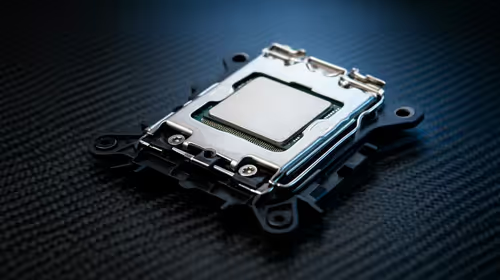
Not every CPU justifies a 420mm AIO. For a Ryzen 7 9800X3D or Core i7-14700K at stock, a 280mm or 360mm AIO provides sufficient cooling with less cost and case complexity. The 420mm format pays for itself with CPUs above 180W sustained TDP: the Ryzen 9 9950X at 170W all-core, the Core Ultra 9 285K at 253W under full AVX-512 load, and Threadripper CPUs at 280 to 350W are appropriate targets. In South Africa's warm ambient conditions where a home office can reach 32 to 36 degrees Celsius in December and January, a 420mm AIO allows these CPUs to maintain all-core boost frequencies through sustained workloads rather than throttling.
Installation Clearances and Common Pitfalls 📋
The most frequently encountered problem with 420mm AIOs is RAM height interference at the top mounting position. DDR5 high-performance kits with tall aluminium heat spreaders can reach 50 to 55mm above the DIMM PCB, which conflicts with the 25mm fan height plus 30mm radiator thickness of a top-mounted AIO. The combined footprint extends 55mm below the top panel, exactly overlapping the RAM zone on many ATX and E-ATX layouts. Check your board's RAM height specification against the case's stated maximum RAM clearance under top radiator. For front mounting, ensure the front panel open area is at least 60% mesh so the three 140mm radiator fans receive adequate fresh air.
Orientation Matters for AIO Longevity ⚡
Mount the 420mm AIO with the pump head at the top of the radiator run and tubes exiting from the bottom of the pump block. This keeps air bubbles in the radiator rather than in the pump, significantly extending pump lifespan and eliminating the gurgling noise that affects incorrectly oriented AIO installations.
FAQ
Can a 420mm AIO cool a Threadripper Pro CPU adequately?
Yes for most workloads, though Threadripper Pro CPUs at 350W TDP push the thermal limits during extended all-core renders. Pairing a 420mm AIO with high-static-pressure 140mm fans keeps temperatures manageable for the majority of professional workloads.
Does a 420mm AIO make more noise than a 280mm or 360mm unit?
Usually less. The additional surface area means fans can run at lower RPM for the same thermal output, reducing audible noise. A well-configured 420mm AIO can be virtually inaudible during light to medium workloads.
Is front or top mounting better for a 420mm AIO in SA's climate?
Front mounting is thermally superior in warm SA conditions because the radiator draws fresh room-temperature air. The CPU temperature advantage of front versus top mounting is typically 3 to 6 degrees Celsius, meaningful in summer ambient conditions above 30 degrees.
Looking for a case that handles a 420mm AIO without compromise?
Evetech stocks a curated range of performance cases with confirmed 420mm radiator support at top and front positions. Browse the case range to find the right enclosure for your cooling setup.