Quick Answer
Choose an SD card based on the three specifications that match your camera's requirements: speed class (V30 minimum for 4K video, V60 or V90 for 8K and RAW burst shooting), bus interface (UHS-I for consumer cameras, UHS-II for professional bodies), and capacity (64GB for casual photography, 128GB to 512GB for video and travel work).
Speed Classes and Why They Determine What Your Camera Can Do 📷
The Video Speed Class rating on an SD card (V10, V30, V60, V90) specifies the minimum guaranteed sustained write speed in megabytes per second. V30 guarantees 30 MB/s minimum write, V60 guarantees 60 MB/s and V90 guarantees 90 MB/s. For 4K video at 100 Mbps bitrate, 30 MB/s (V30) is adequate. For 4K RAW or 6K video above 200 Mbps from a Sony Alpha or Canon EOS R series camera, V60 is the minimum to avoid dropped frames. For 8K RAW or high-frame-rate slow motion at 400 Mbps-plus, V90 is required. Getting this wrong causes your camera to warn you mid-shoot that the card is too slow, pausing recording. In South Africa, V30 cards in 128GB capacity start around R250 to R450, V60 cards in 128GB cost R650 to R1,200, and V90 cards in 256GB reach R2,500 to R5,000, all depending on brand and whether they are UHS-I or UHS-II interface.
UHS-I vs UHS-II: Interface Speed and Camera Compatibility 🔬
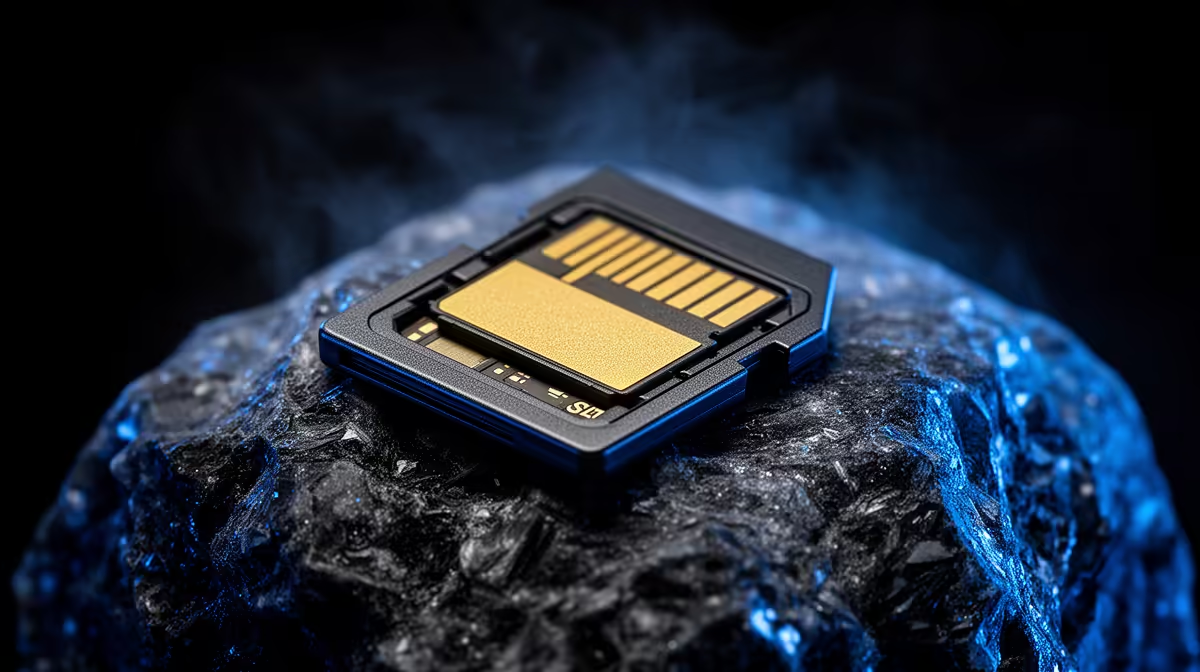
Beyond the speed class label, the bus interface determines the maximum possible transfer speed between card and camera (or card reader). UHS-I uses one row of pins and supports a theoretical 104 MB/s maximum. UHS-II adds a second row of pins and supports up to 312 MB/s theoretical throughput.
Capacity Planning for Travel and Video Storage 🗄️
Capacity needs depend heavily on your shooting style. A travel photographer shooting JPEG plus RAW at 24 megapixels can store roughly 1,500 to 2,000 images on a 64GB card, which is enough for a full day of sightseeing. A videographer shooting 4K 10-bit footage at 200 Mbps fills a 128GB card in approximately 85 minutes of footage. For a South African safari where you may be away from a laptop for five days, a 512GB card or multiple 256GB cards is the practical minimum for video work. Redundancy matters: carrying two or three smaller cards rather than one large card protects against a single card failure losing an entire trip's work. Cards from established brands like SanDisk, Sony, Lexar and Samsung that are currently stocked at Evetech include recovery software bundles and longer warranty terms than generic alternatives.
Test Your Card's Real Speed Before an Important Shoot ⚡
SD card labelling sometimes reflects peak read speed rather than sustained write speed. Before a paid shoot or once-in-a-lifetime travel shoot, run a benchmark using free software like CrystalDiskMark or the SD Association's SD Formatter tool. Record 10 minutes of your highest-quality video format and confirm the camera shows no buffer warnings. This 15-minute test can save an entire job's worth of footage.
FAQ
What SD card should a South African wildlife photographer use for burst shooting?
For burst shooting at 20 frames per second in RAW with a camera like the Sony Alpha 1 or Nikon Z9, choose a UHS-II V60 or V90 card in 256GB or larger.
Can I use an SD card from my camera as storage for a laptop or PC?
SD cards function as storage for any device with an SD card reader or via a USB adapter.
How should I store and protect SD cards during travel in South Africa?
Carry SD cards in a rigid case with labelled slots, both to protect the pins from dust and to keep shot cards separate from blank ones.
Need the right SD card for your camera, drone or action camera?
Evetech stocks a range of SD cards across speed classes and capacities, from everyday V30 options to professional V90 UHS-II cards, with local stock for South African photographers and videographers.