Quick Answer
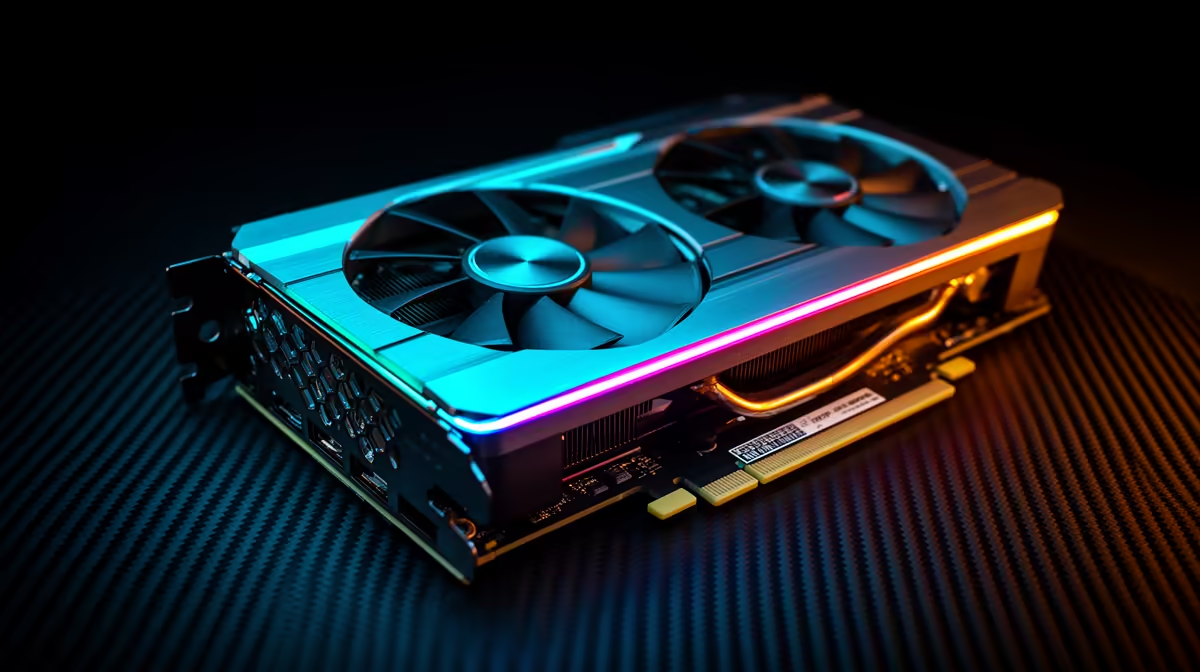
Entry-level RTX cards in 2026 sit between R6,500 and R11,000 in South Africa and deliver genuine ray tracing, DLSS 4 upscaling, and 1080p frame rates above 100 fps in most current AAA titles. For rand-conscious buyers, the RTX 5060 represents the clearest entry point into Blackwell architecture features without jumping to a mid-range price bracket.
What You Get With Entry RTX in 2026 🚀
Entry-level RTX in the current generation means Blackwell tensor cores and DLSS 4 Multi Frame Generation, not just basic rasterisation. That changes the value equation significantly: a card that natively pushes 80 fps at 1080p High can effectively output 160 fps or more through frame generation, making a 144 Hz monitor a justifiable pairing. Hardware ray tracing cores handle reflections and global illumination in supported titles without requiring a mid-range card. For SA gamers who largely play on 1080p 144 Hz panels, this performance ceiling is more than enough headroom for the next two to three gaming seasons.
Breaking Down the ZAR Cost of Features 💰
At around R9,000 to R11,000 for an RTX 5060, SA buyers are paying for GDDR7 memory bandwidth, DLSS 4, hardware RT cores, and Blackwell efficiency. Compare that to last-gen RTX 4060 cards still floating around R7,000 to R8,500: the older card still offers DLSS 3 and solid 1080p rasterisation, but lacks the GDDR7 bandwidth uplift and DLSS 4 support. Over a three-year ownership window the newer card typically costs R500 to R1,000 more upfront but ages more gracefully as games push higher VRAM demands. SA distributors typically bundle a local warranty through authorised channels, which matters given import costs if a card needs a replacement.
Pairing Entry RTX With the Rest of Your Build 🖥️
An entry RTX card paired with a mid-range Ryzen 7000-series CPU and 16GB DDR5 RAM creates a balanced 1080p to 1440p build in the R18,000 to R25,000 total range. Bottlenecking an RTX 5060 with an aged CPU costs measurable fps: testing shows CPU-limited scenarios can reduce effective frame rates by 15 to 25 percent in CPU-heavy open-world titles. Prioritise at least a six-core current-gen processor and a 500GB NVMe SSD to keep texture streaming smooth. SA gaming cafes running this configuration report consistent 100 to 144 fps across popular esports and AAA titles on local ISP connections through Vumatel or Openserve.
Match Your Monitor Before Buying ⚡
An entry RTX card shines on a 1080p 144 Hz or 1440p 165 Hz monitor. If your current panel is 60 Hz, upgrade the display at the same time to see the full performance benefit of DLSS 4 and the higher native frame rates the card can deliver.
FAQ
Is the RTX 5060 the best entry RTX in 2026 for SA buyers?
For most buyers, yes. It combines Blackwell architecture, GDDR7 memory, and DLSS 4 support at a price around R9,500 to R11,000, which is the most feature-rich entry point currently stocked at Evetech in the RTX lineup.
Can an entry RTX card handle ray tracing properly?
Yes, at 1080p with DLSS Quality or Balanced mode enabled. Native 1080p ray tracing is demanding, but DLSS 4 recaptures the lost frames, keeping most titles above 60 fps even with ray tracing switched on at medium settings.
What happens to entry RTX value as games get more demanding?
DLSS 4 provides a meaningful buffer: as rasterisation demands climb, AI upscaling compensates. Entry RTX cards typically remain viable at 1080p for three to four years when paired with upscaling, which is the key reason newer-architecture entry cards justify a modest premium over older stock.
Looking at entry RTX options?
Check out the current range of RTX graphics cards stocked at Evetech to compare pricing, VRAM, and feature sets across the latest Blackwell entries.