Quick Answer
A quality 360mm AIO liquid cooler costs R1,600 to R3,500 in South Africa, while a premium tower air cooler sits at R900 to R1,800. The price gap is R700 to R1,700, and whether that gap is justified depends entirely on your CPU's TDP and your case's airflow capacity.
Air Cooling: What Your Rands Actually Buy 💰
At the premium end of tower air cooling, the Noctua NH-D15 and be quiet! Dark Rock Pro 4 land around R1,500 to R1,800 locally and deliver cooling performance that handles CPUs up to approximately 150W under sustained load before hitting thermal limits in warm ambient conditions. Single-tower units like the be quiet! Pure Rock 2 or Deepcool AK620 sit at R700 to R1,100 and cover most mid-range CPUs (65W to 100W sustained) comfortably. Air coolers carry no moving parts beyond the fans, have no pump failure risk, and require zero software to operate. They also add no USB header requirement and have no sealed coolant loop that could theoretically leak.
360mm AIO: The Extra Cost Breakdown 🔧
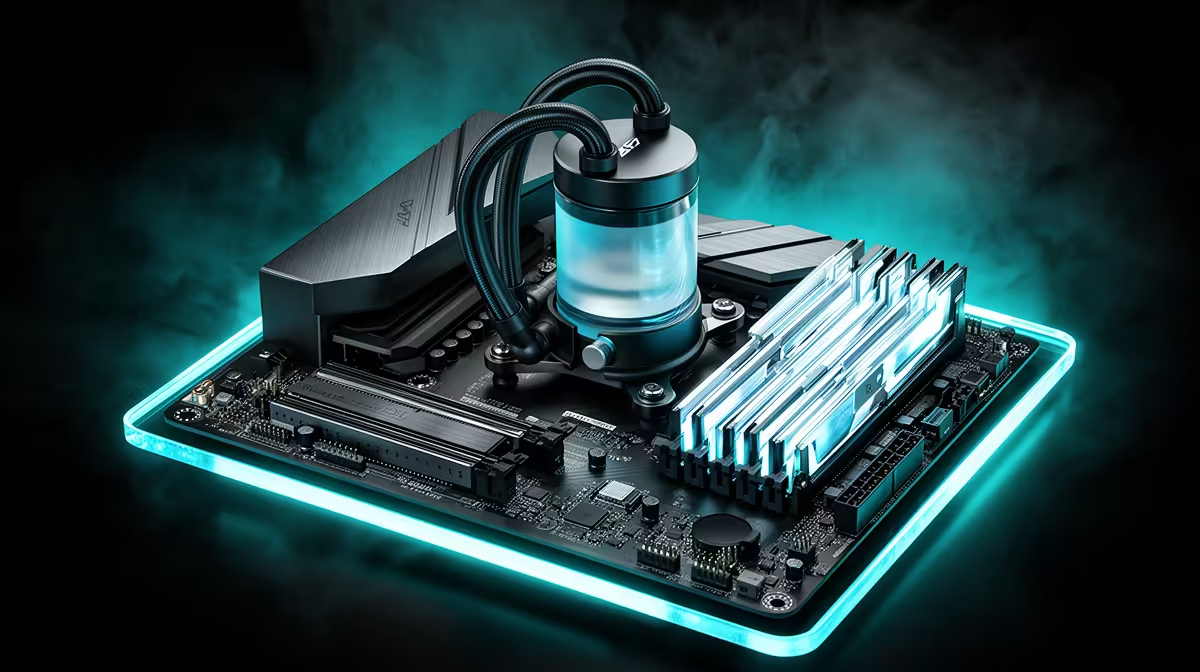
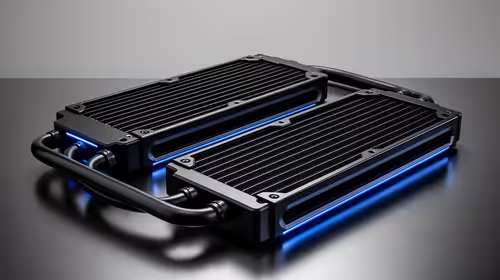
Moving to a 360mm AIO at R1,800 to R3,200 means paying R700 to R1,400 more than an equivalent premium air cooler. In return you receive 8 to 15 degrees lower CPU temperature under sustained loads above 125W, better visual aesthetics particularly in windowed cases, and the ability to place the heat-rejection (radiator) directly at a case exhaust vent rather than competing with case airflow inside the chassis. For CPUs like the Ryzen 9 9950X at R9,000 to R12,000 locally, spending an extra R1,000 on liquid cooling to keep it running at full boost frequency is a straightforward efficiency argument. For a Ryzen 5 9600X, the same extra R1,000 buys you temperature headroom you do not strictly need.
When the Price Gap Is Worth Paying 🖥️
The liquid cooling premium makes clear sense in four scenarios: when the CPU TDP exceeds 125W sustained, when the case has a small internal footprint that limits tower cooler height clearance, when the build uses a single-fan exhaust configuration that a large tower cooler would disrupt, and when aesthetics are a stated priority in a build with a tempered glass window. In a R35,000 to R55,000 South African gaming build, the cooler represents 5 to 10 percent of total cost, and the visual contribution of a well-mounted 360mm AIO with ARGB fans adds measurable value to a showcase build that a tower heatsink cannot match.
Factor In Fan Costs for Air Coolers ⚡
Premium tower coolers often ship with one or two fans, but many South African builders add a third push-pull fan for improved performance, adding R200 to R400 to the air cooler total cost. When comparing air versus liquid cooling costs honestly, include the full fan configuration you plan to run, not just the heatsink purchase price.
FAQ
Is a 360mm AIO always better than a premium air cooler for gaming?
Not always. For CPUs below 100W sustained, the best air coolers match or beat entry-tier 360mm AIOs on noise-normalised cooling performance. The AIO advantage grows sharply above 125W and becomes decisive above 150W sustained.
Does liquid cooling increase electricity usage compared to air cooling?
Minimally. An AIO pump draws around 3 to 6W continuously, which is negligible over the course of a gaming session. The fans on both air and liquid coolers draw similar power at equivalent noise levels, so total system power difference between the two cooling types is under 10W in most configurations.
Which lasts longer: a premium tower air cooler or a 360mm AIO?
A premium tower air cooler with quality fans can last 10 or more years since the heatsink itself has no moving parts and fans can be replaced individually. A 360mm AIO typically lasts 5 to 8 years before pump reliability becomes a concern. The air cooler has a longevity advantage, though many builders upgrade before either cooling solution fails.
Air or liquid: which makes sense for your build?
Compare Evetech's full cooling range, from premium tower air coolers to 360mm AIOs, and find the right thermal solution for your CPU and budget.