Quick Answer
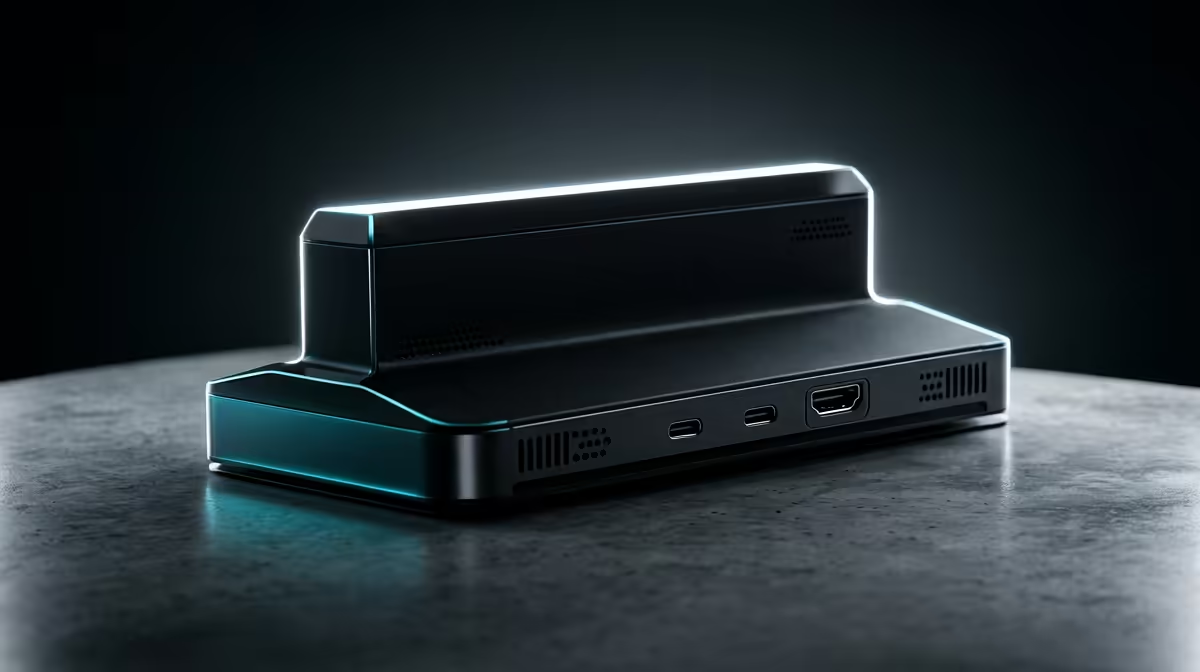
Thunderbolt 4 docking stations deliver up to 40 Gbps bandwidth, guaranteed dual 4K display support, and consistent certification standards. USB-C docks vary widely in capability from 5 Gbps to 20 Gbps depending on the USB standard used, and display support is not guaranteed without a DisplayLink chip.
What Thunderbolt 4 Docks Offer 🔌
Thunderbolt 4 is a certified standard enforced by Intel, which means every TB4 dock must support 40 Gbps data transfer, at least one Thunderbolt 4 downstream port for daisy-chaining, dual 4K display output, USB 3.2 Gen 2 speeds for peripheral ports, and a minimum of 15W charging to connected devices. A laptop connecting to a TB4 dock via a single cable simultaneously gets power delivery (up to 100W on premium docks), two 4K monitors, wired Ethernet, and USB peripherals all without any individual bottlenecking. For creators or developers at a Cape Town agency or Johannesburg fintech firm who need a reliable single-cable workstation experience, the certification guarantee removes uncertainty. TB4 docks range from around R2,500 to R6,000 at Evetech depending on port count and power delivery spec.
What USB-C Docks Offer 🖥️
USB-C docking stations span a wide capability range. A USB 3.2 Gen 1 dock operates at 5 Gbps total bandwidth shared across all ports, which is enough for one 1080p display, keyboard, mouse, and Ethernet but struggles with 4K video plus simultaneous large file transfers. USB 3.2 Gen 2 docks (10 Gbps) handle 4K at 60Hz and faster USB storage. USB4 docks reach 20 to 40 Gbps and partly overlap with Thunderbolt 4 in capability, though without the Intel certification guarantees. DisplayLink USB-C docks add a compression chip to drive multiple displays even from a low-bandwidth USB-A connection, but require a DisplayLink driver and add a slight latency in display rendering. The major advantage of USB-C docks is price: decent 4-in-1 USB-C hubs cost R400 to R800, while a multi-port USB4 dock with display output costs R1,200 to R2,500.
Which One to Buy 💰
Choose Thunderbolt 4 if your laptop has a TB4 port, you need two 4K displays, you transfer large files regularly, or you want a guaranteed certified experience. Choose USB-C if your laptop lacks Thunderbolt, you only need one display, or budget is the priority. Do not buy a TB4 dock for a USB-C-only laptop: it will work but you will pay for Thunderbolt capabilities your laptop cannot use. Check your laptop spec sheet: the lightning bolt icon next to a port confirms Thunderbolt support.
Verify Your Laptop Port Before Buying ⚡
USB-C and Thunderbolt 4 ports look identical. On Windows, open Device Manager and expand Universal Serial Bus controllers. If you see an Intel Thunderbolt entry, your port supports TB4. Without that entry, a Thunderbolt 4 dock will function at USB-C speeds only, making the price premium unjustifiable.
FAQ
Can I use a Thunderbolt 4 dock with a MacBook?
Yes. Apple's M-series MacBooks include Thunderbolt 4 ports and work fully with TB4 docks. Display output limits on Apple silicon differ from Intel, with some M1 MacBook Air models supporting only one external display without workarounds.
Will a USB-C dock charge my laptop?
It depends on the dock's power delivery rating. A 65W dock charges most slim laptops. Gaming laptops drawing 100W or more need a 130W or higher dock to charge at full speed. Check the dock's PD spec before buying.
Are Thunderbolt 4 docks worth it in South Africa?
If your laptop supports TB4, yes. The additional cost over a premium USB4 dock is typically R800 to R1,500, and the certified guarantee of dual 4K and daisy-chaining eliminates compatibility guesswork that becomes expensive in a professional workflow.
Not sure whether to go Thunderbolt 4 or USB-C for your setup?
Browse the full docking station range at Evetech to compare specs and pricing side by side.