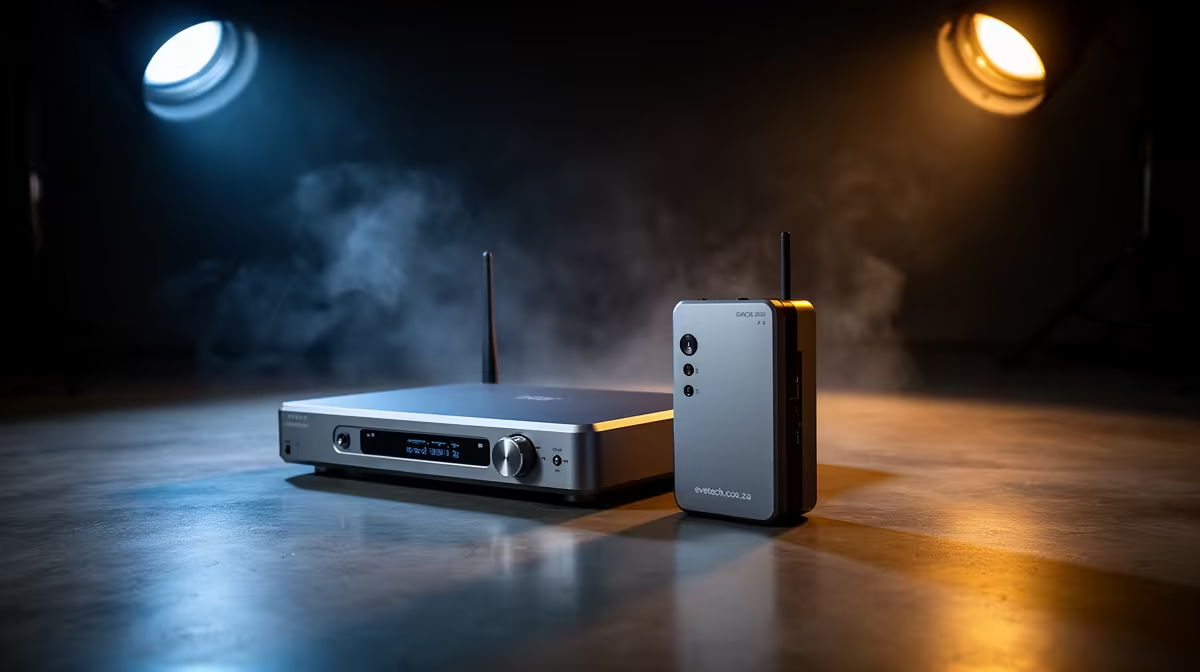
Most video and podcast rigs live or die by one decision made before pressing record: how many voices need to go on tape, and how cleanly does each one arrive. Transmitter and receiver configuration is the spec that answers that question at the hardware level. From a lone presenter with a single clip-on all the way to a rack unit juggling eight performers, every configuration involves a deliberate trade-off between simplicity and capacity.
Quick Answer
The configuration is the transmitter-to-receiver ratio. A single TX to one RX suits one voice. Two transmitters to one dual-channel receiver covers interviews. Rack systems handle four to eight transmitters for panels. Match the channel count to your subject count or you will lose voices.
🎯 The Single-TX Solo Rig
The simplest wireless configuration pairs one transmitter with one receiver and records a single audio channel. That straightforwardness is the point. Clip the transmitter to your lapel, plug the receiver into your camera or interface, and the signal path is essentially three pieces of gear and one cable.
For a solo vlogger, a documentary presenter, or a corporate talking-head shoot, this configuration covers every scenario without any routing complexity. There is no gain staging between two talent mics to balance, no split-track editing later, and no frequency coordination headache. The single-TX approach is also the entry point for wireless audio in South Africa: most kits at the R1,500 to R3,000 level ship as one transmitter and one receiver, which is exactly what most creators need.
The limitation is obvious: one channel is one voice. The moment a second speaker enters the frame, this configuration either records only one of them cleanly or records both on the same channel, which collapses any chance of independent level control in the edit.
⚡ Dual-TX Configurations for Interview Work
A dual-transmitter setup routes two clip-on or handheld transmitters into a single receiver that outputs two discrete channels, typically splitting them as left and right on a stereo track. Each voice lands on its own track. That separation is the key feature: if your interview subject is significantly louder than you are, you trim their channel without touching yours, and the edit is clean regardless of how mismatched the voices were in the room.
Dual-channel capture and track management
The receiver converts those two RF signals into a stereo output where channel one occupies the left ear and channel two occupies the right. Your camera or recorder treats this as a single stereo file. In post, you split the stereo track into two mono tracks and edit them as independent voices. This is the standard approach on a talking-head interview, a two-presenter podcast recorded on location, or a panel of two filmed for social content.
Frequency coordination on a two-TX rig
Dual transmitters must operate on separate frequencies inside the same band. Most matched dual kits pair automatically on power-up, assigning each transmitter a distinct slot so they do not interfere. This auto-pairing is reliable in low-interference conditions. In a busy venue with other wireless systems active, manual frequency selection is the safer approach: scan the environment, identify clear channels, and assign each transmitter to one.
🔧 Rack Systems: Four to Eight Channels
Professional production environments, corporate events, and broadcast studios move past dual-channel rigs into rack receivers that manage anywhere from four to eight transmitters simultaneously on discrete frequencies. Each transmitter corresponds to a dedicated channel on the rack unit, and every channel feeds independently into the mixing desk or recording system.
The coordination challenge scales up accordingly. With eight transmitters active in the same physical space, frequency planning becomes critical. Professional rack systems include spectrum scanning tools that identify clean frequency bands and assign transmitters automatically, avoiding the manual trial-and-error that would eat setup time on a live event.
Rack configurations are also where diversity reception becomes standard rather than optional. Most rack receivers dedicate two antennas to each channel and select whichever antenna is pulling the stronger signal at any given moment. That constant antenna-switching happens invisibly and keeps dropouts out of the recording even in a crowded environment.
Pro Tip ⚡
When running a four-channel or larger rack system in a South African convention centre or multi-camera studio, bring a spectrum analyser app on your phone and scan the 2.4GHz band before assigning frequencies. Venue Wi-Fi and other production teams often occupy predictable blocks, and steering clear of those blocks before the shoot saves troubleshooting time during it.
🌐 True Diversity vs. Single-Antenna Receivers
Diversity reception deserves its own attention because it is the spec that separates receivers that drop out in challenging environments from those that hold the signal steady. A single-antenna receiver has one point of reception: if that antenna loses line of sight, even briefly, the audio cuts. A true diversity receiver carries two antennas, each sampling the RF environment independently, and its internal logic selects the stronger feed on a near-continuous basis.
The practical difference shows up in situations where the transmitter moves: a presenter pacing a stage, a subject turning away from camera on a run-and-gun shoot, a performer who moves behind a speaker stack. Single-antenna receivers produce crackle or silence in these moments. True diversity receivers typically hold clean audio through them because at least one antenna almost always has an acceptable path to the transmitter.
In a South African conference or corporate event where the presenter is mobile and the room's geometry is fixed, true diversity in the receiver is not a luxury feature. It is the specification that determines whether the recording is usable.
Frequently Asked Questions
What is the simplest wireless configuration available?
A single transmitter paired with a single receiver records one voice on one channel. It is the entry-level configuration for solo creators and corporate presenters. Setup is minimal, the signal path is short, and most plug-and-play kits at the R1,500 to R3,000 range ship in exactly this pairing. The only limitation is capacity: one channel handles one voice cleanly.
How does a dual-transmitter rig differ from the solo setup?
Two transmitters feed a single dual-channel receiver, delivering each voice on its own independent output. The receiver splits them to left and right, giving you two separate mono tracks after editing. This separation means you can balance, cut, and process each speaker independently in post, which is why dual-TX is the go-to configuration for interviews and two-presenter shoots.
Can a single receiver support more than two transmitters?
Yes. Rack receivers designed for professional production handle four to eight transmitters, each occupying a discrete frequency channel. The receiver outputs each transmitter as an independent audio channel to the mixing desk or recorder. Frequency coordination becomes more involved at this scale, and rack systems generally include spectrum scanning tools to assist with it.
Why does true diversity matter on a moving shoot?
A single-antenna receiver has one reception path: if that path is interrupted by body movement, a set wall, or distance, the audio drops. True diversity receivers use two antennas and continuously select whichever is pulling a cleaner signal. The switching is instantaneous and invisible, so a presenter turning or walking away from the camera does not produce crackle in the recording.
Will a transmitter from one brand pair with a receiver from another?
Almost never reliably. Wireless audio manufacturers use proprietary pairing protocols, so a transmitter and receiver generally need to originate from the same kit to establish a stable link. Cross-brand pairings occasionally connect in demo conditions but rarely hold the signal quality or channel-lock stability needed for a production shoot. Buy the transmitter and receiver as a matched set.
Ready to build the wireless audio configuration your shoots actually need?
Browse the wireless microphone range and find the transmitter and receiver setup that matches your channel count, whether you are recording solo, running a two-person interview, or covering a full panel.