Quick Answer
Triple-shielded cables reduce electromagnetic interference significantly more than standard single-shielded cables, with independent testing showing 40 to 60 dB greater attenuation of external EMI. For 4K and 8K video signals where the bandwidth requirements are highest, triple shielding directly translates to fewer signal dropouts and cleaner image stability.
How EMI Disrupts High-Resolution Video 📡
Digital video signals at 4K 60Hz require sustained data transfer rates above 12 Gbps. At that bandwidth, even minor electromagnetic interference introduces bit errors that the display controller cannot correct, resulting in visible screen flicker, pixelation, or complete signal loss. EMI sources in a typical South African home or office include Wi-Fi routers operating at 2.4 GHz and 5 GHz, microwave ovens, fluorescent lighting ballasts, and nearby power cables carrying 230V AC. A standard cable with a single aluminium foil shield attenuates EMI by roughly 30 to 40 dB, which is sufficient for 1080p at short cable runs. At 4K over 1.5m to 2m, this margin shrinks and interference from nearby sources can break through.
What Triple Shielding Adds 🛡️
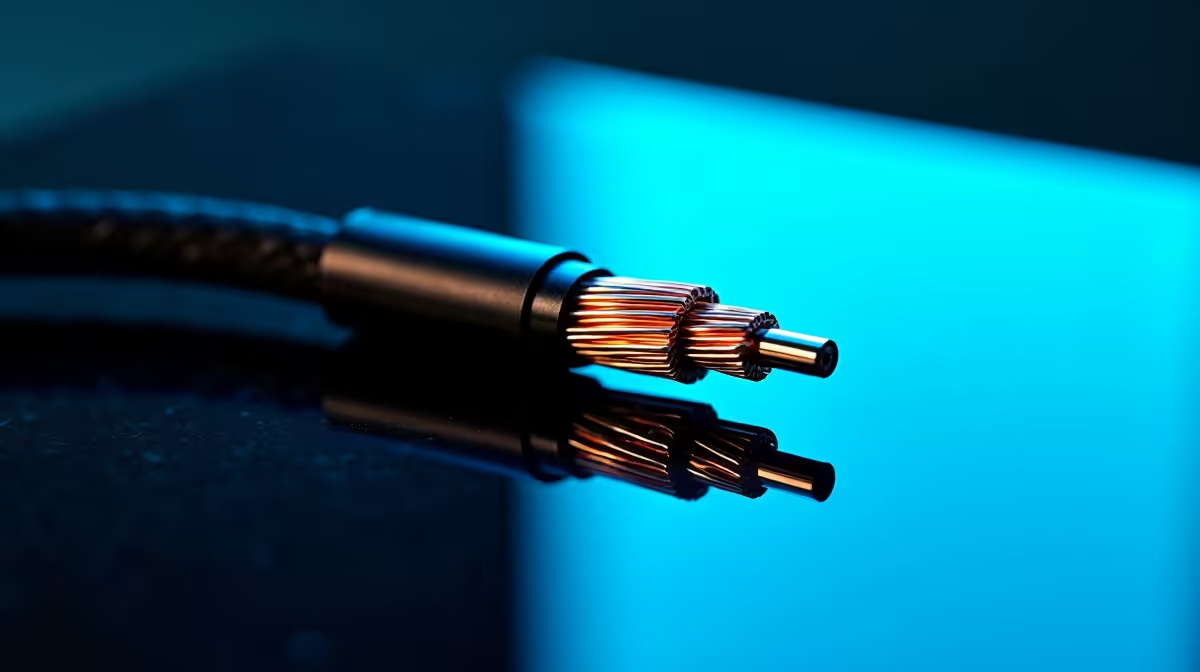
A triple-shielded cable adds a second layer of braided copper or aluminium mesh over the foil, plus a continuous drain wire that provides a low-impedance path to ground for residual charge. The foil handles high-frequency interference above 100 MHz. The braid handles lower frequencies between 1 MHz and 100 MHz where many electrical devices radiate most of their noise. The drain wire ensures the shield remains continuously grounded so charge does not accumulate and re-radiate. Combined, the three layers provide 70 to 100 dB of isolation, meaning almost no external RF energy reaches the signal conductors. For a 4K editing workstation in an open-plan Cape Town or Sandton office with dense wireless infrastructure, the practical outcome is stable 4K output at 2m cable length with no intervention required.
Identifying a Genuinely Triple-Shielded Cable 🔧
Marketing language is inconsistent: some manufacturers label a foil-plus-braid cable as triple shielded when it has only two layers plus basic jacket. Look for spec sheets that list aluminium foil (layer 1), copper braid (layer 2), and drain wire (layer 3) as separate items. A genuine triple-shielded 2m DisplayPort cable is noticeably stiffer and heavier than a single-shielded equivalent. Quality triple-shielded cables retail between R180 and R400 at Evetech, versus R80 to R120 for basic single-shielded alternatives. For a fixed desktop run, the stiffness is irrelevant and the EMI protection is the deciding factor.
Route Power and Video Cables Perpendicularly ⚡
Even the best-shielded cable picks up interference from parallel power cable runs. Cross your display cables over power cables at 90-degree angles rather than running them side by side. This simple routing change reduces inductive coupling and complements whatever shielding the cable provides.
FAQ
Does triple shielding help with 8K video over DisplayPort 2.1?
Yes, the benefit scales with bandwidth. DisplayPort 2.1 carries up to 77.37 Gbps, making it far more sensitive to EMI than DP 1.2. Triple shielding is effectively mandatory for reliable 8K output at cable lengths above 1m.
Can a poorly shielded cable affect audio as well as video?
Yes, HDMI carries audio alongside video on the same conductors. EMI-induced bit errors can corrupt both streams simultaneously, producing audio drop-outs that coincide with visual glitches.
Is triple shielding worth it for a short 0.5m cable on a desktop?
At 0.5m the signal path is short enough that a single-shielded cable manages most interference. Triple shielding becomes clearly valuable above 1m and in environments with dense electrical equipment nearby.
Struggling with 4K flicker or signal instability?
Evetech carries triple-shielded DisplayPort and HDMI cables that deliver clean high-bandwidth signals even in electrically busy South African work environments.