Quick Answer
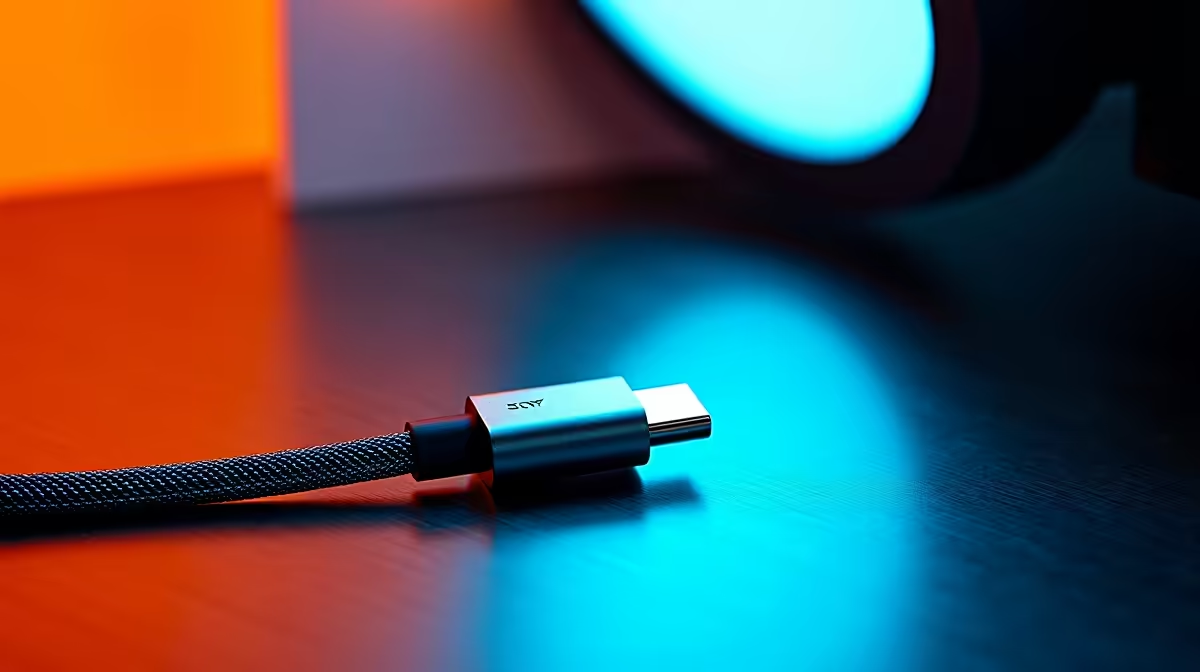
Triple-shielded display cables outperform standard single-shielded cables in electrically noisy environments: they produce fewer signal errors, fewer display dropouts, and more stable high-refresh-rate output. In a quiet home setup the difference is minimal. In a gaming battlestation with multiple USB hubs, RGB controllers, and a UPS nearby, triple shielding provides measurable stability improvement.
How EMI Enters a Standard Cable 📡
A standard cable uses a single aluminium foil shield around the signal conductor bundle. This foil blocks high-frequency radiated interference adequately in low-noise environments but has limited effectiveness against broadband EMI from switched-mode power supplies, USB chargers, and RGB lighting controllers, all common in SA gaming setups. At 1440p at 240Hz or 4K at 144Hz using HBR3 signalling, the timing margin is tight enough that intermittent interference causes uncorrectable symbol errors, visible as flickering, brief black screens, or the monitor dropping out and reconnecting.
What Triple Shielding Adds 🔧
A triple-shielded cable layers a foil wrap around each individual signal pair (reducing crosstalk), a braided copper mesh around the full bundle (providing a robust ground path that dissipates induced current away from signals), and either a second foil or a conductive outer jacket (blocking re-entry from external fields). Together these three layers drop the coupled interference at the receiver by 15 to 25 decibels at typical gaming desk EMI frequencies. In practice, a triple-shielded cable driving a monitor at 1440p at 240Hz in a fully loaded gaming setup maintains the same symbol error rate as a standard cable achieves in an EMI-free environment.
Cost vs Benefit for SA Gamers 💰
A standard single-shielded DisplayPort cable costs R100 to R250 locally. A triple-shielded cable of the same length and rating runs R350 to R700. The premium is worth paying when your setup includes multiple peripherals with their own power supplies near the cable, you are running at 1440p at 240Hz or 4K at high refresh rates, or you have experienced intermittent flicker not explained by cable rating or port version. For a straightforward 1440p at 144Hz setup on a clean desk with minimal nearby electronics, a quality dual-shielded cable at R200 to R350 is sufficient.
Route Cables Perpendicular to Power Lines ⚡
The simplest and free way to reduce EMI coupling is to ensure your display cable crosses any power cables at a 90-degree angle rather than running parallel to them. Parallel runs of 30 centimetres or more between a display cable and an AC power cable create an effective antenna that couples interference directly into the signal. Cable clips and thoughtful routing cost nothing and reduce EMI before any cable upgrade is needed.
FAQ
Can EMI from RGB lighting cause display flicker?
Yes, in some configurations. RGB LED controllers and their power supplies switch at frequencies that couple into nearby display cables. If flicker appears after adding RGB strips, try routing the display cable away from the RGB wiring as a first step before buying a new cable.
Is triple shielding necessary for HDMI cables as well as DisplayPort?
The same physics applies. HDMI at 4K at 120Hz (HDMI 2.1) benefits from better shielding in noisy environments, particularly for longer cable runs typical in living-room gaming setups.
Does a triple-shielded cable affect signal quality on a quiet desk?
No. A well-designed triple-shielded cable performs identically to a standard cable in a low-EMI environment. There is no signal quality improvement from shielding when there is no interference to block.
Building a high-refresh-rate gaming setup and want it reliable?
Evetech stocks shielded DisplayPort cables and gaming monitors to pair correctly for your target resolution and refresh rate.