Quick Answer
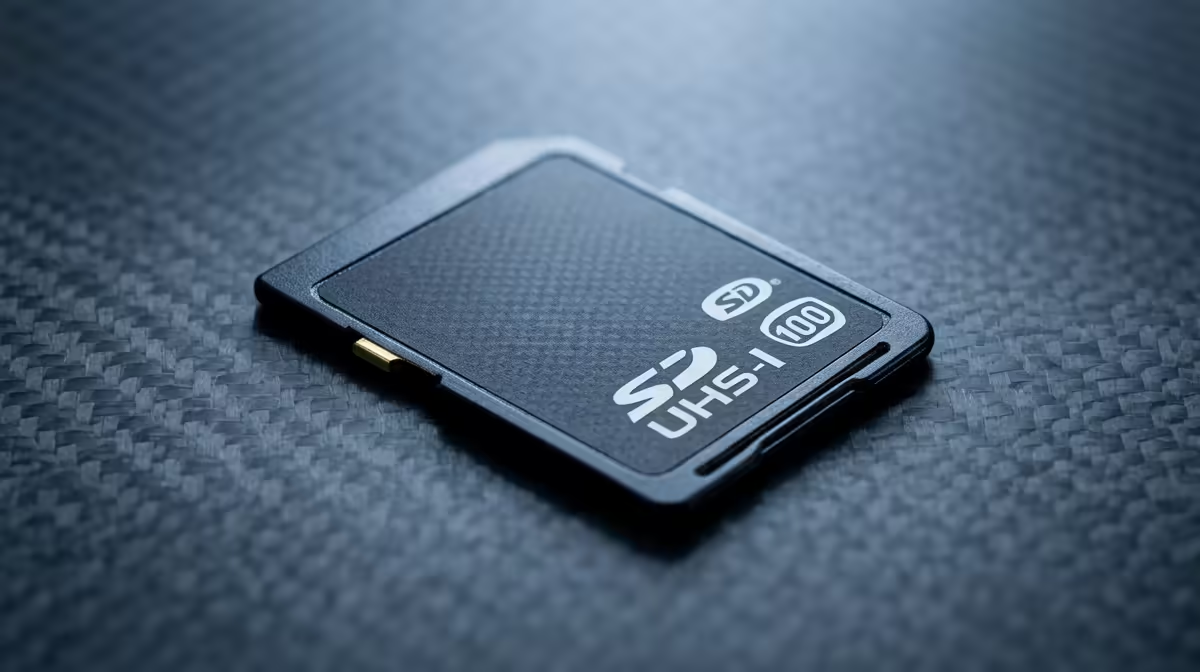
Most 4K recording workflows need only UHS-I: its 104MB/s ceiling handles 4K H.265 at bitrates up to 830Mbps in theory, far above any consumer camera codec. UHS-II (312MB/s) and CFexpress (1,700MB/s+) become relevant only for very high bitrate professional recording or for cutting offload time significantly. Buy the bus speed your camera's slot supports, not the highest available.
What UHS-I Actually Delivers in Real Use 📊
UHS-I (Ultra High Speed Phase I) operates on a single-row contact interface and peaks at 104MB/s theoretical read speed. In practice, consumer UHS-I SDXC cards reach 60MB/s to 95MB/s sequential read speeds with compatible card readers. For in-camera 4K recording, the write speed matters: V30 certified UHS-I cards write at a minimum of 30MB/s sustained, which exceeds the data rate of 4K H.264 or H.265 at bitrates up to 240Mbps (30MB/s). Consumer cameras including the Sony ZV-E10 II at 4K 30fps (60Mbps), DJI Mini 4 Pro at 4K 60fps (150Mbps), and GoPro Hero 13 at 5.3K 60fps (120Mbps) are all well within UHS-I V30 territory.
When UHS-II Is Worth the Price Premium 🔧
UHS-II adds a second row of contacts and pushes to 312MB/s theoretical speeds. The recording benefit only materialises for cameras with UHS-II slots recording at 200Mbps+ in ALL-Intra codecs: Sony FX30 in XAVC S-I 4K, Canon EOS R5 in 8K RAW, Fujifilm GFX100S II at high bitrates. For the typical South African content creator using a consumer mirrorless or drone, the camera's slot is UHS-I and a UHS-II card provides zero in-camera recording benefit. Where UHS-II earns its premium is offload speed: a UHS-II card in a compatible card reader transfers footage to the editing laptop at up to 250MB/s, cutting 128GB offload from 22 minutes (UHS-I at 95MB/s) to under 9 minutes. If same-day turnaround on edited content is a commercial requirement, this time saving justifies the R200 to R500 price premium per card.
CFexpress, SDUC and Formats Beyond UHS-II 🚀
CFexpress Type A and Type B cards use PCIe lanes rather than SD contacts and achieve 1,700MB/s to 4,000MB/s speeds. They are required for 8K RAW on Sony and Canon professional bodies. CFexpress slots are found on Sony A7 IV, Canon EOS R3, and similar professional cameras; they are not present on consumer cameras or drones. SDUC (SD Ultra Capacity) extends the SD spec to support cards above 2TB and UHS-III speeds, but consumer SDUC cards and compatible slots are not yet in wide circulation. For South African videographers working below R2,500 per camera body, UHS-I V30 is the practical spec; above that, check whether the specific camera body has a UHS-II slot before spending on premium cards.
Read Speed on the Box vs Card Reader Compatibility ⚡
A UHS-I card rated at 170MB s read speed (common on marketing packaging) only achieves that speed through a compatible USB 3.2 UHS-I optimised card reader. Through a standard USB 2.0 reader or a built-in laptop SD slot that only supports UHS-I at its base mode (25MB s), the same card reads at a fraction of its rated speed. The bottleneck is always the reader slot, not the card itself.
FAQ
Is UHS-II worth buying for a DJI Mavic 3 Pro?
No. The DJI Mavic 3 Pro uses a microSD slot rated for UHS-I.
Do all SD card readers support UHS-II?
No. Most built-in laptop SD slots and standard USB card readers are UHS-I only.
Should student filmmakers at South African universities invest in UHS-II cards?
For student production work where the cameras are UHS-I consumer bodies or university-issued DSLRs, UHS-I V30 cards are perfectly adequate and significantly more affordable. UHS-II becomes relevant when working with professional cinema bodies in advanced production courses or paid commercial work.
Matching your card to your camera's actual capabilities?
Evetech stocks SD and microSD cards across UHS-I V30, UHS-II V60, and V90 speed classes. Browse the full memory card range at Evetech to get the right spec without overpaying.