Running a chatbot on your own machine instead of the cloud comes down to one resource: how much fast memory the model can sit in. That is where the unified memory of Apple Silicon and the dedicated VRAM of a discrete GPU take completely different routes to the same goal. A 64GB M-series Mac can load models that would otherwise need an expensive high-VRAM card, while a Windows PC with a good GPU is usually the cheaper, faster path for most local AI work.
Quick Answer
For local AI chat, Apple Silicon's unified memory lets all your system RAM act as VRAM, so a 64GB M-series Mac runs large models without a separate graphics card. On Windows, a dedicated GPU with its own VRAM is the more cost-efficient and often faster choice for most users. Macs win on large models cheaply; PCs win on raw speed and value per rand.
Why Memory Is the Bottleneck
Before a language model can respond, its weights must be held in fast memory. If the model fits, inference proceeds normally. If it does not, the model either fails to load or overflows into slower system RAM and slows to a crawl. The real question for local AI is therefore not raw chip speed, but how much fast memory the model can occupy.
This is exactly where the two architectures diverge. They solve the memory problem in opposite ways, and that difference decides which machine suits which job.
How Unified Memory Works
Apple Silicon uses a single unified pool that both the CPU and GPU draw from. There is no separate block of VRAM reserved for graphics alone. Every gigabyte is available to whichever task needs it, meaning a 64GB M-series Mac can hand the bulk of that capacity to a language model.
The Big Advantage
This is a genuine edge for large models. To match a 64GB Mac on a PC, you would need a graphics card with a very large amount of dedicated VRAM, and consumer cards with that much memory are scarce and costly. A well-specced Mac can load big models that would otherwise demand professional-tier hardware, which makes it a tidy option for anyone who wants to experiment with larger local models without a sprawling build.
The Trade-Off
Shared memory does not mean unlimited memory. Whatever the model uses is taken away from everything else your Mac is doing, and the raw memory bandwidth and compute, while strong, still trail a high-end discrete GPU on pure throughput. Unified memory wins on capacity for the money, not necessarily on speed.
How a Dedicated GPU Works
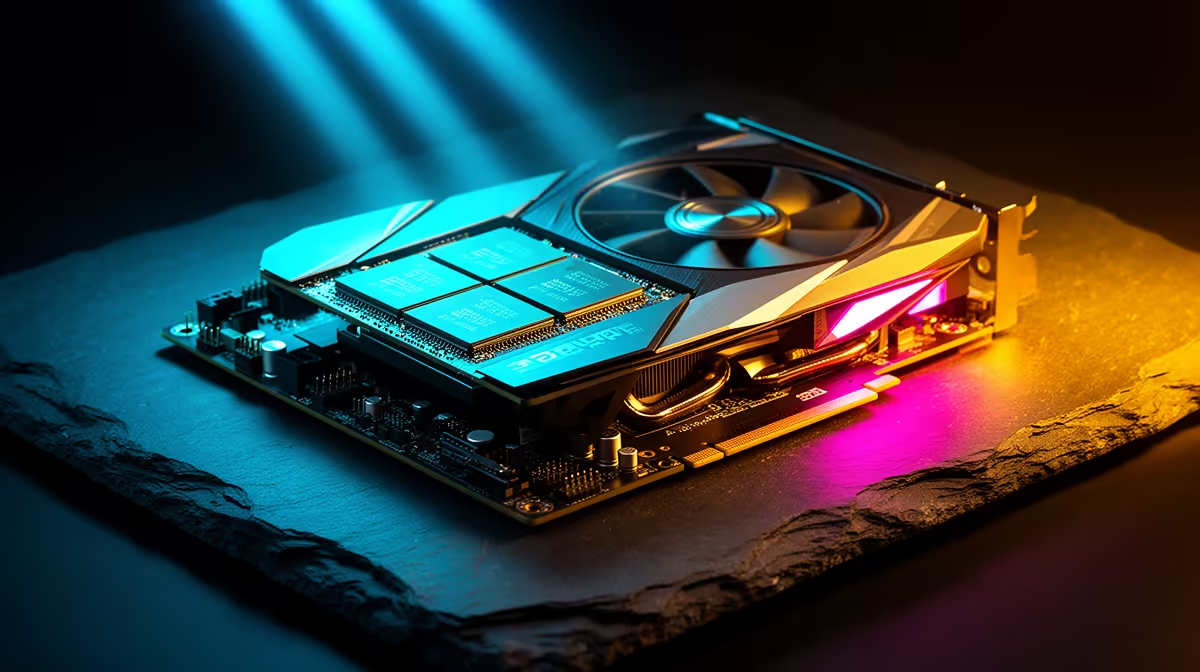
A discrete GPU brings its own VRAM, soldered to the card and extremely fast. The model loads into that dedicated memory and the GPU's many cores process it at high speed.
The Big Advantage
For raw performance per rand, this is usually the stronger route. If your chosen model fits inside the card's VRAM, a dedicated GPU typically generates responses faster than a Mac of similar price, and you can upgrade or swap the card later. For most users running mainstream model sizes, a PC with a capable GPU delivers more speed for the money.
The Trade-Off
The ceiling is the card's VRAM. Once a model is too big to fit, performance falls off a cliff as it spills into system RAM, and buying a card with enough VRAM to rival a 64GB Mac is expensive. You get speed, but capacity costs you.
Beyond Memory: The Other Factors
Speed of Responses
Capacity decides whether a model runs at all, but memory bandwidth and compute decide how fast it answers. A high-end discrete GPU has enormous memory bandwidth feeding thousands of cores, so for a model that fits its VRAM it often returns text faster than a Mac. Apple Silicon's bandwidth is strong for an integrated design but generally trails a top discrete card, so the Mac's edge is loading big models, not necessarily answering quickest.
Power, Noise and Heat
A Mac sips power and stays near silent, which is genuinely pleasant if the machine lives on your desk and runs models often. A PC with a powerful GPU draws far more power and needs real cooling, so it runs hotter and louder under load. For always-on local AI in a quiet room, the efficiency of Apple Silicon is a real, if less obvious, advantage.
Software and Ecosystem
The local AI tooling landscape moves fast on both platforms, and most popular runtimes support Mac and Windows. That said, the broadest selection of cutting-edge tools and the earliest support for new techniques often appears on the GPU-driven PC side first, simply because that is where most of the community builds. If you want to be on the bleeding edge, a PC keeps more doors open; if you want a stable, efficient setup, the Mac is very capable.
Which Should You Choose
Pick the Mac route if you want to run unusually large models, value a quiet, compact, low-power machine, and are happy to pay for memory capacity. Pick the PC route if you want the most speed per rand for mainstream model sizes, want the freedom to upgrade the GPU later, and do not need to load the very biggest models.
For most South African buyers running everyday local chat and coding assistants, a PC with a solid dedicated GPU is the more cost-efficient pick. The Mac becomes compelling specifically when model size, silence and efficiency outweigh raw cost. Machines built specifically for this kind of work are catalogued on the AI PC range at Evetech, and for a broader view of complete systems the PC best sellers at Evetech show how current popular builds are configured.
Frequently Asked Questions
Can unified memory really replace a dedicated GPU for AI?
For capacity, yes. A 64GB Mac can load large models that would need a costly high-VRAM card. For raw speed on models that fit a GPU's VRAM, a dedicated card usually still pulls ahead.
Why can a Mac run bigger models than many PCs?
Because all of its memory can act as VRAM. A 64GB Mac can devote most of that to a model, whereas matching it on a PC needs a graphics card with a rare and expensive amount of dedicated VRAM.
Is a PC or a Mac better value for local AI?
For mainstream model sizes, a PC with a capable dedicated GPU generally offers more speed per rand and the option to upgrade later. The Mac's value shows specifically when you need to load very large models.
What happens if a model is too big for my GPU's VRAM?
It spills into slower system RAM and performance drops sharply. The card's VRAM is a hard ceiling, which is why VRAM capacity matters as much as the GPU's speed for local AI.
How much memory do I need for local AI chat?
Smaller chat models run comfortably in modest VRAM, but larger models want a lot. Aim for as much fast memory as your budget allows, since memory capacity is the main thing that decides which models you can run.
Deciding between a high-memory Mac and a GPU-driven PC for local AI? Compare AI PCs and complete systems at Evetech and match the hardware to the model sizes you actually want to run.