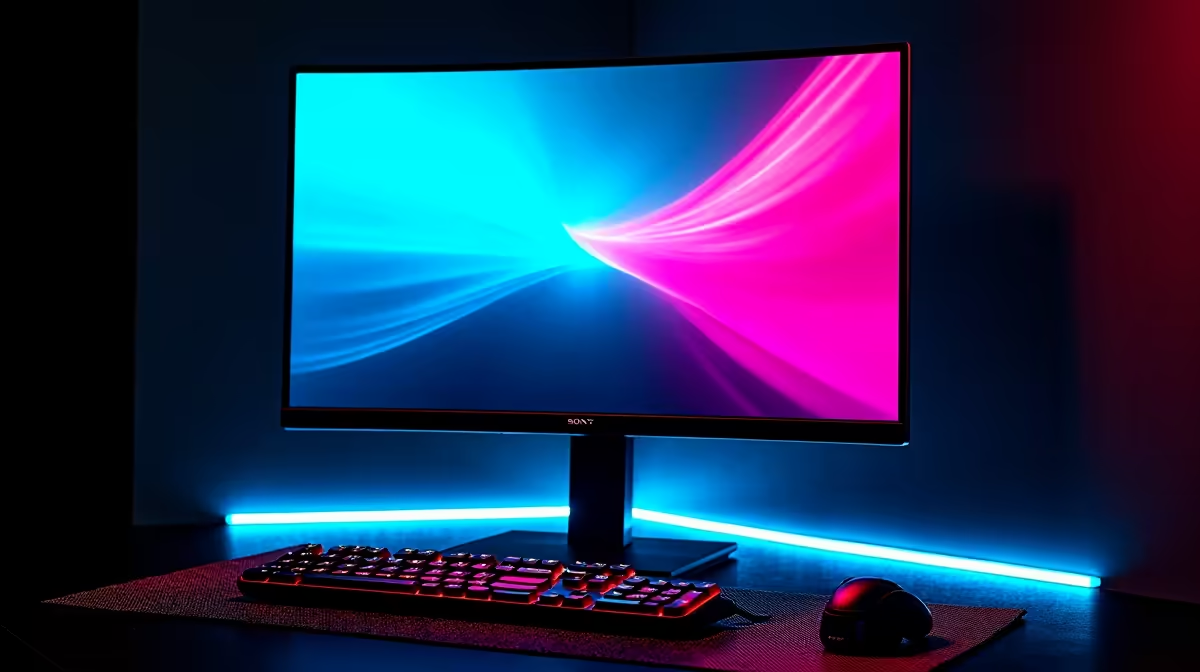
Budget GPU upgrades get most of the attention in SA gaming circles, but the display is the component you stare at for every single second of every session. Upgrading from a years-old 60Hz TN panel to a high frame rate IPS monitor transforms how a gaming rig feels even when nothing inside the case changes. The SA market now has genuinely capable options starting under R3,500, and knowing which compromises matter opens up clear decisions.
Quick Answer
Budget 144Hz IPS gaming monitors start around R3,000 for 24-inch 1080p in South Africa. Spend between R3,000 and R5,000 and you land in the range with fast refresh, decent IPS colour, and FreeSync support. Keep resolution at 1080p to give mid-range hardware the best chance of actually hitting 144 FPS.
💰 What Budget IPS Means in the SA Market
The South African monitor market reflects global pricing with a rand premium attached, so understanding where the value segments land locally is more useful than citing USD specifications. Entry-level 24-inch 1080p 144Hz IPS panels are available from around R3,000. The R3,500 to R4,500 bracket gets you a stronger selection with better verified response times and slightly more consistent colour out of the box.
Moving to 27-inch at 1080p stretches the budget to roughly R4,500 to R5,500 for IPS 144Hz options. The larger size at 1080p reduces sharpness from 92 pixels per inch on a 24-inch panel to about 81 pixels per inch on a 27-inch, which becomes visible when reading text at close range. For competitive gaming where most targets are in motion, the difference is less noticeable than at a productivity desk.
The case for staying at 24 inches on a strict budget is pixel density. 92 PPI keeps the image sharp and clean, and the smaller footprint suits compact desks. Spend the saved money on a quality mouse and pad combination rather than screen size.
🔧 IPS Versus VA on a Tight Budget
Both technologies appear in this price range, and the choice is not always straightforward. IPS panels deliver accurate colour, consistent brightness across viewing angles, and typically cleaner motion in dark scenes. The black levels are shallower than VA, which produces richer contrast, but IPS avoids the dark-to-dark smearing that can plague budget VA gaming panels.
In competitive titles where maps include dark corridors, shadowed buildings, and night environments, VA smearing can make it genuinely harder to spot moving enemies in those zones. That is a functional disadvantage rather than a cosmetic one. IPS keeps dark transitions cleaner, which matters for the scenarios where visibility is a competitive factor.
Budget VA panels also vary more between units in terms of colour uniformity and panel lottery outcomes. IPS tends to be more consistent within a given model's production run. For a buyer who cannot inspect the panel before purchasing, that consistency reduces the risk of a disappointment.
The IPS disadvantage is contrast ratio. A budget IPS panel measures around 800:1 to 1000:1, which is noticeably lower than a VA panel in the 2500:1 to 4000:1 range. In a dark room the difference in black depth is real. For an IPS at a well-lit gaming desk, the lower contrast is barely noticeable.
⚡ Getting 144 FPS on Mid-Range SA Hardware
A monitor is only as useful as the frame rate the GPU can sustain. A 144Hz panel on a system running 55 FPS in its primary title is a 55Hz monitor for most of that session.
The combination of an RTX 4060 or RX 7600 series GPU with a Ryzen 5 or Core i5 class CPU hits 144 FPS in competitive titles like Valorant, CS2, and Overwatch 2 at 1080p high settings reliably. In more demanding games like Cyberpunk 2077 or Red Dead Redemption 2, those cards land in the 90 to 110 FPS range at quality settings, which still benefits strongly from adaptive sync keeping the output smooth across that range.
An older card like an RX 5600 XT or RTX 2060 delivers respectable 1080p performance in competitive titles, though demanding games may require settings reductions to approach 144 FPS. At 1080p the GPU overhead requirement is about 44 percent lower than at 1440p, which is exactly why keeping resolution at 1080p on a budget build makes the frame rate target attainable on hardware that SA gamers already own.
Dropping to 100Hz to save money is rarely worthwhile. The price gap between 100Hz and 144Hz in the SA market has narrowed to the point where 144Hz panels are often similarly priced or marginally more expensive. The jump from 60Hz to 144Hz is the single most noticeable display upgrade most gamers will make. Going to 100Hz instead means taking most of the cost while landing short of the full benefit.
✨ FreeSync, Adaptive Sync, and OSD Settings
Adaptive sync, labelled FreeSync on most budget panels, is standard across almost the entire 144Hz IPS segment. Nearly every panel in the R3,000 to R5,000 range includes it across a 48Hz to 144Hz range, so paying a premium to get it is unnecessary. FreeSync eliminates screen tearing without the input lag penalty of V-Sync, and keeps the output smooth as GPU frame rates fluctuate between 80 FPS and 130 FPS during scene changes.
NVIDIA GPU owners should verify G-SYNC Compatible certification on the shortlisted model. Many uncertified panels work correctly with NVIDIA hardware, but certification confirms NVIDIA has tested the implementation.
Most budget IPS panels ship with three or four overdrive presets. The fastest setting produces halos ahead of moving objects at maximum voltage. Start at Medium and move up one step while watching a fast panning scene. Stop before halos appear. That level delivers clean, fast transitions without the overshoot artefact.
Pro Tip ⚡
When budgeting a monitor upgrade in SA, set aside R200 to R400 for a quality DisplayPort 1.4 cable. Some budget panels ship without one. DisplayPort carries the full 1080p 144Hz signal with adaptive sync reliably, and a quality cable costs far less than troubleshooting intermittent signal drops later.
Frequently Asked Questions
What does a budget 144Hz IPS gaming monitor cost in SA?
Entry 24-inch 1080p 144Hz IPS panels start around R3,000. A stronger selection with verified response times opens up between R3,500 and R4,500. Moving to 27-inch IPS 144Hz pushes to roughly R4,500 to R5,500. Panels under R3,000 are typically VA or TN rather than IPS, so confirm the panel technology before buying at a very low price.
Is IPS worth paying more for than a budget VA panel?
For dark fast-moving scenes, yes. Budget VA panels can exhibit smearing when transitioning between similar dark shades, creating a smudge in shadowed game environments where enemy visibility matters. IPS handles those transitions more cleanly and holds colour consistency across wider viewing angles. For a gaming desk where the monitor sits directly in front, IPS is the safer choice at comparable prices.
Should I stay at 1080p or stretch to 1440p on a tight budget?
1080p at 144Hz gives mid-range SA hardware the best chance of hitting the refresh ceiling consistently. The GPU works about 44 percent less hard per frame at 1080p than at 1440p. 1440p looks sharper but demands a stronger card to sustain 144 FPS. Unless the GPU can hold 144 FPS at 1440p in the main titles, 1080p produces smoother results in practice.
Do budget IPS panels support adaptive sync?
Yes. FreeSync across a 48Hz to 144Hz range is standard on virtually all budget 144Hz gaming monitors. NVIDIA GPU owners should check for G-SYNC Compatible certification on the specific model. Many uncertified panels work fine with NVIDIA hardware, but certification confirms the implementation has been validated.
Which screen size is the better buy at a tight budget?
24 inches at 1080p delivers 92 PPI, sharp enough for gaming at 60 to 70cm distance. 27 inches at 1080p drops to 81 PPI, which softens text. On a strict budget where both sizes cost similarly, the 24-inch is the sharper pick. Stretching to 27-inch at 1440p (around R5,000 to R6,500) resolves the sharpness issue entirely.
Ready to upgrade to 144Hz IPS gaming?
Browse the budget gaming monitor range for fast IPS panels that bring high frame rate gaming to SA rigs without requiring a premium spend.