

Complete Gaming Setup Guide for the SA Esports Athlete in SA 2026
Complete Gaming Setup Guide for the Esports. Clear setup instructions with SA-specific considerations, troubleshooting tips & recommended components.
Read moreTroubleshoot USB-C handshake issues on Dell laptops with our expert tips 🔧. 🚀 Boost performance and connectivity today!
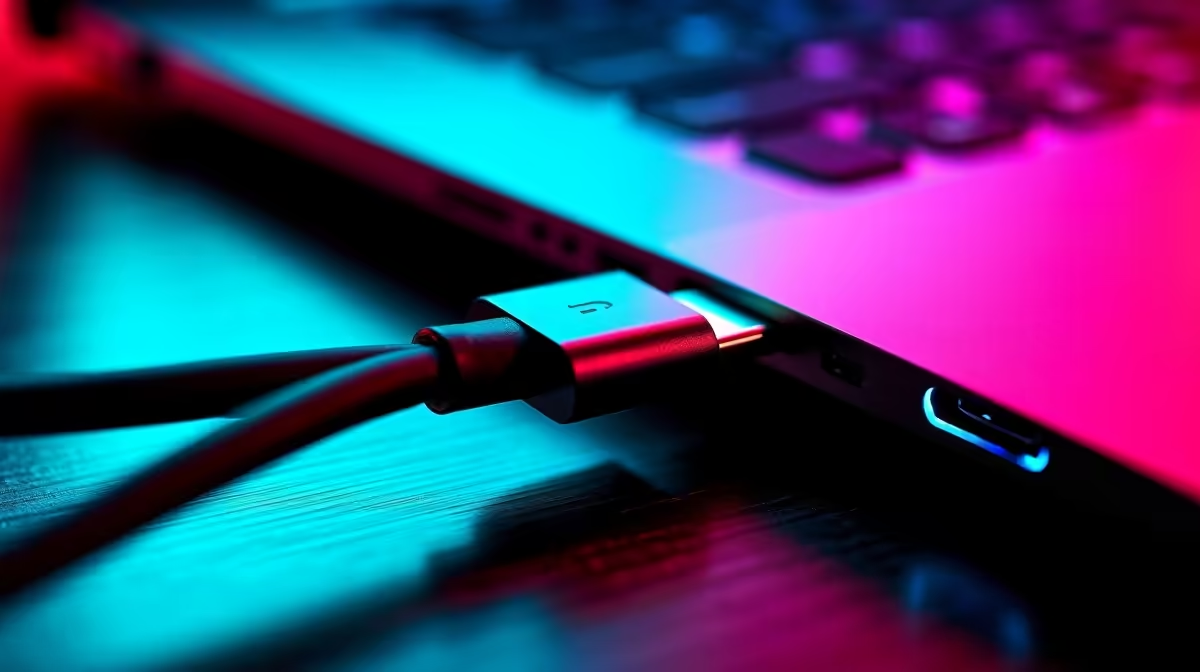
You’ve plugged your shiny new monitor into your Dell laptop with a single, elegant USB-C cable. You’re ready for that clean, one-cable setup. But… nothing. Just a black screen and a “No Signal” message. Sound familiar? These frustrating USB-C handshake issues on Dell laptops are a common headache for many South African gamers and professionals. Before you start pulling your hair out, we’ve got a few quick fixes that usually solve the problem. ⚡
So, what exactly is a "handshake"? Think of it as a digital greeting. When you connect a USB-C device, your Dell laptop and the monitor quickly exchange information to agree on things like power delivery, data speed, and—most importantly for your display—the video signal (using a protocol called DisplayPort Alternate Mode).
A USB-C handshake issue occurs when this conversation fails. Your laptop might not recognise the monitor, or it might fail to send the video signal correctly. This can happen for several reasons, from a dodgy cable to outdated software.
Let's get straight to the solutions. Work your way through these steps to resolve those pesky Dell laptop USB-C problems.
This is more than just a simple restart. A full power cycle drains any residual electricity that might be causing a glitch in the hardware controllers.
Not all USB-C cables are created equal. The one that came with your phone is likely just for charging and won't carry a video signal. You need a cable that explicitly supports DisplayPort Alternate Mode or is a Thunderbolt 3/4 certified cable. A low-quality cable is a primary cause of USB-C handshake issues.
Also, give the ports a quick clean with a puff of compressed air to remove any dust that could be interfering with the connection. A reliable cable is a small investment for a stable setup, and you can find a range of certified cables and other monitor accessories to guarantee a perfect link.
Manually hunting for drivers is a drag. Dell has a free tool called SupportAssist (or Dell Command | Update for business models) that automatically scans your laptop and installs the latest BIOS, firmware, and driver updates. This is often the magic bullet for fixing Dell USB-C handshake problems.
Dell frequently releases updates that improve hardware compatibility and fix known bugs. An outdated BIOS (the fundamental software that runs your laptop's hardware) or graphics driver is a very common culprit.
If you've tried all the steps above and your Dell laptop still won't connect, it might be time to consider if your display is the weak link. Technology moves fast, and modern PC monitors are designed with better compatibility protocols from the get-go.
An older monitor might not fully support the power delivery or DisplayPort standards your Dell laptop is trying to use. This is especially true for high-resolution 5K & 4K monitors that push a huge amount of data through that single USB-C port. Even versatile portable monitors rely on a flawless handshake to function on the go.
Sometimes, upgrading your screen is the simplest long-term solution. Whether you're after the immersion of the latest curved monitors or simply a reliable display that just works, a new screen can eliminate these connection headaches for good. For a massive selection, check out our full catalogue of all gaming monitors to find the perfect match for your Dell setup. 🚀
Upgrade Your View and Ditch the Drama
Stop fighting with connection issues and get a monitor that works seamlessly with your Dell laptop. Check out the best PC monitor deals in South Africa and enjoy a flawless, plug-and-play experience.
Check for intermittent charging/data transfer or error messages. A faulty handshake often causes connectivity problems.
Try resetting the SMC chip or updating firmware/drivers regularly. These steps address common handshake failures.
Yes! Use certified cables. Test different ones to rule out physical connection issues before hardware repair.
Disable/re-enable USB-C power delivery in BIOS settings. This often resolves handshake negotiation errors with devices.
Use Dell Diagnostic tools (SupportAssist) and multi-meter tests for port voltage irregularities causing handshake issues.
Replace ports if reseating/reprogramming fails. Physical damage or persistent handshake errors indicate hardware replacement needs.
Outdated firmware causes handshake incompatibility. Update Thunderbolt firmware via Dell's official website regularly.
Complete Gaming Setup Guide for the Esports. Clear setup instructions with SA-specific considerations, troubleshooting tips & recommended components.
Read more
AIO Liquid 360mm Installation Guide for Your PC. Clear setup instructions with SA-specific considerations, troubleshooting tips & recommended components.
Read more
MacBook Display Colour Looks Wrong? Calibration. Everything you need to know with SA pricing, step-by-step instructions & expert recommendations.
Read more
Printer Terminology Guide. Everything you need to know with SA pricing, step-by-step instructions & expert recommendations.
Read more
Git on Mac: Complete Setup Guide for Beginners. Clear setup instructions with SA-specific considerations, troubleshooting tips & recommended components.
Read more
Ryzen 9 9900X Thermal Paste Dry: Reapplication. Everything you need to know with SA pricing, step-by-step instructions & expert recommendations.
Read more
AMD RX 9050 XT: Rumoured Specs, Price & Release. SA-focused analysis with local pricing data, real-world insights & actionable buying advice.
Can RTX 4080 Super Run AI Workloads for SA Developers Detailed answer with SA data, expert analysis & practical recommendations for local buyers.
Can RTX 4090 Run AI Workloads for SA Developers Detailed answer with SA data, expert analysis & practical recommendations for local buyers.
Top Settings for Intel Arc B580 at Ultrawide 1440p picks evaluated on performance, value & SA availability with current Rand pricing from Evetech.
RTX 4060 CS2 Low Settings at 1080p: FPS Results. Real-world benchmark data, FPS numbers & performance analysis. What SA gamers can actually expect.
Visual Artifacts: Possible GPU Issue Issue #1. Diagnosis steps, proven fixes & when to seek professional help. SA-specific support info included.
Can the RTX 4090 Handle 1440p 144Hz Gaming. Performance testing verdict with real data & practical recommendations for SA buyers.
Top ASUS GPU Under R15000 picks evaluated on performance, value & SA availability with current Rand pricing from Evetech.
GTA 6 Max Settings on RTX 5070. Tested & verified settings for best FPS and visual quality on SA hardware budgets.
Cyberpunk 2077 Max Settings on RTX 5080. Tested & verified settings for best FPS and visual quality on SA hardware budgets.
Starfield Max Settings on RTX 5070 Ti. Tested & verified settings for best FPS and visual quality on SA hardware budgets.
Top RTX 5090 Under R5000 picks evaluated on performance, value & SA availability with current Rand pricing from Evetech.