Quick Answer
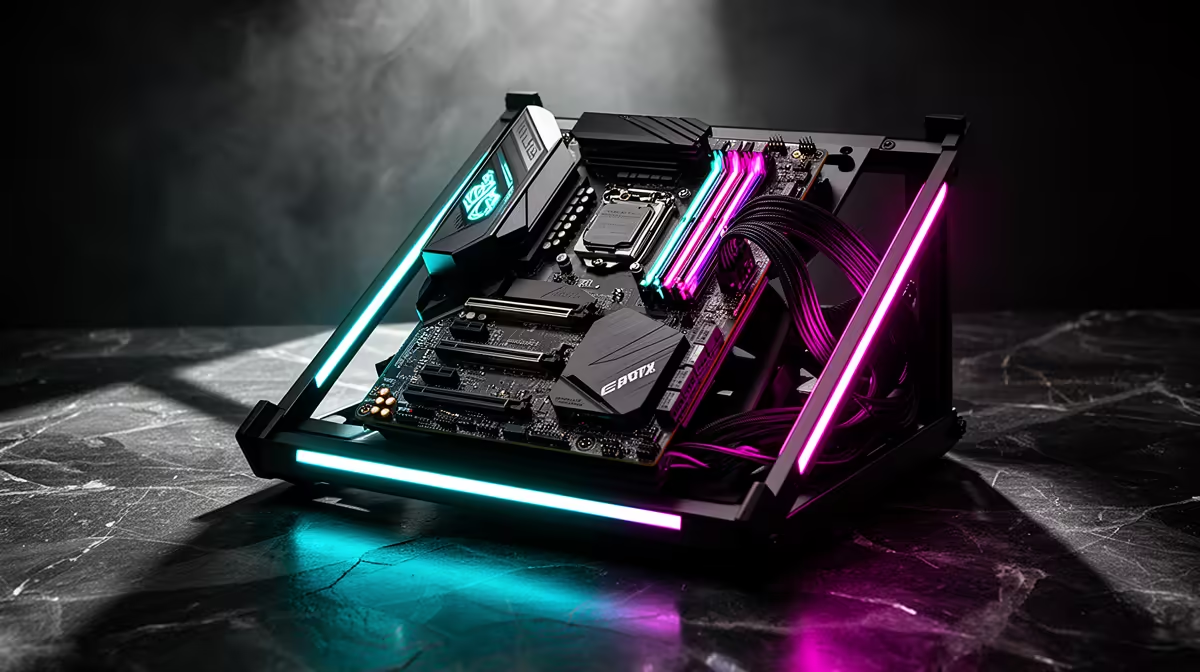
Cable clutter in E-ATX gaming builds is caused by more power connectors than standard ATX boards require, longer cable runs to far-corner connectors, inadequate behind-tray routing space, and non-modular PSU designs forcing unused cables into the main chamber. Using a fully modular PSU, planning cable routes before installing components, and choosing a case with 25mm or more behind-tray space eliminates most clutter before it starts.
Why E-ATX Boards Generate More Cable Complexity 🔧
A standard ATX board requires one 24-pin ATX power connector and one 8-pin EPS CPU connector. A high-end E-ATX board may require two 8-pin EPS CPU connectors, adding a second thick cable running from the PSU to the top-left corner of the board. On an E-ATX board that is 330mm wide, this cable run is 60 to 85mm longer than on a standard ATX board, making neat routing through behind-tray channels substantially harder.
E-ATX builds frequently use the 16-pin 12VHPWR GPU connector. This cable is stiff and thick, making it difficult to route cleanly without a right-angle adapter that allows the cable to exit parallel to the board rather than bending across the GPU surface.
Planning Cable Routes Before Components Go In 📋
The single most effective cable management technique is planning the routing path before the motherboard is installed. Lay the case on its side with the motherboard tray facing up. Run each cable from its estimated PSU exit point through the relevant tray grommet to the destination connector before tightening any cable ties. This reveals conflicts and tight bends before they are hidden behind components.
For E-ATX builds, thread the two EPS CPU cables through the top-rear grommet before fitting the board. Once the board is seated, access to that grommet is blocked by the large board area and CPU cooler. Starting the EPS cables pre-routed saves 15 to 20 minutes of frustration and results in cleaner routing than any after-the-fact solution.
Case Features That Prevent E-ATX Cable Clutter 🖥️
Choose a full-tower case with a minimum of 25mm behind-tray routing space, eight or more cable-tie anchor points, a full PSU shroud, and grommetted pass-throughs at multiple vertical positions. Cases with cable channels moulded into the back panel provide natural routing paths that keep cables separated and parallel.
A fully modular PSU is non-negotiable for clean E-ATX builds. Non-modular PSUs include every cable permanently, meaning unused SATA, molex, and PCIe cables must be stuffed somewhere. In an E-ATX build, this unused bundle can overflow the PSU shroud and disrupt the main airflow chamber.
E-ATX Cable Pre-Planning Tip ⚡
Before ordering a PSU for an E-ATX build, confirm that the two EPS CPU cables are individually detachable in a modular configuration. Some modular PSUs output both CPU cables from a shared single socket. Individual EPS cable sockets allow each cable to be routed through a separate grommet for a cleaner result.
FAQ
Can sleeved cable extensions help with E-ATX cable management?
Yes, significantly. Sleeved extensions are thinner, more flexible, and visually cleaner than stock PSU cables. They come in colour-matched sets for white or black builds and make a visible improvement through the glass panel.
What is the minimum behind-tray routing space for an E-ATX build?
25mm is the practical minimum. Below 25mm, sleeved cables and double EPS runs cannot sit flat behind the tray, causing bulges that prevent the back panel from closing fully.
Is cable management harder in an E-ATX build than a standard ATX build?
Yes, primarily because of longer cable runs and additional power connectors. With a fully modular PSU and adequate case routing space, an experienced builder can produce a clean E-ATX build, but the process takes 30 to 60 minutes longer than an equivalent ATX build.
Planning a clean E-ATX build with no cable clutter?
Evetech stocks full-tower cases with deep cable routing channels, PSU shrouds, and multiple grommet positions to keep even the most cable-heavy E-ATX builds organised.