Quick Answer
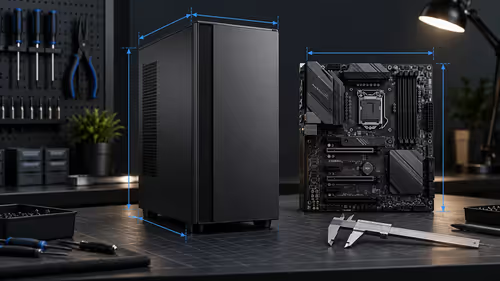
Clearance problems in EATX builds arise because EATX motherboards extend 305 mm wide versus the 244 mm of ATX, pushing the right edge of the board closer to the PSU shroud and the GPU cooler closer to the front fans or radiator. Combined with triple-slot GPUs exceeding 340 mm in length, the result is a geometry puzzle where standard ATX cases simply lack the physical volume to accommodate all components safely.
The Geometry of an EATX Build 📐
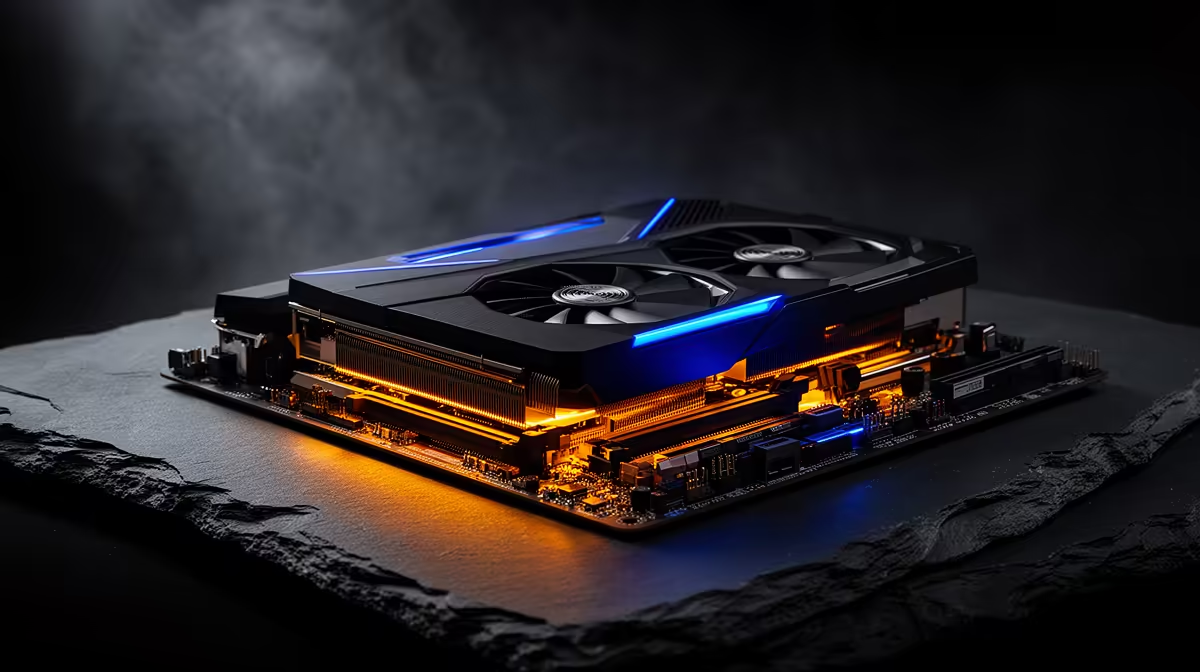
An EATX motherboard requires a case with a minimum internal width of around 270 mm from the motherboard tray to the right side panel. Most ATX cases offer only 180 mm to 220 mm of internal width, so the extra 61 mm of EATX board width immediately disqualifies them. Beyond width, EATX boards often have VRM heatsinks, M.2 covers, and PCIe reinforcement brackets that extend 10 mm to 15 mm above the top edge of the board, directly conflicting with top-mounted radiator brackets. Builders pairing an ASUS ROG Maximus Z890 Apex EATX board with an RTX 5090 frequently discover the GPU's triple-slot cooler protrudes forward past the front fan bracket by 5 mm to 15 mm, blocking 120 mm fan positions entirely.
GPU Length vs. Front Panel Clearance 🔧
GPU clearance in a case is measured from the PCIe slot backplate to the inside face of the front panel or front fan bracket. This dimension varies considerably: a standard ATX mid-tower offers 310 mm to 340 mm, while a purpose-built EATX full-tower offers 380 mm to 430 mm. The RTX 5090's reference Founders Edition card measures 336 mm, placing it at or beyond the safe zone in most mid-towers. With an EATX board installed, the PCIe slot moves slightly forward relative to the front panel, reducing effective GPU clearance by another 10 mm to 20 mm depending on the case design. The practical rule is to confirm front GPU clearance of at least 360 mm for any triple-slot flagship when using an EATX board.
PCIe Riser Cables and Their Clearance Trade-Offs 🖥️
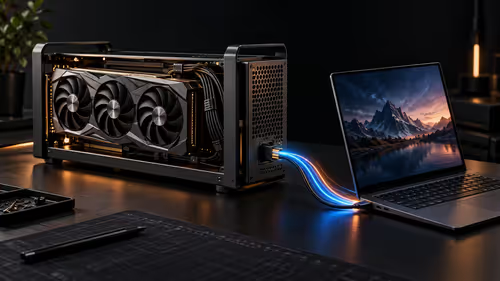
Some builders use vertical PCIe riser cables to rotate the GPU 90 degrees, which solves the front-panel length problem but introduces new clearance challenges. The card now sits 30 mm to 50 mm from the side panel glass, requiring 10 mm to 15 mm more GPU cooler clearance than specified since hot exhaust needs room to exit. Riser cables also add R600 to R1,200 to the build cost for quality PCIe 4.0 or 5.0 versions, and low-quality risers can introduce signal integrity issues at PCIe 5.0 bandwidth. For EATX builds in South Africa, a case designed specifically for EATX format is almost always a cleaner solution than retrofitting riser cables into an undersized chassis.
Measure Before You Buy ⚡
Before purchasing a GPU or case, note the EATX board's PCIe slot position from the front edge of the motherboard tray. Add the GPU length to this number and compare it against the case's stated front GPU clearance spec. A 10 mm buffer is the minimum; aim for 20 mm or more to allow airflow around the GPU front face.
FAQ
Can I fit an EATX board in a standard ATX mid-tower?
Rarely and never without compromise. The side panel typically cannot close, or standoff screws are misaligned. Only a handful of mid-towers advertise "EATX compatible" with verified fitment, and they usually sacrifice top radiator support or PCIe slots to achieve it.
Does an EATX board affect RAM clearance for large CPU coolers?
Yes. EATX boards sometimes have the first two DIMM slots closer to the CPU socket than ATX designs, and tall DDR5 heatspreaders can foul 120 mm tower cooler fan blades. A 240 mm or 360 mm AIO cooler eliminates this conflict entirely.
What case dimensions guarantee EATX and RTX 5090 compatibility?
Look for a case advertising at least 380 mm GPU clearance, 305 mm motherboard width support, and a chassis interior volume above 55 litres. Full-tower designs from Fractal Design, Lian Li, and Corsair meeting these specs are stocked locally.
Planning an EATX flagship build?
Evetech stocks EATX-compatible full-tower cases and the latest EATX motherboards to ensure a clean, compatible build from the start.