Quick Answer
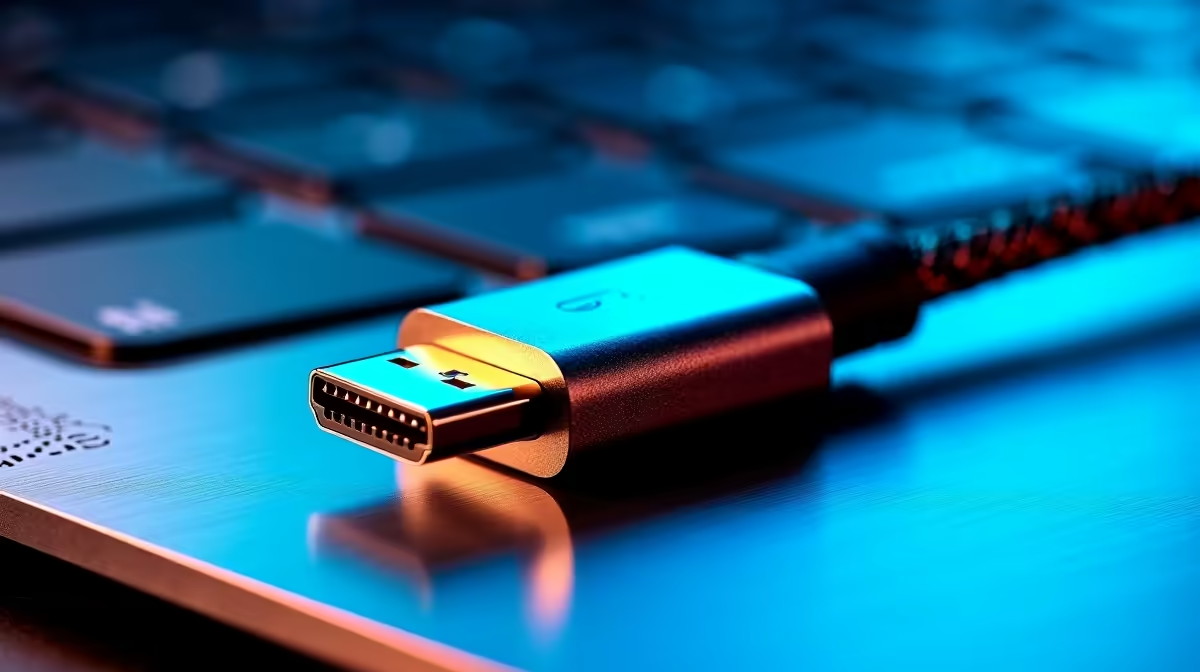
Four features determine 4K 60Hz stability in a Mini DisplayPort to DisplayPort cable: a DisplayPort 1.2 or higher rated conductor set, gold-plated connectors, a shielded cable construction (foil and braid), and cable length at or under 2m for passive copper designs. Any cable meeting these four criteria will deliver stable 4K 60Hz output without flicker or dropouts.
Bandwidth: The Foundation of 4K 60Hz 🖥️
DisplayPort 1.2 carries 17.28 Gbps of usable bandwidth. The raw data requirement for 4K UHD (3840x2160) at 60Hz with 8-bit colour is approximately 12.54 Gbps, leaving a comfortable margin. A cable that meets DP 1.2 specification handles this without compression. Cables sold without a DP version rating are frequently manufactured to lower tolerances and may pass 4K at 30Hz but fail at 60Hz due to conductor resistance exceeding the specification limit. Always confirm the DP version on the product page or packaging. This applies to Mini DisplayPort cables in the same way as full-size DP cables since the electrical standard is identical.
Connector Quality and Shielding 🔌
Gold-plated connector pins maintain contact resistance below 10 milliohms, which is necessary for sustained high-bandwidth signalling. At 12.54 Gbps, elevated contact resistance from oxidised nickel pins causes intermittent bit errors that appear as single-pixel flickering or brief black frames. Triple shielding, specifically aluminium foil, copper braid, and drain wire, prevents EMI from Wi-Fi routers and power cables from corrupting the signal path. In a South African home office where a router is often placed near the monitor setup, the foil-plus-braid combination provides 40 to 60 dB more EMI rejection than an unshielded cable. This is the most common cause of 4K instability that is wrongly blamed on the GPU or display.
Length and Quality Verification for SA Buyers 🔧
Passive copper Mini DisplayPort cables rated for 4K 60Hz perform reliably up to 2m. At 3m, signal integrity depends heavily on conductor gauge: AWG 28 conductors are the minimum standard, but AWG 24 is preferred for lengths above 1.5m. Beyond 3m, consider an active optical DisplayPort cable. In South Africa, where cable runs in home offices often extend over desks and behind furniture, buying a 2m cable rather than the exact length needed provides flexibility without risk. Quality mDP-to-DP cables at Evetech retail between R120 and R280, with premium shielded options at the higher end of that range.
Test at 4K 60Hz on Connection ⚡
After connecting, immediately verify the resolution and refresh rate in Display Settings rather than assuming it defaulted correctly. Windows sometimes defaults to 4K 30Hz or 1080p 60Hz on first connection. Setting the correct mode confirms the cable is fully functional and rules out display negotiation errors.
FAQ
Why does my 4K monitor show 30Hz instead of 60Hz with my mDP cable?
The most common cause is a DP 1.1 cable or source port. DP 1.1 maxes out at 8.64 Gbps, which supports 4K at only 30Hz. Check the cable specification and the GPU or laptop output port version.
Does the brand of Mini DisplayPort cable matter for 4K stability?
Yes. Generic unbranded cables frequently lack proper conductor sizing and shielding despite marketing claims. Brands that publish DP version certification and conductor gauge specifications deliver more consistent 4K 60Hz performance.
Can I use this cable for 4K content creation and colour-accurate work?
Yes, provided the monitor supports the required colour depth and the cable meets DP 1.2. For 10-bit colour at 4K 60Hz you need DP 1.4 bandwidth (32.4 Gbps) to avoid compression. The Mini DisplayPort connector itself does not limit this; the DP version of the cable does.
Looking for a reliable 4K 60Hz cable solution?
Evetech stocks Mini DisplayPort to DisplayPort cables that meet DP 1.2 and DP 1.4 specifications. Browse the display cable range to find the right length for your desk setup.