Quick Answer
For South African fibre gamers who also stream, the most important GPU features are a high-quality hardware encoder, sufficient VRAM for simultaneous gaming and encoding, and enough raw performance to maintain target frame rates while the encoder runs. DLSS support is a strong secondary consideration for maintaining playable frame rates on SA fibre connections.
The Hardware Encoder Makes or Breaks Streaming 📡
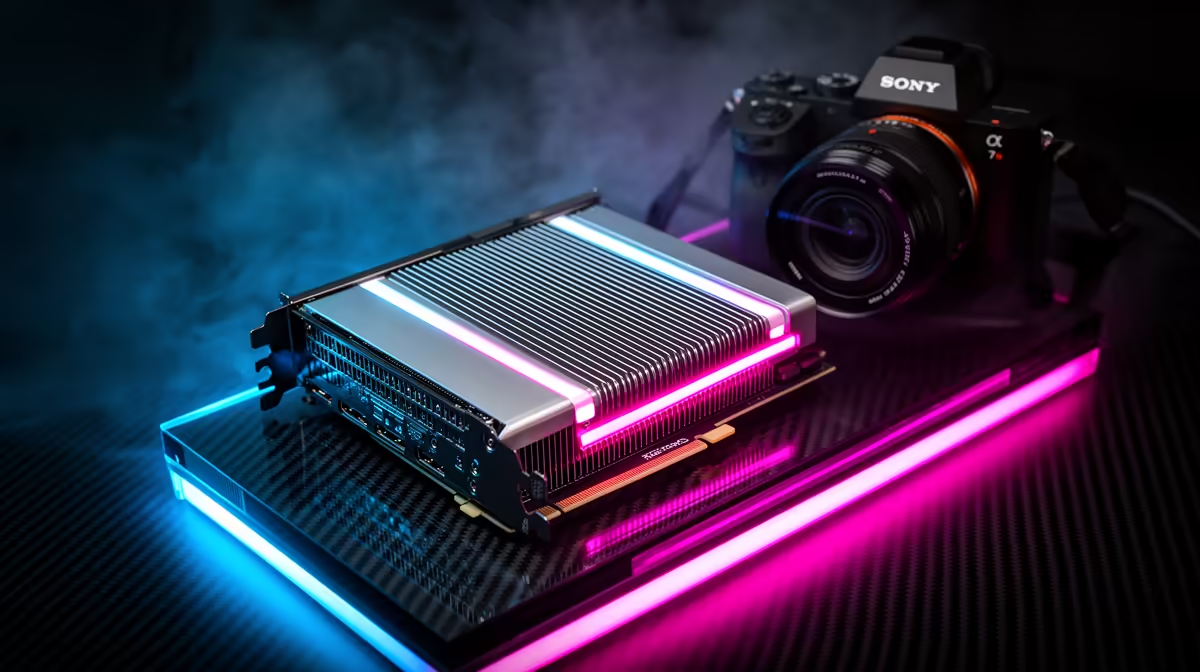
Streaming to Twitch or YouTube from South Africa over Vumatel, Openserve, or Frogfoot fibre adds a consistent upload bandwidth constraint. SA residential fibre plans commonly offer 25 to 100Mbps upload. A GPU's hardware video encoder handles stream encoding without taxing your frame rate. NVIDIA's NVENC on RTX 50-series cards is currently the strongest single-pass encoder available, producing stream quality comparable to x264 medium CPU encoding at a fraction of the performance cost. The RTX 5070 and above carry the ninth-generation NVENC with AV1 support, delivering noticeably better quality per bitrate than H.264 at the same upload speed. For a streaming setup on SA fibre, this matters more than raw gaming frame rate at the top end of the GPU stack.
DLSS and Frame Generation for Fibre Gaming 🖥️
Online competitive gaming over SA fibre involves ping times of 20 to 80ms to local servers. Frame generation technologies that introduce additional display latency are counterproductive for competitive titles. However, DLSS Super Resolution adds minimal latency and allows the GPU to maintain above-144fps in demanding single-player titles at 1440p or 4K. For streaming-while-gaming setups, keeping the base render resolution lower through DLSS Super Resolution also reduces VRAM pressure, leaving more headroom for the encoder's buffer. Cards in the RTX 5070 Ti class, priced around R22,000 to R28,000, represent the sweet spot for this combined use case.
VRAM, Cooling, and Driver Stability 🔧
Simultaneous gaming and encoding places dual demands on VRAM. A game at 1440p ultra settings may use 10 to 14GB while the encoder occupies a separate buffer. Cards with 16GB or more handle this split without memory overflow slowdowns. SA streamers benefit from buying cards through authorised local stockists including Evetech, as local warranty support simplifies any hardware queries without international shipping delays.
Set Your Encoder Bitrate to Match Your Upload Plan ⚡
a 50Mbps upload fibre line, keep your stream bitrate at 8,000 to 12,000 kbps for 1080p60 AV1 encoding. Pushing above 15,000 kbps risks buffering for viewers during SA evening peak hours between 19:00 and 22:00. Test your actual sustained upload speed rather than the headline plan figure.
FAQ
Does the GPU affect my ping to online game servers?
No. Network latency is determined by your ISP, routing, and server location, not your GPU. The GPU affects frame delivery and visual smoothness.
Is AV1 encoding actually better than H.264 for SA streaming?
Yes. AV1 delivers equivalent visual quality at 30 to 40 percent lower bitrate compared to H.264, which is meaningful on SA upload connections where headroom is limited.
How much VRAM do I need to stream at 1440p while gaming at 1440p?
A minimum of 12GB VRAM is recommended for 1440p simultaneous gaming and encoding, with 16GB providing comfortable headroom in VRAM-heavy open-world titles.
Ready to build a gaming and streaming rig for SA fibre?
Browse Evetech's range of RTX 5070 and 5080 class GPUs with NVENC AV1 encoding, available with local warranty and authorised distributor support.