Quick Answer
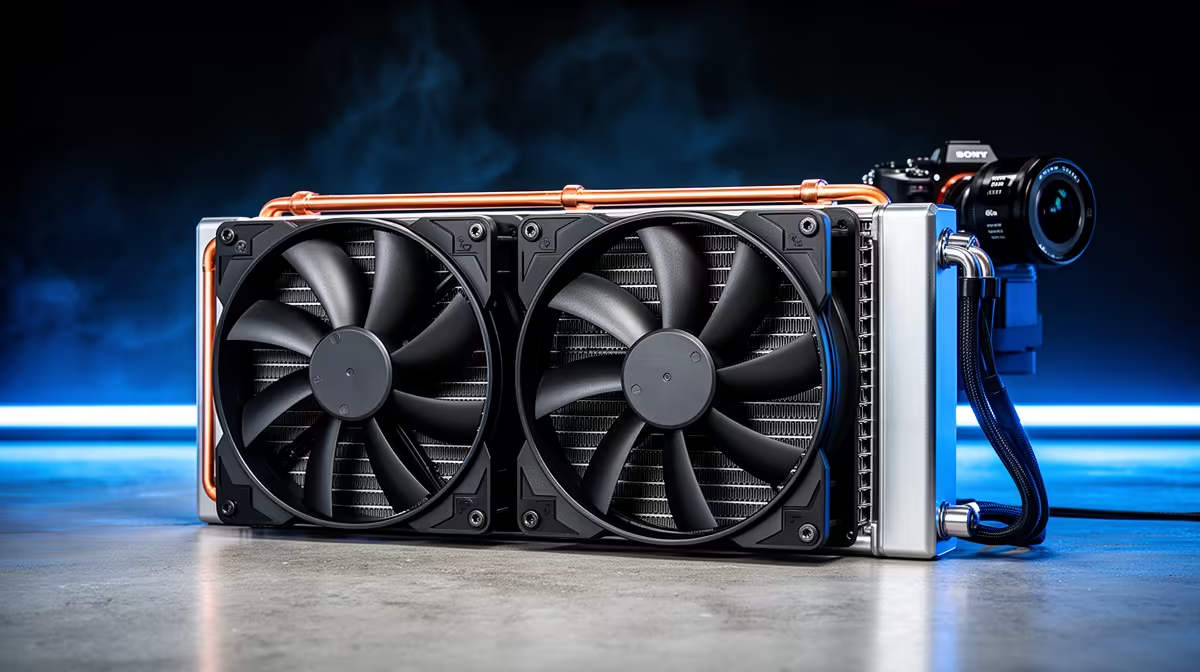
A 360mm radiator is worth the extra case space because it delivers 50 percent more surface area than a 240mm radiator, enabling meaningfully lower peak CPU temperatures, quieter fan speeds, and better performance under sustained workloads. The tradeoff is a case that supports a 360mm mount, which excludes only the smallest mid-tower and compact cases.
Surface Area and Why It Changes Thermal Performance 🔧
A 240mm radiator has 240 square centimetres of radiator surface. A 360mm unit has 360 square centimetres. That 50 percent increase in surface area means 50 percent more fin and tube contact for heat exchange between hot coolant and cooler room air. Under sustained loads on a Ryzen 7 9800X3D generating 130W, this extra surface area allows the coolant to drop 4 to 8 degrees Celsius lower than a 240mm equivalent running the same fan speeds. Lower coolant temperature directly reduces the CPU's thermal load, which translates to more consistent boost clock maintenance and a wider margin before thermal throttling occurs.
Quieter Fans Without Sacrificing Cooling 🎮
The greatest practical benefit of a 360mm radiator over a 240mm for many SA builders is fan noise reduction. With more surface area, three 120mm fans on a 360mm radiator each need to move less air per square centimetre to achieve the same total heat rejection as two fans on a 240mm unit. This means the 360mm fans can run at 200 to 400 RPM lower speeds and still outperform the 240mm at full speed. In practice, a well-tuned 360mm AIO runs its fans below 900 RPM during gaming on a mid-TDP CPU, which is nearly inaudible. The same thermal load on a 240mm unit might require 1,300 to 1,500 RPM, a clearly audible difference during long gaming sessions or work-from-home setups.
Case Compatibility: Which Cases Support 360mm Mounts 🖥️
The case space concern around 360mm radiators is less significant than it appears. The majority of full-tower and standard mid-tower cases support 360mm top or front mounting. Popular cases among South African builders, such as the Lian Li Lancool series, NZXT H-series, and Fractal Design Meshify and Pop series, accommodate 360mm radiators comfortably with room for proper airflow. The cases where 360mm support is absent are typically budget sub-R1,000 cases, compact mATX designs, and ITX enclosures. If you are building a system capable of using a Ryzen 9000-series or Core Ultra 200-series CPU, you are almost certainly in a case that supports 360mm mounting.
Front vs Top Mount: Know Your Case's Limit ⚡
Some mid-tower cases that advertise 360mm support only accommodate the full 360mm at the front mount, not the top. Top clearance may be limited to 280mm or 240mm due to VRM heatsink height. Confirm both the mount position and the clearance spec in your case manual before ordering.
FAQ
Is a 360mm AIO worth it over a 240mm for a Ryzen 5 9600X?
For a Ryzen 5 9600X at stock settings with a 65W TDP, a 240mm AIO is fully sufficient. A 360mm unit adds cost without thermal necessity on this chip. Reserve the 360mm for Ryzen 7 and above or Intel Core i7 or i9 builds.
Does a 360mm radiator need more maintenance than a 240mm?
No. Both sealed AIO sizes require the same minimal maintenance: dusting the radiator fins every few months and monitoring for any unusual pump noise. There is no additional service requirement from the larger size.
How much extra does a 360mm case cost compared to one supporting only 240mm?
Not much. Mid-tower cases supporting 360mm radiators start from around R900 to R1,200 locally, barely more than comparable 240mm-only cases. This is a small additional cost for a significant cooling capability upgrade.
Building a system that needs serious thermal headroom?
Browse the full range of 360mm AIO coolers stocked at Evetech.