Sizing a power supply for an AI workstation built around an RTX 4090 or RTX 5090 is not about adding up the numbers on the spec sheet. The trap is the PSU for a high-VRAM AI rig: these cards draw their rated power on average but slam the rails with millisecond spikes that dwarf the official figure. Independent bench testing has measured an RTX 5090 punching past 600W in short bursts, and well above that in sub-millisecond excursions. A supply that only just covers the average will trip under those spikes.
Quick Answer
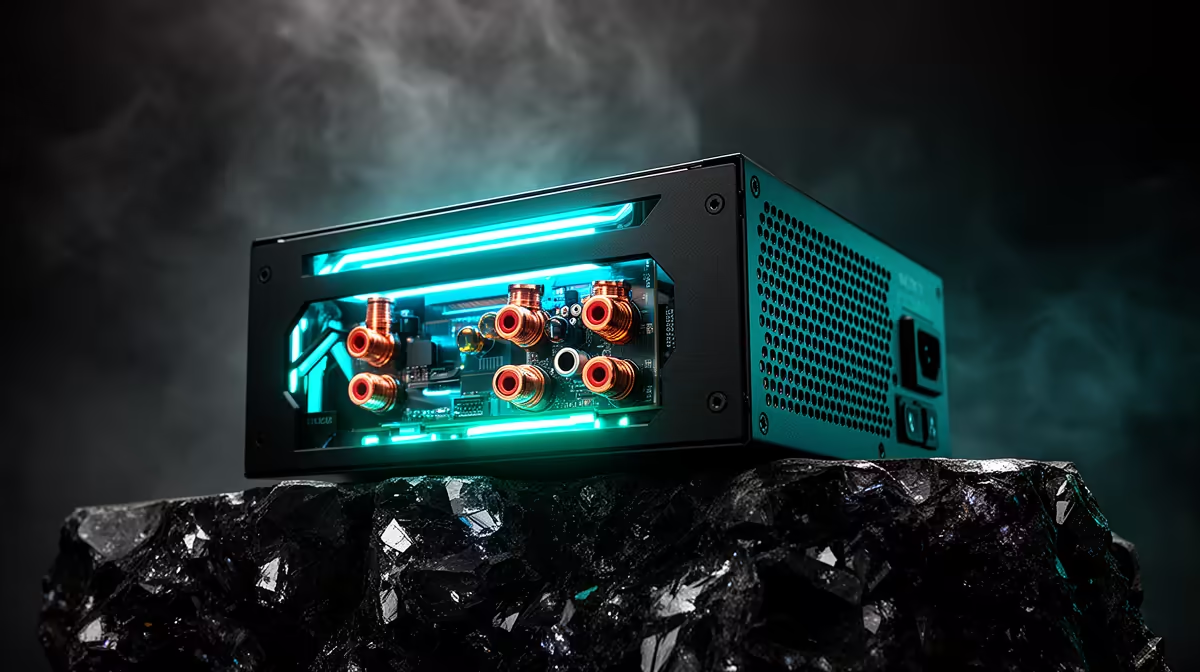
For a single RTX 5090 or RTX 4090 AI rig, fit a 1000W to 1200W 80+ Gold (or better) ATX 3.1 unit with a native 16-pin 12V-2x6 connector. 1000W is the safe floor; 1200W is the comfortable choice once you add a high-core-count CPU and run long training or inference sessions. Going below 1000W on a 5090 invites shutdowns during transient spikes.
Why Average Wattage Lies to You
The RTX 5090 carries a 575W base power rating and the RTX 4090 sits around 450W. Those are sustained figures. The problem is the transient behaviour. Testing from labs including TechPowerUp and Igor's Lab recorded the 5090 spiking to roughly 627W over 10 to 20 millisecond windows, past 800W in the 1 to 5 millisecond range, and brushing 900W in spikes under a single millisecond. Real gameplay traces from Tom's Hardware showed bursts near 659W.
AI workloads make this worse, not better. Training and inference push the GPU into long, sustained high-utilisation states where the average sits near the rated TGP for minutes at a time, and the transient spikes ride on top of that already-high baseline. A PSU chosen for the average alone has no margin left when a spike lands.
The ATX 3.1 Standard Exists for Exactly This
ATX 3.1 power supplies are specified to ride out transient loads far above their continuous rating without dropping the rails. That tolerance is the whole reason to insist on an ATX 3.0 or 3.1 unit behind one of these cards. An older supply might carry the same wattage label yet protect itself by shutting down the instant a spike arrives, which on an AI rig means a crashed run hours into training.
Doing the Wattage Maths Properly
Build the budget from the spikes, not the averages. A worked single-GPU example:
- RTX 5090 sustained draw: around 575W, with transient headroom needed well beyond that.
- High-end CPU under full multi-threaded load: 200W to 300W for a flagship Intel or AMD chip during data preprocessing.
- Motherboard, memory, NVMe drives, and fans: 50W to 100W combined.
Add those and a 5090 system can sit near 850W to 950W of genuine sustained demand, before transient spikes. That is why 1000W is the floor and 1200W the sensible target. Running a PSU at roughly 60 to 80 percent of its rating also keeps it in its most efficient band and the fan quieter, which matters on a machine that runs for hours.
The RTX 4090 Is Less Demanding, but Not by Much
A 4090 system pulls less on average, and a quality 1000W unit handles a single card comfortably. The same transient logic applies, though, so an ATX 3.0 or 3.1 supply with a native 16-pin lead is still the right call rather than relying on adapter cables.
Why Single-Rail Designs Suit These Cards
A modern high-wattage unit typically runs a single 12V rail, meaning all the available current can flow to wherever the load demands it. That matters for a card that pulls heavily down one 16-pin cable, because a single strong rail avoids the per-rail current limits that older multi-rail designs imposed. For an AI rig that loads the GPU hard for hours, a single-rail unit from a reputable maker removes one more thing that can trip during a spike.
The Connector Matters as Much as the Wattage
Both cards use the 16-pin 12V-2x6 connector, the revised version of the original 12VHPWR design. It delivers up to 600W down a single cable. The fix in the 2x6 revision is in the pin geometry, which reduces the risk of a poorly seated plug overheating.
Two practical rules. First, use the native 16-pin cable that ships with an ATX 3.1 supply rather than a daisy-chain of 8-pin adapters, which add resistance and failure points. Second, seat the connector fully until it clicks and route it with a gentle bend, since a sharp bend right at the plug is the classic cause of a hot connector. A clean, fully-inserted native cable is the single biggest safety factor after raw wattage.
Headroom for Multi-GPU and Future Cards
If your AI work points toward two cards down the line, the calculus changes entirely. Two 5090-class GPUs can demand transient peaks that push a single consumer ATX supply past its limit, and that is the point where a 1600W unit, or a workstation-class platform, becomes the right tool. For most people a single flagship card is the build, and 1200W leaves room for a CPU upgrade or extra storage without revisiting the PSU. Evetech's purpose-built AI PC range is configured around these power realities, and the matching GPU best sellers list is a quick way to confirm which flagship cards are currently in stock locally.
Frequently Asked Questions
Can I run an RTX 5090 on an 850W power supply?
It is not recommended. The 5090's transient spikes past 600W leave almost no margin on an 850W unit once the CPU and the rest of the system draw their share, and an older 850W PSU may shut down during a spike. Treat 1000W as the realistic minimum.
Is 1200W overkill for a single 5090?
No. A 1200W unit puts a single-card system in the efficient 60 to 80 percent load band, leaves headroom for transient spikes, and accommodates a future CPU or storage upgrade. The small price step over 1000W buys real reliability for long AI runs.
Do I need an ATX 3.1 PSU specifically, or is 3.0 fine?
Either ATX 3.0 or 3.1 is suitable, because both are designed to tolerate the large transient loads these GPUs produce. The key point is to avoid older standards that lack that transient tolerance, regardless of the wattage on the label.
Should I use the adapter cable that came with the card?
Use the native 16-pin 12V-2x6 cable supplied with an ATX 3.1 PSU where possible. Multi-plug 8-pin adapters work but add connection points and resistance. Whichever cable you use, seat it fully until it clicks and avoid a sharp bend at the plug.
What 80+ rating should I look for?
80+ Gold is the sensible baseline for an AI rig, balancing efficiency and cost. Platinum or Titanium reduce heat and running cost further on a machine that runs long workloads, but Gold is entirely adequate for a single flagship GPU.
Building an AI workstation around a 4090 or 5090? Match the card to a 1000W to 1200W ATX 3.1 supply and browse Evetech's AI PC range to get the power and connectors right from the start. Quote a custom build if you want it spec'd and tested before it ships.