Quick Answer
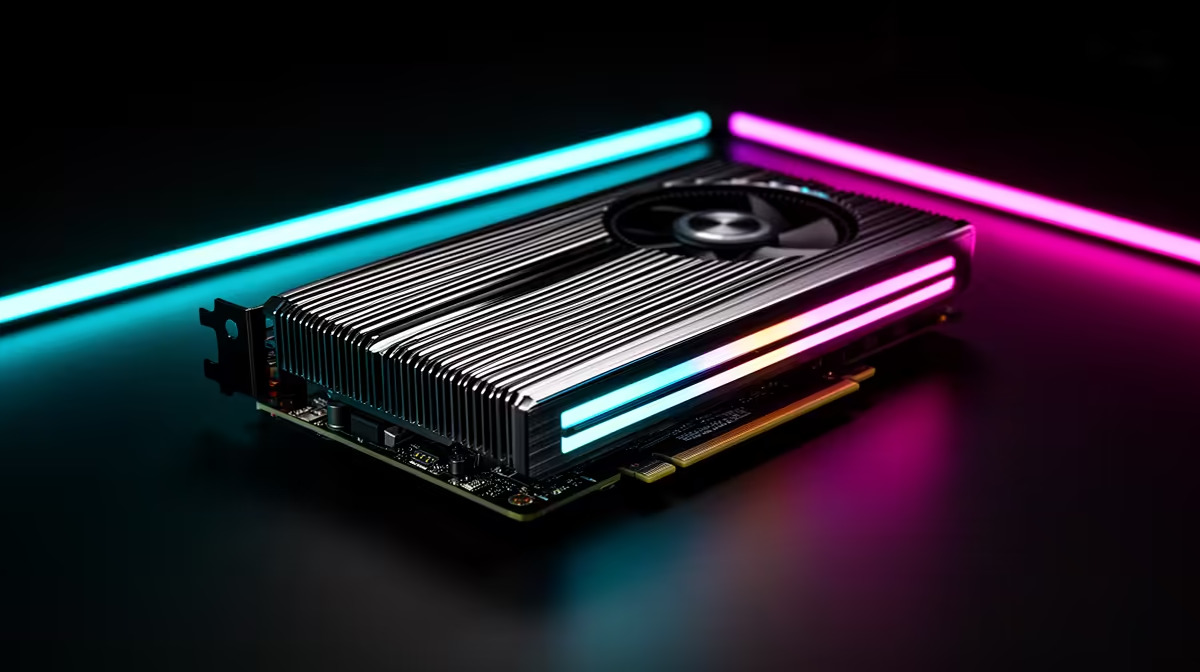
Under R7,000, prioritise at least 8GB of VRAM, a modern architecture (RDNA 3 or Ada Lovelace minimum), and GDDR6 or better memory. Cards at this price should deliver solid 1080p performance at Medium to High settings at 60 fps or above. Avoid any card with 4GB or 6GB VRAM entirely.
VRAM, Memory Type, and Bus Width 💰
At the R7,000 price point, VRAM capacity is the first filter. Skip 4GB cards: modern games exceed that at 1080p Medium settings. Cards with 6GB are marginal for current titles. Focus on 8GB options, the practical minimum for playing 2025 and 2026 releases without texture streaming stutters.
Memory bandwidth matters nearly as much as capacity. GDDR6 at 192 bits is preferable to GDDR6 at 128 bits. If a card in this range offers GDDR6X or GDDR7, prioritise it over equivalent GDDR6 options even if clock speeds look similar, because the extra bandwidth reduces the chance of the memory bus bottlenecking at 1080p High settings.
Also check TGP. Cards above 120W at this price often have undersized coolers to hit the target, resulting in noise and thermal throttling. A moderate TGP with a decent dual-fan design beats a high-TGP card with a single fan.
Architecture Generation and Driver Longevity 🔧
Older GPU architectures sometimes appear in the sub-R7,000 range as clearance stock. Use Ada Lovelace (RTX 40-series) or RDNA 3 (RX 7000-series) as your minimum architecture. Both support DLSS or FSR upscaling, which effectively extends the performance ceiling of an entry card by letting you render at a lower resolution and upscale to 1080p with minimal quality loss.
Avoid GTX 16-series and RX 5000-series cards as a primary purchase. They will receive diminishing driver optimisation going forward and may lack hardware ray tracing or current-gen upscaling support.
What You Cannot Realistically Expect Under R7,000 🎮
Ray tracing is possible but limited. Entry Ada Lovelace and RDNA 3 cards run ray tracing in supported games at Low or Medium quality to maintain 60 fps. 1440p gaming works only at Medium settings with FSR or DLSS assistance. Ultra-wide and 4K are not realistic targets.
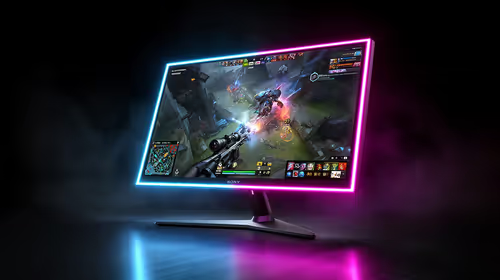
The sweet spot for sub-R7,000 cards is 1080p at High settings with upscaling enabled. Paired with a Ryzen 5 5600 or Core i5-12400, a well-chosen card in this range delivers a complete and enjoyable 1080p gaming experience.
Enable FSR or DLSS on Day One ⚡
The moment you install your drivers, enable FSR or DLSS in supported titles. Setting upscaling to Quality mode at 1080p output is nearly indistinguishable from native resolution for most players and adds 20 to 40 fps in demanding scenes. Budget GPUs benefit most from upscaling.
FAQ
Is a used GPU under R7,000 worth considering?
Used GPUs offer better specs per rand but carry risks: no local warranty, potential thermal paste degradation, and worn fans. If buying used, confirm proof of purchase and check the card has not been used for cryptocurrency mining.
Will a sub-R7,000 GPU reach 144 fps on a high-refresh 1080p monitor?
In esports titles like Valorant, CS2, and Apex Legends, a capable budget card regularly hits 144 fps or above at 1080p. In demanding single-player games it averages 60 to 90 fps at High settings.
What CPU should I pair with a budget GPU?
Ensure at least 4 fast cores. A Ryzen 5 5600 or Core i5-12400 keeps a sub-R7,000 GPU from being held back in most titles. A very old dual-core CPU wastes the GPU's potential regardless of how capable the card is.
Looking for the best GPU your budget can buy?
Evetech stocks new graphics cards at a full range of price points. Browse the graphics card category to compare VRAM, architecture, and memory type to find the right card for your 1080p setup.