Quick Answer
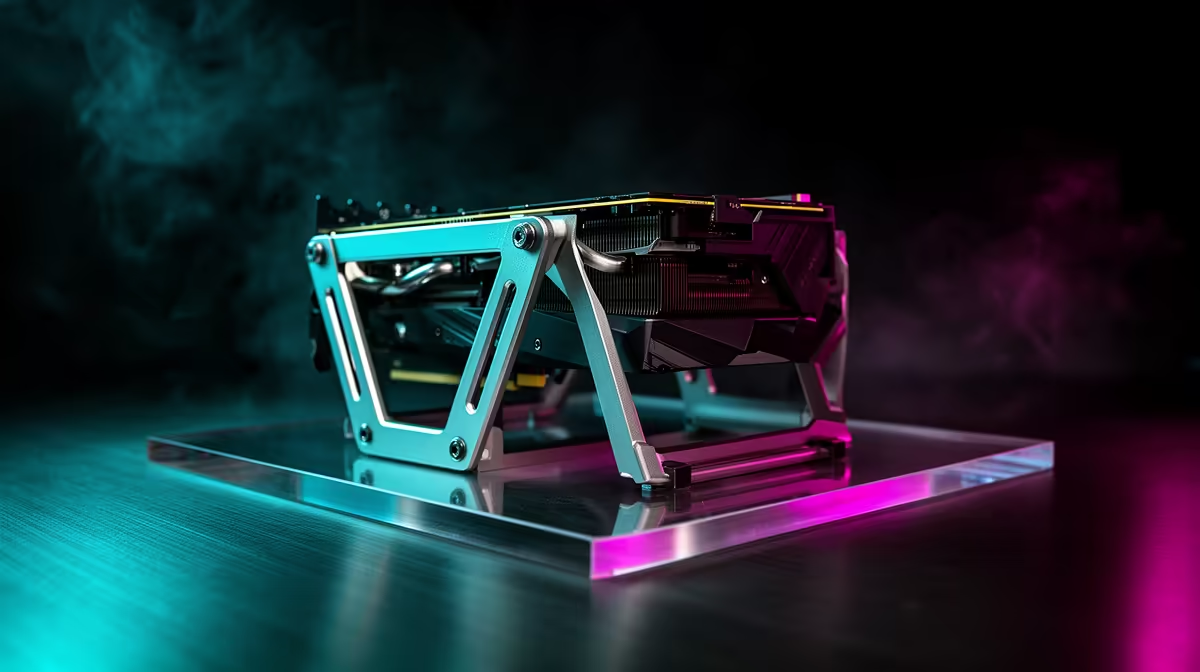
For heavy GPUs above 1.5 kg, prioritise a holder with a rated load capacity clearly stated by the manufacturer, a rigid metal build (aluminium or steel, not plastic), and an adjustable height mechanism that locks securely. Aesthetic extras are secondary to structural integrity.
Load Rating and Material Construction 🔧
The single most important specification on any GPU holder for a heavy card is its rated load capacity. Many decorative acrylic or lightweight aluminium brackets are designed for cards in the 800 g to 1.2 kg range. A three-slot flagship like the RTX 5090 or RX 9070 XT tips the scales above 1.8 kg in some configurations, and a bracket that cannot support that weight will deflect under the load rather than prevent sag. Look for holders that explicitly state a capacity of 2 kg or more, are constructed from 2 mm or thicker steel or aircraft-grade aluminium, and have a contact pad (rubber or silicone) that grips the GPU shroud without scratching it. Plastic posts that screw into case standoffs tend to loosen over time, so threaded metal standoff compatibility is a meaningful upgrade.
Adjustability and Case Compatibility 🖥️
No two GPUs sit at the same height relative to the bottom panel. An RTX 5080 in a mid-tower sits differently from the same card in a full-tower, and double-slot cards require a different contact height than triple-slot cards. A good heavy-duty holder has either a telescoping post or a notched height-adjustment system with enough range (typically 30 mm to 80 mm) to cover both scenarios. Confirm the holder mounts to your specific case: some attach to the case floor via adhesive pads, others screw into PCI bracket slots, and others clamp to the bottom rail. Check your case manual before purchasing, because an incompatible mounting system makes an otherwise excellent bracket useless.
Contact Points and Anti-Scratch Design 🎮
A holder that contacts your GPU shroud directly with bare metal will leave marks over time, especially as thermal expansion and contraction cause slight movement. Quality heavy-duty brackets include a silicone or rubberised contact surface at the top of the post. Some premium models use a roller or swivel head so the GPU can shift slightly during thermal cycling without the holder gouging the shroud. This is a genuine quality-of-life difference on expensive cards. In the SA market, where warranty service on flagship GPUs can take two to three weeks, protecting the physical condition of your card from day one makes sense.
Weigh Your GPU Before You Buy ⚡
Most GPU manufacturers list the weight of their cards in the product specifications on their website. Check that figure against the bracket's rated load before ordering. A bracket rated for 1.5 kg on a 1.9 kg card will not fail immediately but will compress its contact pad unevenly and lose holding strength within months.
FAQ
Are universal GPU holders truly universal?
Most "universal" holders cover the majority of mid and full-tower cases but will not fit small-form-factor cases, open-air benchtables, or cases with non-standard PCIe slot spacing. Always verify the mounting method matches your specific case before purchasing.
How much do quality heavy-duty GPU holders cost in South Africa?
Decent rigid-metal holders with adjustable height mechanisms typically range from R150 to R450 in the SA market. Premium models with roller contact heads and rated capacities above 2 kg sit at the upper end of that range and are worth the extra spend for flagship-tier GPUs.
Can I use two holders for a very heavy GPU?
Yes, and for triple-slot cards with a blower cooler added, two holders spaced evenly under the GPU shroud distribute the load more effectively than one centred bracket. Some builds use one holder under each end of the card.
Got a heavy three-slot GPU that needs proper support?
Evetech carries GPU support brackets built to handle the load. Check the accessories section for options that match your case and card weight.