Quick Answer
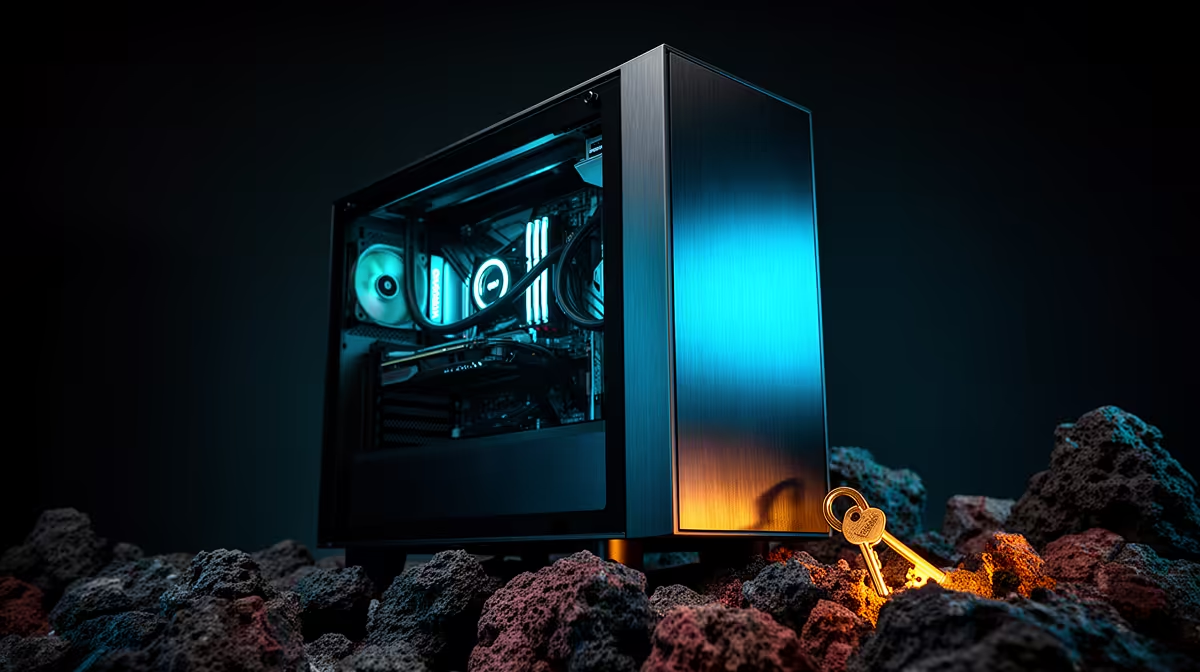
A premium E-ATX workstation case must support boards up to at least 305 x 330mm, include a 420mm top radiator mounting position, offer ten or more expansion slots, and provide at minimum 40mm of rear cable channel depth to handle the extra cables a multi-socket or multi-GPU workstation generates.
Motherboard Fitment and Expansion Slot Count 🖥️
The first non-negotiable is genuine E-ATX compatibility, not just the label. Some cases list E-ATX support but only accommodate boards up to 305 x 272mm, which excludes true E-ATX workstation boards at 305 x 330mm used by Threadripper Pro and Xeon W platforms. Verify the exact maximum board dimensions in the spec sheet, not just the form factor label. Expansion slots matter equally: a Threadripper Pro 7000 WX board has up to ten PCIe slots for GPU, capture, network, and storage cards. The case needs enough slot openings and enough physical height to accommodate cards installed in all slots, including 4-slot wide GPU coolers in the top PCIe lanes. Cases with twelve slot openings are preferable for maximum flexibility.
Cooling Infrastructure for Sustained Workstation Loads 🔧
Workstation CPUs like the Threadripper Pro 7995WX have a 350W TDP at boost and can sustain 300W under long renders. This demands a 420mm AIO or custom loop, and the case must support it without clearance compromises. A premium E-ATX workstation case should offer a top 420mm radiator position with at least 60mm panel-to-board clearance, a front 420mm position as an alternative, and optional side panel radiator mounts. With 4-slot wide cards in the RTX 5090 class, the case needs at least 380mm of GPU clearance from the PCIe slot to the front panel. Some cases include a GPU bracket to support the weight of heavy cards and prevent PCIe slot sag.
Storage, I/O, and Cable Management 📦
A professional workstation case should include at minimum four 3.5-inch HDD bays and four 2.5-inch SSD trays. Front I/O should include at least two USB 3.2 Gen 2 ports and a USB-C 20Gbps port for fast media transfers. A premium case in this range should also include a PCIe Gen 5 riser cable if vertical GPU mounting is supported, since earlier generation riser cables throttle bandwidth on RTX 5000-series and RX 9000-series cards. Cable channel depth of 40mm or more behind the motherboard tray is essential in an E-ATX build where the wider board increases cable run lengths.
Weight-Rate Your Workbench First ⚡
A fully loaded E-ATX workstation can weigh 25 to 35 kg. Confirm your desk or workbench is rated for this load before building. Many standard particle-board desks flex under 25 kg and can bow over time, which risks vibration damage to drives. A solid wood or steel-frame desk surface is strongly recommended for permanent workstation installations.
FAQ
How much should I budget for a premium E-ATX workstation case in South Africa?
Quality E-ATX full-tower cases suitable for professional workstation builds are priced between R4,500 and R10,000 locally. Below R4,500 you may get E-ATX fitment but without the cooling infrastructure, cable management depth, or expansion slot count that a professional build demands.
Do I need a specific PSU for an E-ATX workstation case?
The PSU form factor is standard ATX. A Threadripper Pro workstation with a high-end GPU should run a 1200W to 1600W 80 Plus Gold or Platinum PSU. The case accommodates a standard ATX PSU regardless of wattage.
Is cable management harder in an E-ATX case than an ATX case?
Yes, because cable runs are longer and cable count is higher due to more power phases and more PCIe slots. A rear cable channel of 40mm or more is essential. Using fully modular PSU cables and routing each cable bundle separately prevents the rear panel from bulging.
Speccing a professional workstation that needs to run all day?
Evetech stocks full-tower E-ATX cases and workstation-class cooling hardware to support even the most demanding Threadripper or Xeon builds. Browse the case and cooling range today.