Quick Answer
Prioritise sensor accuracy, connection stability, battery life, and comfort above everything else. For most South African office workers and students, a wireless mouse with a proven optical sensor, at least 30 hours of charge or 12-month battery life, and 2.4GHz or dual-mode connectivity covers all daily needs.
Sensor and Tracking: The Foundation 🔬
The sensor determines how accurately the cursor tracks your hand movement. For office and study tasks, any optical sensor rated between 1,000 and 4,000 DPI with low deviation is sufficient. Laser sensors once dominated the premium tier but optical sensors have surpassed them in consistency, especially on glass desks that are common in modern South African home offices. You do not need 8,000-plus DPI for spreadsheets or document work. Look for models specifying tracking speeds above 150 IPS (inches per second) and acceleration tolerance of at least 20G; these figures confirm smooth tracking during fast, sweeping cursor movements across large monitors.
Connectivity and Battery: Non-Negotiables 📶
For reliability at a desk, 2.4GHz via USB dongle is the safest pick. It delivers latency under 1ms and holds connection across a full-size monitor setup without interference from other wireless devices. Bluetooth 5.0 is fine for lightweight use and saves a USB port on ultrabooks. Battery life should match your recharge habits: rechargeable models offering 50 to 70 hours per charge suit most workers, while AA-powered models with 12-month ratings suit users who dislike remembering to charge. Dual-mode mice offering both connection types add R100 to R200 to the price but pay off quickly if you switch between a desktop and a laptop.
Comfort, Size, and Build Quality 🖐️
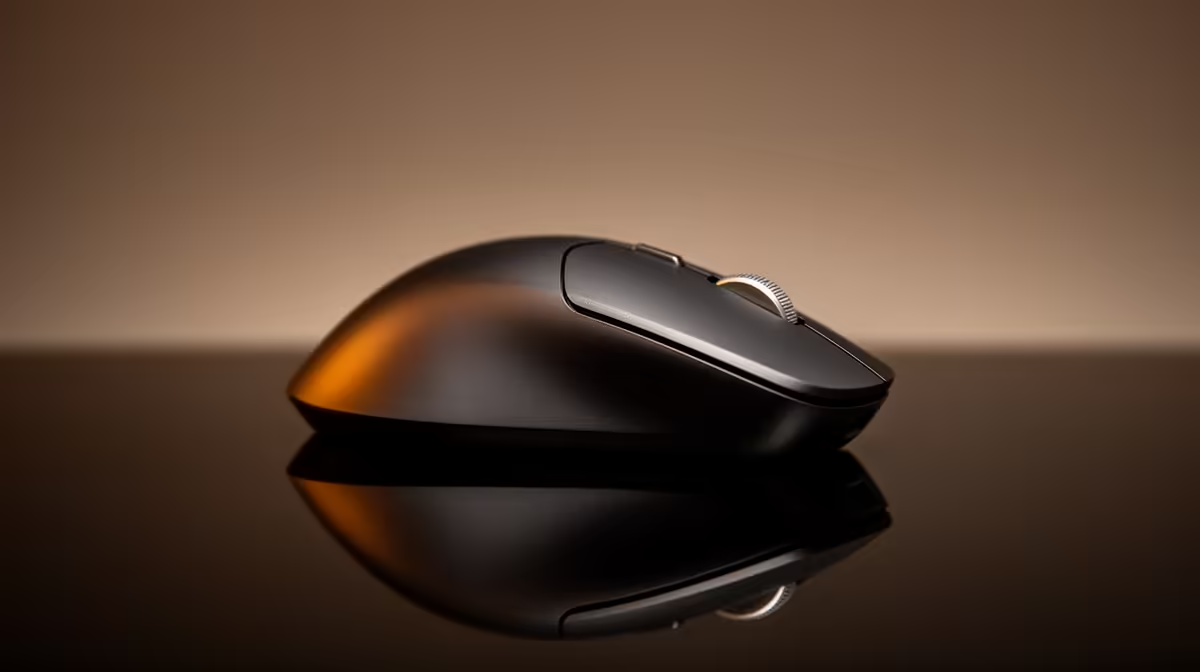
A mouse you use for six to eight hours a day needs to fit your hand, not just look good in a photo. Consider your grip style: palm grippers need a larger, curved body; fingertip and claw grippers can use a flatter, more compact shell. Weight matters too; lighter mice under 100 grams reduce forearm fatigue during long sessions. Scroll wheel quality is often overlooked; for research-heavy work or long documents, a free-spinning wheel that lets you zip through pages instantly is a notable productivity gain. Build quality signals reliability: rubber side grips, a firm scroll wheel click, and solid button feedback all correlate with longevity in the R400 to R900 price band common for quality work-and-study mice in South Africa.
Try Before You Buy If You Can ⚡
Evetech product pages list mouse dimensions and weight. Cross-reference the length against your measured hand size before ordering, especially if you are buying online. A mouse that is even 10mm too short or too long for your palm will cause discomfort within a week of daily use.
FAQ
How many DPI settings do I actually need for office work?
Two settings cover 90% of office use cases: a lower setting around 800 DPI for precise cursor work in spreadsheets and a higher setting around 1,600 DPI for faster navigation across a large or ultrawide screen. Most mice with a DPI switch button let you cycle between three to five presets.
Does wireless mouse quality matter if I only use it a few hours a day?
It matters for sensor consistency and button durability. Cheaper mice under R200 often develop double-click issues or tracking drift within six months of regular use. Spending R400 to R600 buys substantially better mechanical switches rated to 10 million clicks or more.
Is a mouse pad necessary for a wireless optical mouse?
Not mandatory, but recommended. A textured mouse pad improves sensor tracking consistency and reduces surface wear on the mouse feet. Basic cloth mouse pads start around R80 at Evetech and extend the life of the mouse glide feet noticeably.
Not sure which wireless mouse ticks every box for your setup?
Evetech stocks a curated range of work and study wireless mice covering every hand size, connection type, and budget from R250 upward.