Quick Answer
For a 27-inch QHD gaming monitor, prioritise: a panel type that matches your use case (Fast IPS for motion clarity, VA for contrast, OLED for both), a refresh rate your GPU can sustain (144Hz minimum, 240Hz if your GPU averages above 200 fps), and VRR certification matched to your GPU brand. Colour gamut, HDR tier, and stand adjustability are secondary but worth confirming.
Panel Type at 27 Inches QHD 🖥️
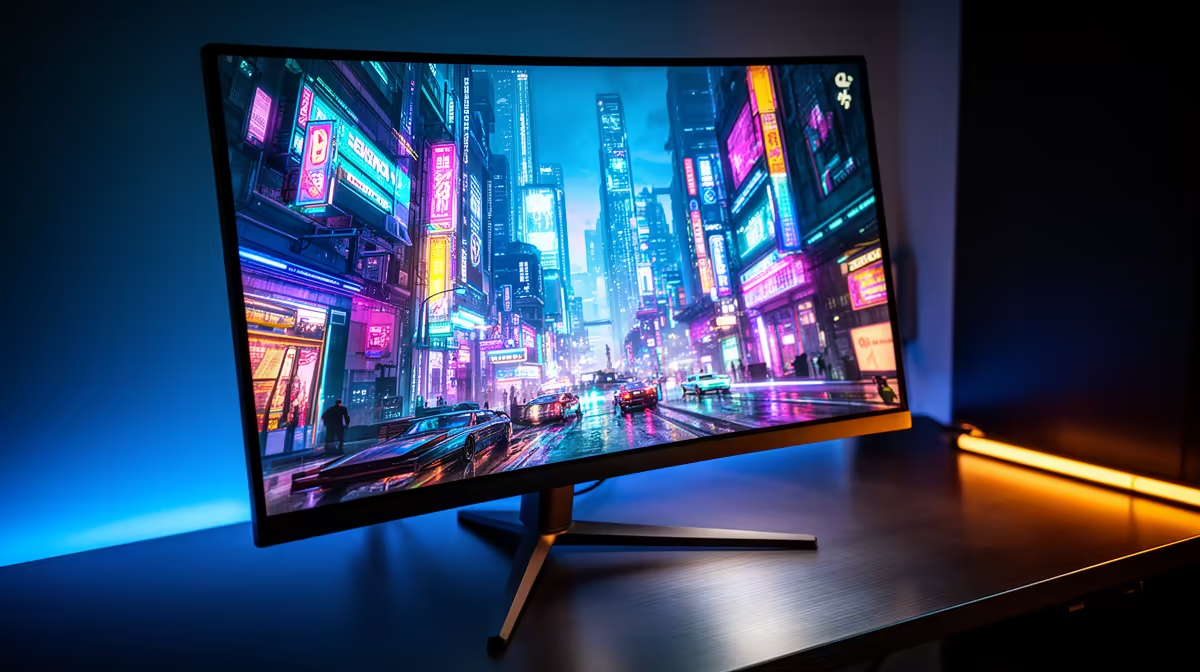
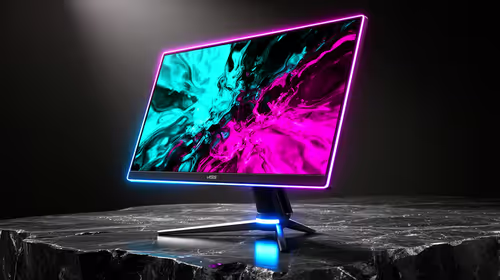
At 2560x1440 on a 27-inch panel, pixel density is 109 PPI, which looks sharp and clean at typical PC viewing distances of 50 cm to 70 cm. The panel technology you choose defines the experience more than the resolution. Fast IPS offers 1 ms pixel response and accurate colours across a wide viewing angle, making it the default recommendation for competitive gaming and mixed use. VA panels offer contrast ratios of 3000:1 or higher (versus 1000:1 for IPS), producing deep blacks that make dark game environments more immersive; the trade-off is slower pixel response (4 ms to 10 ms GTG) that can smear fast motion. OLED panels at 27 inches QHD offer near-instant pixel response and essentially infinite contrast but start at R8,000 to R18,000 in the SA market and carry a burn-in risk for users who display static UI elements for many hours.
Refresh Rate and VRR: Matching to Your GPU 🎮
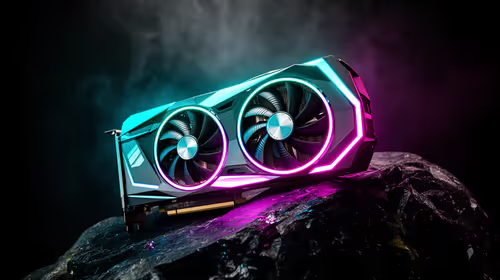
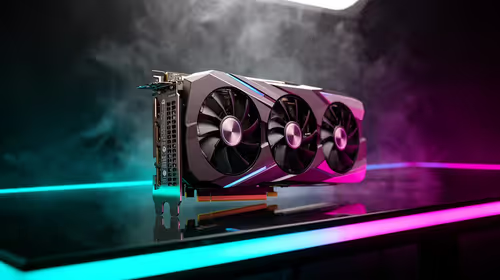
A 144Hz QHD monitor is a sensible pairing for GPUs in the RTX 4060 to RTX 4070 range (approximately R7,000 to R14,000 in SA), which deliver 100 to 180 fps in most competitive titles at 1440p. A 240Hz QHD panel suits the RTX 4070 Ti Super, RTX 5070, and RX 9070 XT tier, which push above 200 fps in esports titles at 1440p. At 300Hz, only the RTX 5080, RTX 5090, and their AMD equivalents consistently feed the panel's full potential in demanding competitive games. For VRR, match the certification to your GPU: FreeSync Premium or FreeSync Premium Pro for AMD, G-Sync Compatible or full G-Sync for NVIDIA. Most current QHD monitors carry G-Sync Compatible plus FreeSync certification simultaneously, so GPU brand is not a limitation in practice.
HDR, Colour Gamut, and Stand 🔧
HDR on gaming monitors ranges from DisplayHDR 400 (basic brightness boost) to DisplayHDR 1000 with full-array local dimming. DisplayHDR 400 is common at R4,000 to R6,500 and provides a nominal HDR certification. DisplayHDR 600 or above with local dimming (from R7,000) delivers genuine dark-scene contrast improvement. Prioritise 95% DCI-P3 or better for colour gamut. For stand, height adjustment of 75 mm to 150 mm is essential; monitors without it need a riser or arm costing R300 to R800.
Check Panel Uniformity in Reviews Before Buying ⚡
IPS glow and backlight bleed vary by unit on the same monitor model. Before purchasing a QHD IPS panel, read reviews that include uniformity test results. Some models have consistent IPS glow in corners that is distracting in dark scenes. This is harder to evaluate from spec sheets but well-documented in community reviews on display-focused forums.
FAQ
Is a 27-inch QHD monitor too large for a small desk setup in a South African flat or student room?
At 27 inches, the recommended viewing distance is 50 cm to 70 cm, which most SA desk setups accommodate. If your desk is under 50 cm deep, a 24-inch monitor is the better fit.
Should I buy a 27-inch QHD monitor or a 32-inch QHD monitor?
At 32 inches, QHD is 92 PPI, slightly softer than 27-inch QHD. The 32-inch suits productivity and immersive gaming; the 27-inch suits competitive play where seeing the full screen without head movement matters.
Are 27-inch QHD monitors significantly more expensive than 1080p in SA?
The gap has narrowed. 27-inch QHD monitors at 144Hz start at R4,000 to R5,500 versus R2,500 to R4,000 for comparable 1080p panels. The R1,500 to R2,000 QHD premium is justified by the clearly better image quality at 27 inches.
Ready to choose a 27-inch QHD gaming monitor for your SA build?
Evetech stocks QHD monitors across all refresh rates and panel types. Browse the monitor section to compare specs and find the panel that matches your GPU and your gaming goals.