Quick Answer
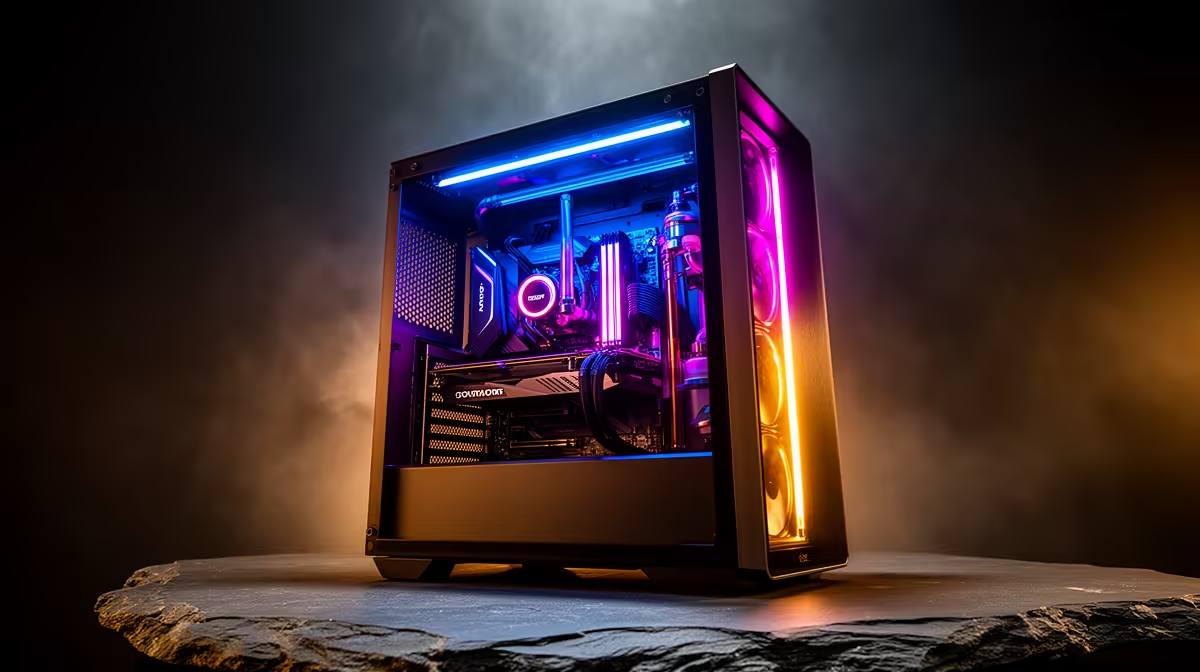
South African gamers running large GPUs and liquid cooling should prioritise in this order: GPU clearance of 410mm or more, front or top 360mm radiator support, mesh-dominant intake panels for SA summer ambient temperatures, and a cable routing channel deeper than 25mm behind the motherboard tray. Aesthetics and RGB matter, but thermal capacity comes first when you are spending R18,000 or more on a GPU that needs consistent airflow year-round.
GPU Clearance for Current and Future Cards 🖥️
The RTX 5090 is the flagship benchmark for clearance requirements in 2026. Triple-fan board partner designs from ASUS ROG, MSI, and Gigabyte AORUS measure between 336mm and 366mm in length. A case with 410mm to 430mm GPU clearance provides the buffer needed for both current long cards and the right-angle 16-pin power connector that routes from the rear of those cards. Cases rated at 350mm or 360mm cut clearance too fine for the largest current-gen cards, leaving no margin for cable routing. For SA builders, ATX mid-towers with 430mm clearance are available from R2,800, while premium showcase designs with equivalent clearance start from R4,000.
Radiator Support and SA Summer Thermal Reality 🌡️
Johannesburg summer ambient temperatures average 28 to 35 degrees Celsius, and gaming rooms without air conditioning can push past 38 degrees Celsius on hot afternoons. Cases designed with 360mm front or top radiator mounts allow AIOs to exhaust heat directly out of the case before it recirculates through the GPU area. When gaming room temperatures are 10 to 15 degrees Celsius higher than European benchmark conditions, a 360mm AIO drops CPU temps enough to reduce case ambient by 2 to 4 degrees Celsius versus a 240mm unit, which cascades to a 2 to 4 degree reduction in GPU inlet temp and a quieter, more stable GPU fan curve.
Front Panel Mesh and Airflow Strategy 💧
The most thermally correct case for SA conditions has a predominantly mesh front panel. Mesh designs move 35 to 50 percent more air at equivalent fan RPM compared to solid glass fronts, which directly reduces GPU temps and fan noise. This matters more in SA than in climate-controlled European gaming rooms. If the build goal includes a display-worthy appearance, look for hybrid cases that combine a glass or ARGB front decorative ring with mesh intake sections alongside or below the decorative element. These designs compromise slightly on visual impact but retain most of the airflow advantage.
Set Seasonal Fan Curves ⚡
two separate fan curve profiles in your BIOS or fan controller software: one for SA winter (cooler temps, quieter curves) and one for SA summer (higher RPM targets that activate sooner). Switching between profiles takes 30 seconds and keeps your GPU temps consistent regardless of the season without leaving summer-aggressive fan noise running year-round.
FAQ
Should SA gamers prioritise mesh or glass front panels?
For Gauteng, Limpopo, and North West Province where summer temps regularly exceed 35 degrees Celsius, mesh front panels are clearly the better thermal choice. For Cape Town and Durban where summers are milder, glass-front panorama cases are a viable aesthetic choice without significant thermal penalty.
How often should I clean dust filters in an SA gaming case?
In Johannesburg and Pretoria where dust levels are high, monthly cleaning of intake dust filters is practical. In Cape Town with lower dust and higher humidity, every six to eight weeks is typically adequate.
Is a vertical GPU mount worth it in an SA showcase build?
A vertical GPU mount positions the card face-outward toward the side glass, improving display visibility but reducing GPU airflow by restricting intake below the card. In SA summer conditions, this thermal penalty (typically 3 to 8 degrees Celsius GPU temp increase) must be weighed against the display benefit.
Building for SA summer conditions with large GPUs?
Browse Evetech's ATX gaming cases with 360mm radiator support and 430mm GPU clearance, ready for the SA climate.