Quick Answer
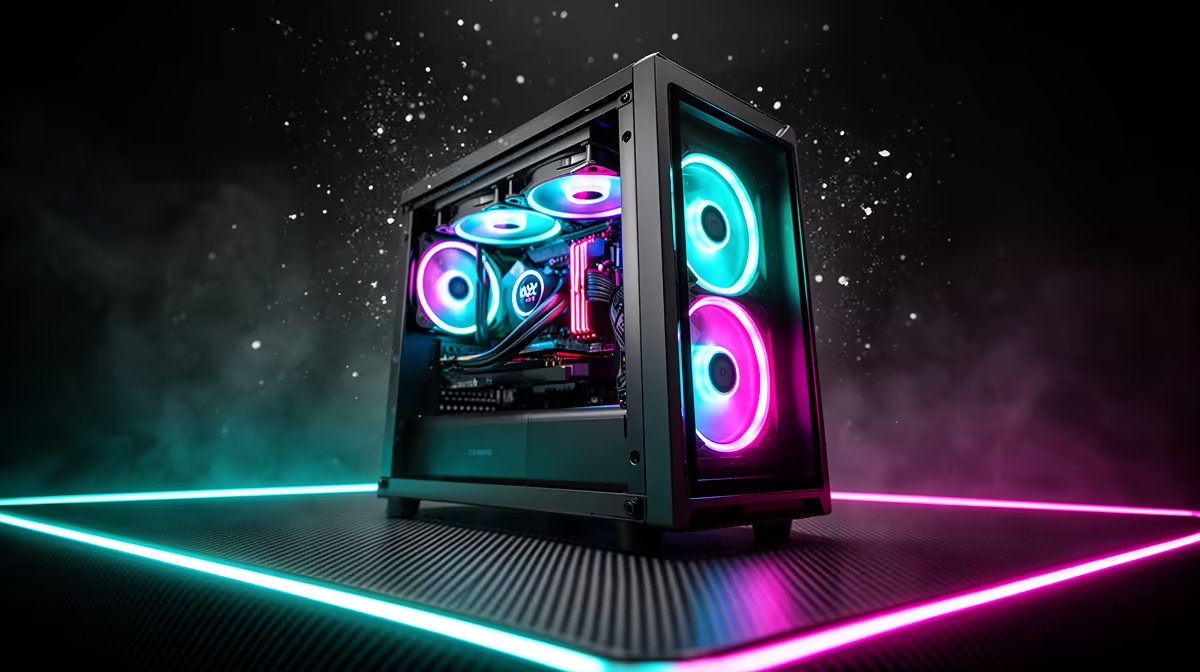
Prioritise GPU clearance of at least 400mm, a mesh front panel with strong intake airflow, and a removable drive cage. These three features determine whether a large triple-slot GPU like the RTX 5080 or RX 9070 XT actually runs cool and fits without forcing cable compromises.
GPU Clearance: The Non-Negotiable Spec 📏
Current flagship and upper-mid GPUs are physically large. The RTX 5090 Founders Edition measures around 336mm, but third-party models from leading AIB partners regularly reach 360mm to 400mm. Some factory-overclocked triple-fan variants push past 420mm. A case rated for 320mm GPU clearance will not fit these cards; you need a minimum of 380mm clearance for comfortable fitment with drive cage removal and at least 400mm if you want overhead for cable routing behind the GPU. In South Africa, mid-tower cases with 380mm to 420mm clearance sit between R1,400 and R2,800. Always subtract 20 to 30mm from the manufacturer-claimed clearance to account for cabling and power connector obstruction on 16-pin connectors.
Front Panel Airflow for SA Ambient Conditions 🌬️
South African summers in Gauteng and the Western Cape regularly see ambient room temperatures above 28 to 33 degrees Celsius during load. A solid front panel with decorative cutouts restricts intake airflow and raises GPU temperatures by 5 to 10 degrees Celsius compared to a full mesh front. For a large GPU producing 300W to 450W of heat, that temperature difference is meaningful. Prioritise cases with perforated or mesh front panels covering at least 60 percent of the front face, and ensure the mesh has a removable magnetic dust filter. Highveld dust and Cape Town coastal particles clog filters quickly; filters that pop off for cleaning matter more here than in markets with cleaner air.
Removable Drive Cages and Internal Clearance 🔧
Many triple-fan GPUs have their power connectors positioned at the front edge of the card rather than the rear, which means a fixed drive cage in front of the GPU slot can block the 16-pin connector entirely. A removable drive cage solves this problem and adds roughly 50 to 80mm of extra GPU length clearance. Modern builders rarely need more than one or two 3.5-inch hard drives, so removing a cage sacrifices little and gains substantial installation flexibility. Cases with fully tool-free modular cage systems are preferable, typically found in the R1,800 to R3,000 segment.
Measure Before You Order ⚡
Before ordering your GPU and case, find the exact GPU length on the manufacturer's spec sheet, including the power connector overhang if listed. Compare that against the case's stated GPU clearance after drive cage removal. A 10mm mismatch discovered after unpacking wastes time and shipping costs, which are non-trivial in SA.
FAQ
Does GPU sag damage my motherboard PCIe slot over time?
Slow sagging from a heavy triple-fan GPU does stress the PCIe x16 slot. A GPU brace or anti-sag bracket, sold separately for around R200 to R500 or built into some premium cases, prevents contact damage to the slot and reduces micro-fractures in solder joints on heavy cooler designs.
Will a large GPU block my case fans?
A GPU over 360mm can partially obstruct the lowest front intake fan, reducing airflow to the bottom of the case. Position the two upper front fans to pull air directly toward the GPU blower intakes and mount any bottom fan as a secondary intake rather than a primary source.
How many watts does my PSU need for a large GPU build?
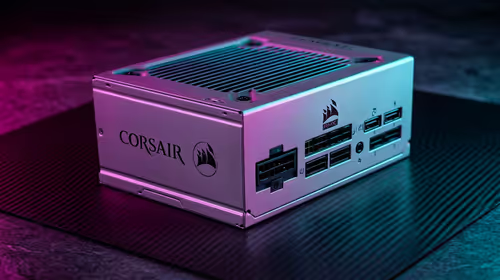
An RTX 5080 paired with a Ryzen 7 9800X3D requires a minimum 850W PSU. An RTX 5090 system needs 1,000W or more. Budget R1,800 to R2,800 for a reputable modular gold-rated PSU in this power range from South African stock.
Need a case that actually fits your high-end GPU?
Evetech carries cases with verified large-GPU clearance specs so you can build with confidence from day one.