Quick Answer
South African PC builders pairing a large GPU like the RTX 5080 or RTX 5090 with a high-end build should prioritise, in order: sufficient GPU clearance (380 mm or more), mesh-dominant front intake for the SA summer climate, an integrated GPU brace for transport stability, and a verified local warranty. These four factors directly affect build reliability in local conditions more than any other case specification.
GPU Clearance First, Always 📐
For SA builders targeting flagship GPUs, GPU clearance is the primary filter. The RTX 5090 Founders Edition is 336 mm, but AIB partner cards with extended coolers reach 360 mm to 410 mm. A case with 400 mm clearance handles all current reference designs and most AIB variants with buffer. Verify the clearance spec with a front radiator installed if you plan liquid cooling, since a 360 mm front radiator reduces the clearance figure by 55 mm to 60 mm. The local consequence of getting this wrong is significant: returning a case purchased in South Africa takes 5 to 10 business days through a local distributor, and returning an incompatible GPU that arrived pre-installed in the case is even more complicated. Measure before purchase.
Airflow Priority for the South African Climate 🌡️
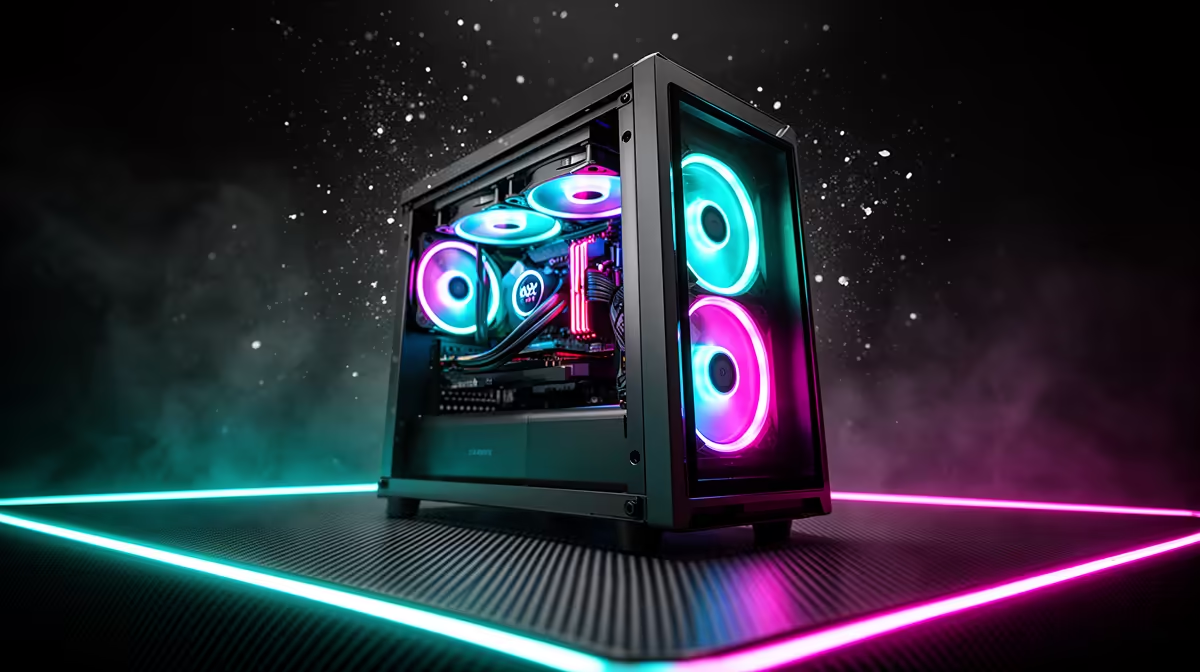
South Africa's summer is particularly punishing for computers. Gauteng averages 28 degrees Celsius to 33 degrees Celsius indoors in January without air conditioning, and the Northern Cape regularly exceeds 38 degrees Celsius outdoors, driving indoor ambient temperatures that stress PC thermal systems. In these conditions, a mesh-front case drops GPU temperatures by 5 degrees Celsius to 9 degrees Celsius compared to a glass-front design, which is the difference between an RTX 5090 throttling at 83 degrees Celsius junction or running comfortably at 76 degrees Celsius. The Highveld dust season also demands removable magnetic dust filters on both the front and PSU base, since fine dry dust accumulates inside cases faster than in coastal cities with higher humidity.
GPU Brace and Transport Stability 🔧
SA builders who attend LAN events, move between student accommodation like res and digs, or transport their PCs between home and university are exposed to transport stress that stationary European or North American builds never experience. A case with an integrated GPU brace rail prevents the PCIe slot damage that results from an unbraced 2 kg GPU being jostled in a car boot over potholed roads. This is a distinctly local concern: South African road conditions and the culture of LAN gaming mean transport is more frequent and more rough than typical international PC use patterns.
Local Warranty Is Non-Negotiable ⚡
For any SA build above R20,000, purchase components with verified South African warranty coverage. Grey-market cases can be R800 to R2,000 cheaper but require international shipping for warranty claims, with courier costs that often exceed the warranty repair value. Locally purchased cases stocked at authorised SA retailers carry Consumer Protection Act warranty rights, which provide an additional layer of protection beyond the manufacturer warranty.
FAQ
Are mesh-front cases more expensive than glass-front cases in SA?
Not significantly. Mesh-front cases in the R3,000 to R6,000 range offer similar or better build quality to glass-front alternatives at the same price. The thermal advantage is purely a design choice by the manufacturer, not a cost premium.
Does SA voltage affect PC case selection?
The case itself is not affected by voltage. The PSU handles voltage conversion, and a quality 80 Plus Gold or Platinum unit handles the South African 220 V / 50 Hz supply correctly. The case just needs a standard ATX PSU mount.
How often should I clean my case filters in SA conditions?
Every 4 to 6 weeks in Gauteng during dry season, and every 8 to 10 weeks in coastal cities like Cape Town or Durban.
Building with a large GPU in South Africa?
Evetech stocks locally warranted cases with the airflow and clearance specs SA builders need, alongside the full range of large flagship GPUs.