Quick Answer
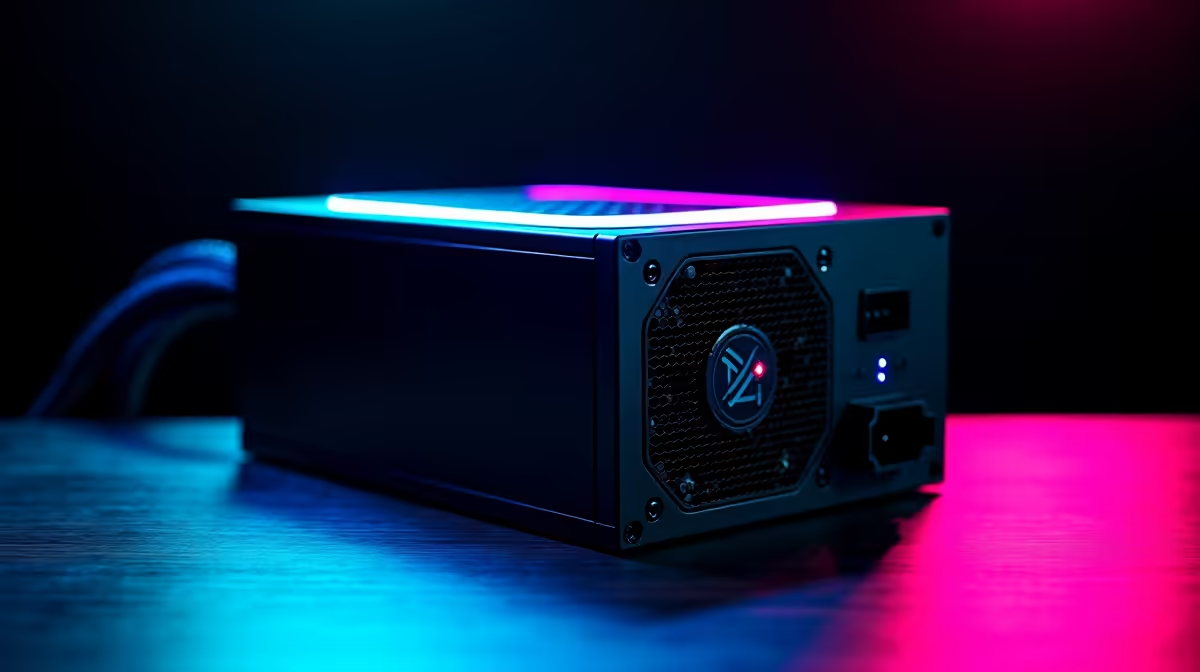
When choosing a PSU for a high-end GPU in South Africa, prioritise in this order: ATX 3.1 certification for transient load handling, adequate wattage with at least 20% headroom above your system's peak draw, a native 16-pin 12V-2x6 cable, 80 Plus Platinum or Gold efficiency, fully modular cabling, and a local warranty path for the brand you choose.
Why ATX 3.1 Certification Is Non-Negotiable for RTX 5000 and RX 9000 Builds 🔌
The RTX 5090, RTX 5080 and AMD RX 9070 XT all exhibit transient current spikes that exceed their rated TBP by significant margins during complex rendering moments. A PSU without ATX 3.1's mandatory 200% transient handling on PCIe rails may shut down briefly during these spikes, causing black screens, driver crashes or system restarts. The fix is straightforward: buy an ATX 3.1 certified unit. This requirement overrides other considerations: a higher-wattage non-ATX 3.1 PSU is a worse choice for an RTX 5090 build than a correctly-wattaged ATX 3.1 unit. The price premium for ATX 3.1 over ATX 3.0 or older standards has narrowed considerably through 2025 and 2026, with reputable ATX 3.1 units starting around R2,400 for 750W models and R4,500 for 1200W models at Evetech.
Wattage Selection: How to Calculate What You Need 🔧
Wattage selection starts with your GPU's Total Board Power and your CPU's sustained all-core power draw. RTX 5090: 575W TBP. RTX 5080: 360W TBP. AMD RX 9070 XT: 304W TBP. Add your CPU: Ryzen 9 9950X at 200W, Core Ultra 9 285K at 250W, Ryzen 7 9800X3D at 120W. Add system overhead for motherboard, RAM, drives and fans: typically 50W to 80W. Then add 20% headroom to the total. An RTX 5090 with a Ryzen 9 9950X peaks at around 855W plus 20% headroom equals a 1,026W minimum, so a 1200W unit is the sensible choice. An RTX 5080 with a Ryzen 7 9800X3D peaks at around 550W plus 20% headroom equals a 660W minimum, making an 850W unit the right choice. Oversizing by more than 40% is unnecessary and shifts the PSU to operate in its lower-efficiency zone.
Local Warranty and Grid Considerations Specific to South Africa 🛡️
South Africa's mains supply operates at 220V to 230V, which is within the ideal range for modern PSU efficiency. However, the grid experiences occasional brownouts and brief outages, particularly during summer storm season in Gauteng, that can damage PSUs without proper hold-up time and protection circuits. An ATX 3.1 PSU's minimum 17ms hold-up time provides a safety margin for brief input interruptions.
Run Your Build on a UPS From Day One ⚡
A quality line-interactive UPS in the 1,500VA to 2,000VA range costs R1,800 to R3,500 locally and protects your entire system from the grid events that cause premature PSU and motherboard failure. For a South African high-end build worth R30,000 to R80,000 in components, a UPS is the most cost-effective insurance policy available. Install it before your first boot, not after you experience your first unexpected shutdown.
FAQ
Should I choose a 1000W or 1200W PSU for an RTX 5090 and Ryzen 9 9950X build?
A 1200W unit provides comfortable headroom for this pairing.
Does the PSU brand matter if the wattage and efficiency rating are correct?
Yes, significantly.
How do I verify that a PSU's advertised specs are real before buying?
Cross-reference the model against third-party reviews from hardware testing publications that measure actual 12V rail ripple and transient response under load.
Choosing a PSU for your high-end South African GPU build?
Evetech's full range of ATX 3.1 certified power supplies covers every wattage from 750W to 1600W, with brands that have local warranty support and proven engineering quality.