Quick Answer
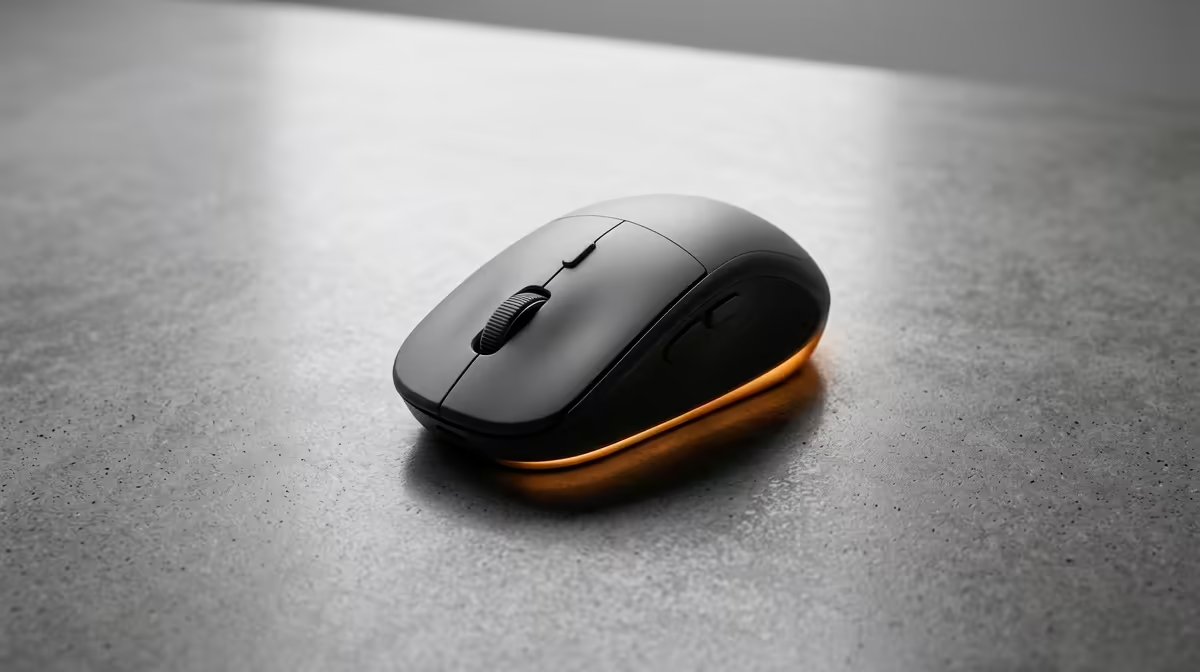
For a wireless productivity mouse in South Africa, prioritise battery life (at least 12 months on AA or a large internal battery), a comfortable ergonomic shape for your grip style, a reliable 2.4GHz nano receiver over Bluetooth for consistent low-latency tracking, and a sensor accurate enough for 1080p to 1440p office work (1000 to 4000 DPI range with smooth mid-speed tracking). Price range for a capable model is R500 to R1,200.
Battery Life and Charging: What Long-Term Means in Practice 🔋
Productivity mice spend most of their time moving at moderate speeds across documents and spreadsheets, which is undemanding on the sensor and allows power management to extend real battery life significantly. A AA-battery productivity mouse rated for 12 to 24 months of claimed battery life typically delivers 9 to 18 months in actual use. USB-C rechargeable mice with 500mAh to 800mAh built-in batteries last two to four weeks per charge at a typical eight-hour office day. USB-C charging is the modern standard and worth insisting on for new purchases: micro-USB charging cables are becoming hard to source in South Africa as the market moves away from the older standard.
Ergonomics and Grip Style for Long Office Sessions 🖱️
Productivity mice are built for sustained desk use, which means ergonomic shaping matters more than sensor precision. Palm grip users need a mouse with a high arch that fills the whole hand; claw grip users need a shorter, lower-profile body with side grips. A vertical mouse (90-degree rotation of the standard shape) reduces forearm pronation and suits users with wrist strain from flat mice over long sessions. For South African remote workers putting in six to eight hours daily at a desk, a mouse that causes forearm fatigue or wrist strain after three hours is a health consideration, not just a comfort preference.
Multi-Device Connectivity and South African Workplace Scenarios 📡
Multi-device wireless mice that support two to three device profiles via a button switch (alternating between 2.4GHz nano receiver and one or two Bluetooth connections) are highly practical for South African hybrid workers who use a personal laptop at home and a work-issued machine at the office. Switching between paired devices with a button click on the underside or side of the mouse takes under two seconds. This avoids the cost of buying a second mouse or unplugging and re-pairing a single-device mouse between machines.
Nano Receiver vs Bluetooth for Office Wi-Fi Environments ⚡
In large open-plan offices with many Bluetooth devices competing on the 2.4GHz band, a mouse on a dedicated 2.4GHz nano receiver maintains more consistent latency than Bluetooth. The nano receiver creates a point-to-point encrypted channel that is less susceptible to Bluetooth congestion from nearby devices. If you share desk space in a busy co-working setup, prefer nano receiver connectivity over Bluetooth for the mouse.
FAQ
How much should I spend on a wireless productivity mouse in South Africa?
R400 to R700 covers reliable nano receiver mice with good ergonomics and one to two year battery life suitable for daily office use. R700 to R1,200 adds multi-device switching, USB-C charging, and better sensor accuracy for occasional design or photo editing work.
Do wireless productivity mice work on glass desks common in South African home offices?
Most standard optical sensors (blue LED or red LED) do not track reliably on glass surfaces. If your desk is glass-topped, use a thin mousepad.
Is it worth getting a mouse with a scroll wheel that tilts horizontally for office work?
Looking for a wireless mouse that gets out of the way and just works?
Evetech stocks wireless productivity and ergonomic mice at a range of price points. Browse the full mouse selection at Evetech to find the right fit for your South African home or office setup.