Quick Answer
360mm radiator support is worth the extra case cost when your CPU has a TDP of 105W or more, when your room lacks air conditioning in SA summers, or when you plan to upgrade to a higher-TDP processor within the case's lifespan. For Ryzen 5 9600X or equivalent 65W CPUs on a 240mm AIO, the upgrade is not necessary.
When 240mm Is Enough and When It Falls Short 💧
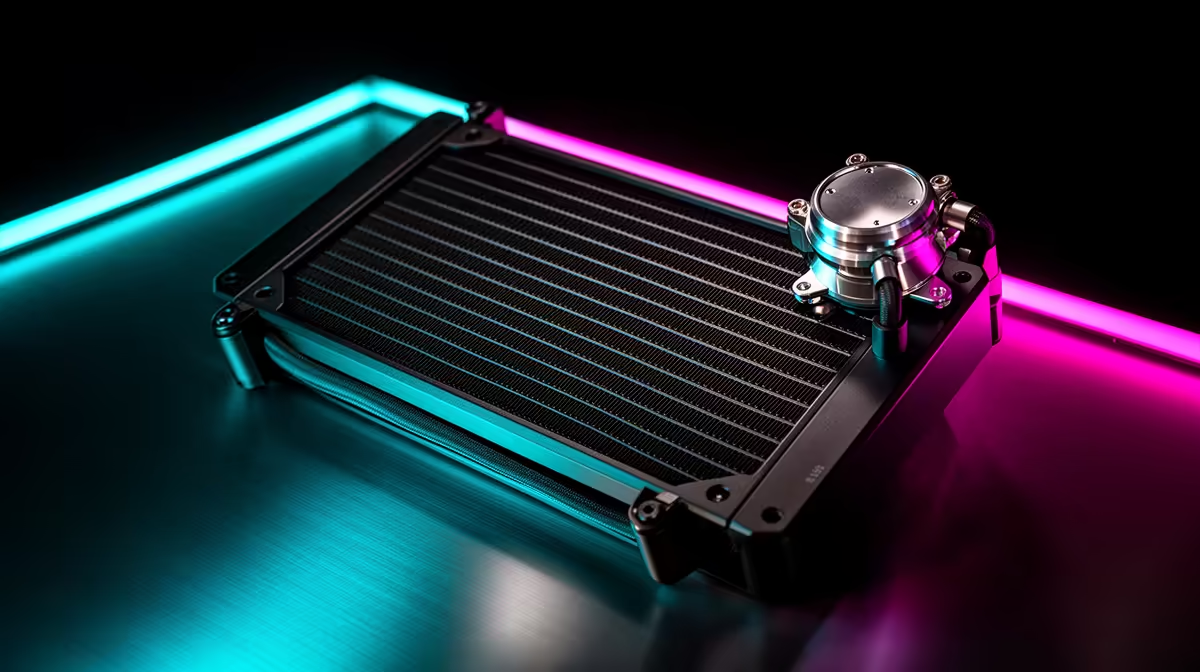
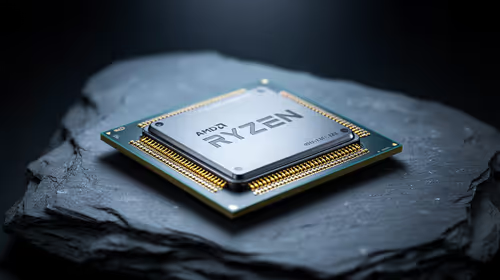
A 240mm AIO handles CPU TDPs up to around 125W with adequate thermal headroom. The Ryzen 5 9600X at 65W TDP, Core i5-14600K at 125W, and Ryzen 7 9700X at 65W eco mode all run comfortably below 80 degrees Celsius on a 240mm AIO during gaming loads. For these processors, paying R200 to R400 more for a case that supports 360mm is paying for future upgrade flexibility, not a present thermal requirement.
The calculation changes for processors above 125W sustained TDP. The Ryzen 9 9950X at 170W and Core Ultra 9 285K at up to 253W under PL2 benefit meaningfully from 360mm radiator surface. A 240mm AIO on a Ryzen 9 9950X under all-core Cinebench will push 90 degrees or higher and engage throttling. A 360mm AIO on the same chip holds 75 to 80 degrees with comfortable headroom.
The South African Summer Factor 🌡️
South African gamers in Gauteng, the Western Cape, and KwaZulu-Natal deal with ambient room temperatures of 28 to 36 degrees Celsius in summer, particularly in homes without central air conditioning. Every degree of ambient room temperature adds approximately one degree to CPU operating temperature under load. A chip running at 78 degrees in a 22-degree room will reach 84 degrees in a 28-degree room under identical load.
This ambient temperature premium means SA gamers effectively need 6 to 10 degrees more thermal headroom than European or North American benchmark conditions assume. A 240mm AIO adequate in a Johannesburg winter may push a Ryzen 7 9700X into throttling in February. 360mm radiator support provides the buffer that makes a build thermally stable year-round.
How Much More Do 360mm-Capable Cases Cost in SA? 💰
In the South African market, cases with genuine 360mm radiator support typically command a R300 to R700 premium over otherwise equivalent cases without it. A mid-range ATX case at R1,500 without 360mm support might have an equivalent at R1,900 with 360mm front support. For most gaming builds, this R400 premium buys permanent upgrade flexibility and better thermal headroom for SA summer conditions.
For a builder expecting to keep the same case through two CPU generations, having 360mm support from day one eliminates the need to replace the case if they upgrade from a Ryzen 7 to a Ryzen 9 processor.
360mm Radiator Support Verification ⚡
When a case spec lists 360mm radiator support, confirm whether this applies to the front position, top position, or both. Front 360mm with GPU co-location clearance is thermally superior but constraining for long GPU builds. Top 360mm is more common and compatible with longer GPUs but draws warmer case air through the radiator rather than fresh outside air.
FAQ
Does 360mm radiator support add significant cost to a case?
Typically R300 to R700 above a comparable 240mm-only case in South Africa. This premium is worthwhile for any build with a CPU above 105W TDP, particularly given SA summer ambient conditions.
Can I fit a 360mm AIO in a case that only lists 240mm support?
No. The fan mount cutouts and structural rails are sized for specific radiator lengths. A 360mm radiator physically does not fit in a 240mm mount position.
Is 360mm worth it for gaming-only builds with no CPU-heavy workloads?
For pure gaming loads, CPUs rarely hit sustained all-core maximum power. 360mm provides overhead for burst all-core spikes during game loading. Whether it justifies the premium depends on CPU tier: yes for Ryzen 9 builds, borderline for Ryzen 7, generally no for Ryzen 5.
Building for SA summer gaming conditions?
Evetech stocks ATX gaming cases with front and top 360mm radiator support alongside AIO liquid coolers in 240mm and 360mm configurations.