Quick Answer
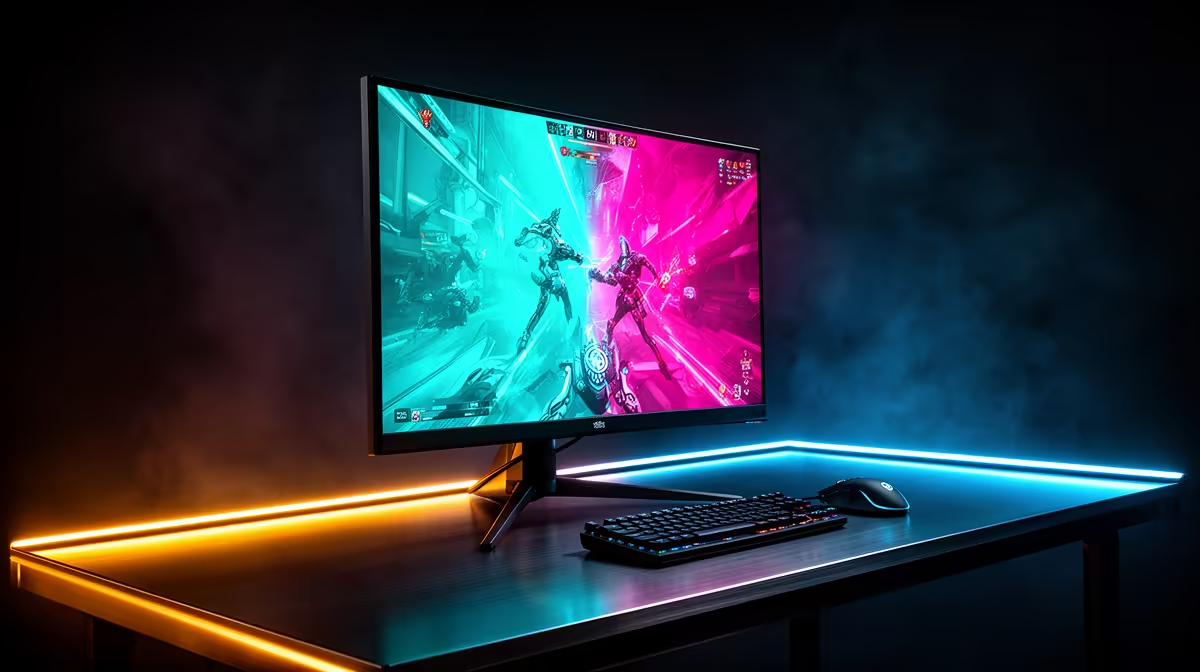
A 250Hz FreeSync Premium monitor is worth the extra cost in South Africa when you own a GPU that can deliver consistent 200-plus fps in your main game and you play reflex-sensitive titles like Valorant, CS2, or Apex Legends. If your GPU averages below 144fps in those titles, spending the additional R1,500 to R3,000 over a 144Hz equivalent delivers no visible benefit until the GPU is upgraded.
When 250Hz Makes a Real Difference 🎮
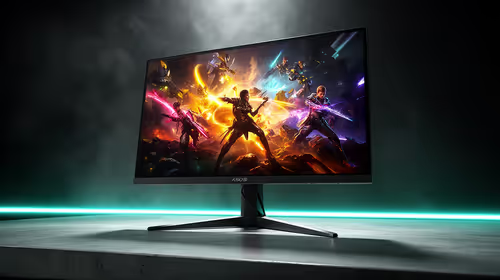
The human visual system detects frame rate improvements most sharply in the 60Hz to 144Hz transition, with progressively less gain in subsequent jumps. However, in competitive play 250Hz offers a genuine latency reduction: each frame persists for 4ms versus 6.9ms at 144Hz. For a player running an RTX 4070 Ti or RX 7900 GRE sustaining 220 to 300fps in CS2 at 1080p, the 250Hz panel displays frames more frequently and reduces input-to-display lag meaningfully. At a local price between R5,500 and R9,000 for a 27-inch 250Hz FreeSync Premium model, the uplift is real at this GPU tier.
When It Is Not Worth the Premium 💰
If your primary game is a slower-paced title (open-world RPG, strategy, simulation), 250Hz offers zero advantage over 144Hz. If your setup runs an RX 7600 or RTX 4060 and you play demanding titles at near-maximum settings, those cards average 100 to 130fps in many games at 1080p; the monitor's headroom sits unused. A smarter ZAR allocation in that case is a 144Hz or 165Hz monitor at R3,500 to R5,000 and the saved R2,000 to R4,000 toward the next GPU tier.
FreeSync Premium at 250Hz: Why Certification Matters 🔧
FreeSync Premium guarantees Low Framerate Compensation (LFC), meaning adaptive sync stays active and smooth when fps dips below the panel's minimum threshold. Even a powerful GPU running at a 250Hz average will dip to 180fps during GPU-heavy scenes. Without LFC, the sync range disengages at its minimum, reintroducing tearing during exactly the moments that matter most. For NVIDIA users, confirm the panel also carries G-Sync Compatible approval, which most FreeSync Premium 250Hz panels do.
Benchmark Before You Buy ⚡
Run a benchmark in your main game and record average and 1% low fps. If your 1% low is consistently above 180fps, a 250Hz monitor will feel noticeably smoother. If it sits below 120fps regularly, fix the GPU bottleneck first and revisit the monitor upgrade in the next component cycle.
FAQ
Is there a visible difference between 144Hz and 250Hz in South Africa's gaming conditions?
Yes, but only in motion-heavy competitive titles and only when your GPU feeds the monitor enough frames. At 250Hz with a high-fps GPU, cursor and crosshair motion appear notably smoother than at 144Hz.
Do I need a special cable to run 250Hz?
Yes. Use DisplayPort 1.4 or higher, which supports uncompressed 1080p at 250Hz. HDMI 2.0 can reach 240Hz at 1080p in some implementations, but DisplayPort is the safe and recommended choice for this refresh rate.
What is the price gap between 144Hz and 250Hz monitors locally?
The premium for 250Hz over 144Hz at comparable panel size and quality is approximately R1,500 to R3,000 in the South African market, taking you from R3,500 to R5,500 for a strong 144Hz panel up to R5,500 to R8,500 for a comparable 250Hz model.
Not sure whether 144Hz or 250Hz is right for your setup?
Evetech stocks both refresh rate tiers across multiple panel sizes. Browse the range and compare specifications side by side.