Quick Answer
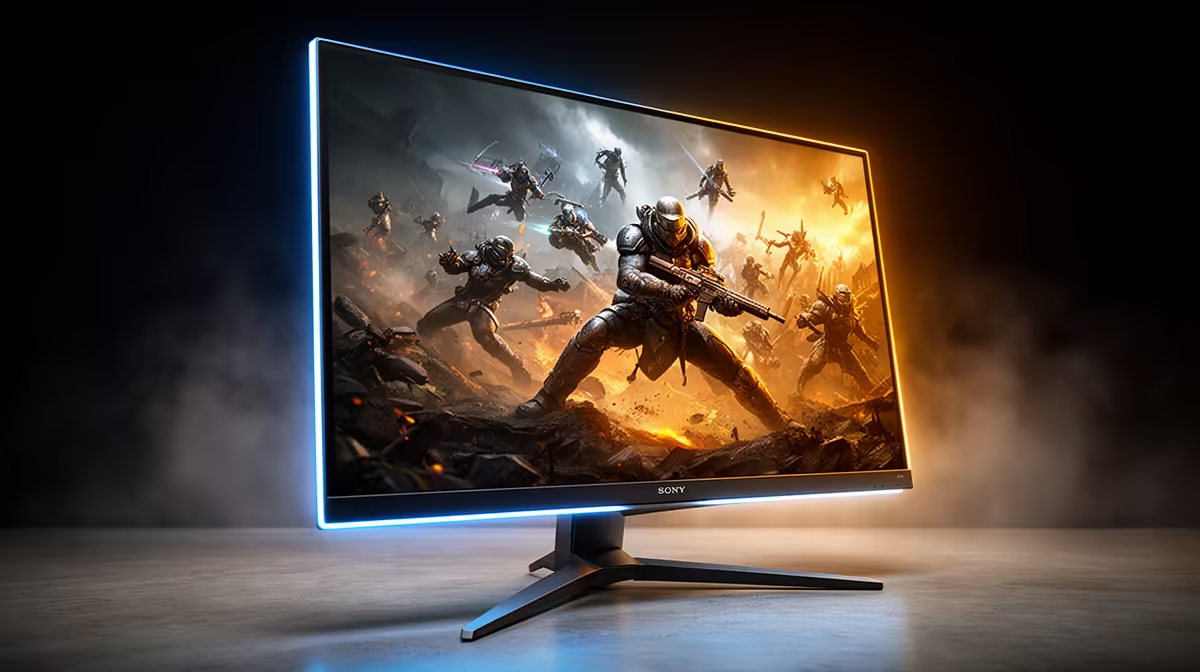
Upgrade from 1080p to 27-inch QHD when you have a GPU that can sustain 100 fps or higher at 1440p in your primary games and your 1080p monitor is 24 inches or smaller. At 27 inches, 1080p is visibly soft, while 1440p at 109 PPI reads as genuinely sharp from normal desk viewing distances.
The Right GPU Threshold for a QHD Upgrade 💻
The most common mistake SA builders make when upgrading to QHD is doing it before the GPU is ready. A 27-inch 1440p monitor will display at 1080p if your card cannot maintain acceptable frame rates at native resolution, and a 1080p image on a 1440p screen is softer than a native 1080p panel because of integer scaling misalignment.
The minimum sensible GPU pairing for a 27-inch QHD monitor is an RTX 4070 or RX 7800 XT for a mixed gaming workload. In Valorant and CS2, both cards exceed 200 fps at 1440p on competitive settings. In more demanding titles like Cyberpunk 2077 or Avatar: Frontiers of Pandora, they produce 50 to 80 fps at 1440p on high settings, which is comfortable with VRR active.
When the Size Jump Makes the Biggest Difference 🖥️
If you are currently on a 24-inch 1080p monitor, the jump to 27-inch 1440p is a double upgrade: more screen space and more pixels per inch. At 24 inches 1080p, pixel density is 91 PPI. At 27 inches 1440p, it rises to 109 PPI.
For South African students at universities like UCT, Wits, or UP who use the same monitor for both gaming and academic work, the 27-inch QHD jump is especially practical. A larger, sharper screen reduces eye strain during extended document work and gives more usable desktop real estate when running multiple windows or reference material alongside a PDF.
How to Time the Upgrade for Maximum Value 💰
Monitor technology updates more slowly than GPU generations, meaning a quality 27-inch QHD 165Hz or 240Hz panel purchased today will remain relevant for four to six years. GPU generations cycle every 18 to 24 months.
Locally, a quality 27-inch QHD 165Hz fast IPS monitor costs R5,500 to R9,000. A 27-inch QHD 240Hz model runs R7,000 to R12,000. For an SA builder coming off a 24-inch 1080p 60Hz monitor, either tier represents a substantial and immediately noticeable quality improvement in both gaming and productivity.
Check Windows Scaling Before You Commit to 1440p ⚡
At 1440p on a 27-inch screen, Windows 100 percent scaling produces small but readable UI elements. Most users run 125 percent scaling on 1440p, which enlarges the interface without the soft edges that 150 percent scaling introduces. Verify your applications support 125 percent DPI scaling before the upgrade to avoid blurry legacy software on the new panel.
FAQ
Is the difference between 1080p and 1440p on a 27-inch screen noticeable from a normal desk?
Yes, clearly. At a viewing distance of 60 to 70 cm, the pixel density difference between 82 PPI (1080p on 27 inches) and 109 PPI (1440p on 27 inches) is visible in text sharpness and fine in-game detail. Most users who make the switch immediately notice the improvement without needing side-by-side comparison.
Can I use a 1440p monitor at 1080p temporarily while I save for a GPU upgrade?
Yes, but the image quality at 1080p on a 1440p panel is noticeably softer than a native 1080p screen. Use this as a short-term solution only. Most games allow you to render at a lower internal resolution while the OS remains at native 1440p, which keeps the desktop sharp even if in-game visuals are scaled down.
Does 1440p increase load times or CPU usage?
No. Resolution affects GPU rendering workload but has no impact on load times, which are storage-speed dependent, and negligible impact on CPU usage in most game engines. Switching from 1080p to 1440p will reduce your GPU frame rate but not affect CPU frame times meaningfully.
Ready to make the move to 27-inch QHD?
Evetech stocks QHD gaming monitors across 165Hz, 240Hz, and 300Hz options, with local warranty and delivery. Head to the monitors section to find the right panel for your current GPU and future upgrade plans.