Quick Answer
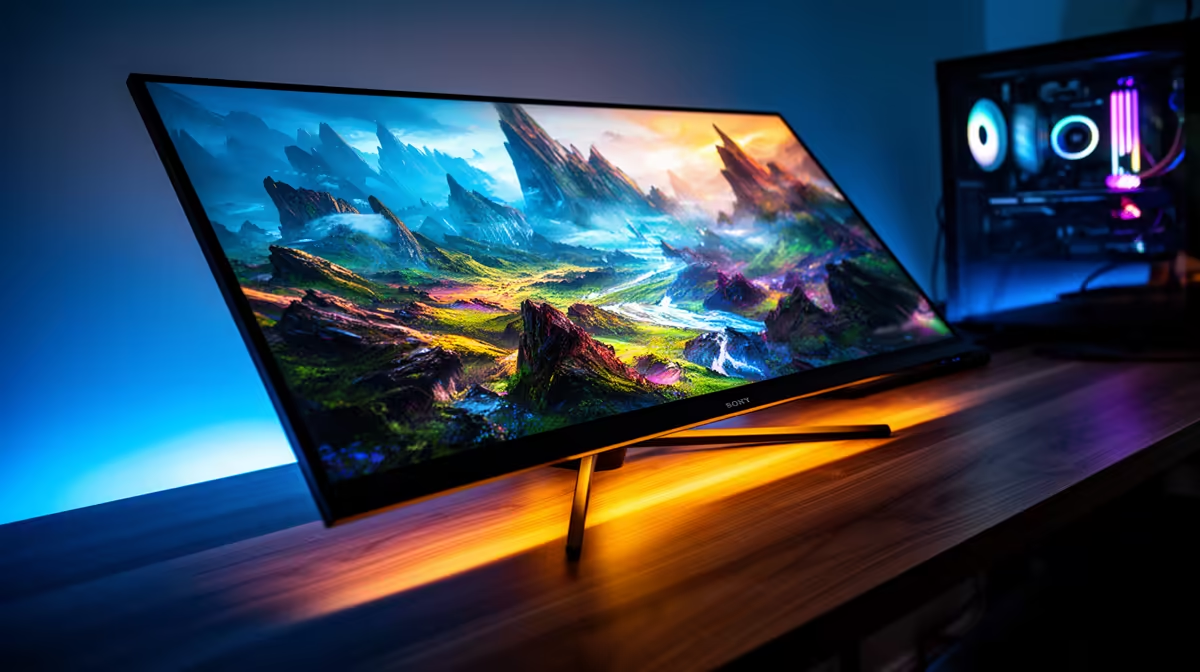
In a ZAR-based gaming PC budget, a 27-inch 4K QD-OLED monitor priced at R22,000 to R32,000 should represent 25 to 35% of your total build spend.
Budget Allocations for a QD-OLED Capable Gaming PC 💰
Building a gaming PC around a 27-inch 4K QD-OLED monitor requires an honest look at where rand goes in a high-end build. GPU and monitor together form the core expenditure. An RTX 5080 at R25,000 to R32,000 plus a QD-OLED monitor at R22,000 to R32,000 means R47,000 to R64,000 on those two components before CPU, memory, storage, motherboard, cooling, case, and PSU are added.
A sensible platform for that GPU pairing is a Ryzen 9 9950X or Core Ultra 9 285K at R12,000 to R14,000, a DDR5 motherboard at R4,000 to R7,000, 32 GB DDR5 6000 MHz at R4,000 to R6,000, a 2 TB PCIe 5.0 NVMe SSD at R3,000 to R5,000, a 360mm AIO cooler at R2,000 to R4,000, an ATX case with good airflow at R2,000 to R4,000, and a 1000W 80+ Gold PSU at R2,500 to R4,500.
How to Prioritise When Budget is Constrained 🔧
If total budget is closer to R60,000 than R100,000, the GPU-monitor trade-off requires a deliberate decision.
Option B: start with a 4K 144Hz OLED at R18,000 to R22,000 and invest more in the GPU (RTX 5080) to maximise frame rates. The 144Hz ceiling is less limiting than it sounds when your GPU cannot consistently exceed it anyway, and the 4K OLED experience at 144Hz is still a significant upgrade over any 1440p IPS display.
For most South African gamers, Option A (prioritise the QD-OLED, accept an RTX 5070 Ti) delivers the greater perceptual upgrade per rand because the visual leap from 1440p IPS to 4K QD-OLED is more immediately apparent than the RTX 5070 Ti to RTX 5080 frame rate difference in casual play.
ZAR Budget Planning: Common Mistakes to Avoid 💡
Underallocating on the PSU is the most common high-end build mistake. An RTX 5080 at 360W TDP in a system with a 9950X (170W TDP) needs a 1000W PSU minimum for comfortable headroom. Skimping to a 750W unit to save R500 creates system instability risk that is frustrating and expensive to diagnose.
Overspending on RAM beyond 32 GB DDR5 is rarely justified for gaming. 64 GB is only worth adding if the machine is also used for memory-intensive workloads like video rendering or virtual machines. That saved R3,000 to R6,000 is better allocated toward a higher-quality monitor stand with full articulation or a better NVMe SSD tier.
Phase the Build Over Two Purchases If Needed ⚡
If the R80,000-plus all-in build exceeds your current budget, phase the purchase. Buy the QD-OLED monitor and an RTX 5070 Ti now. The monitor will still be current-generation hardware in 18 to 24 months when you upgrade the GPU to an RTX 5080 or the generation equivalent, and your display investment is not wasted.
FAQ
Should I buy a prebuilt gaming PC or build my own for a QD-OLED setup in SA?
For builds above R80,000, custom building typically saves R5,000 to R15,000 compared to equivalent prebuilt configurations because you control component brand selection and avoid the system integrator margin.
Is a 27-inch QD-OLED monitor better value than a 32-inch 4K OLED at the same price?
At 27 inches the pixel density is 163 PPI versus 138 PPI at 32 inches. For desk use at 60 to 80 cm, the 27-inch is sharper and better suited to productivity alongside gaming. For primarily gaming use from a couch or further viewing distance, 32 inches may offer better immersion. The 27-inch is the more versatile choice for a desk setup.
Can I run a 27-inch QD-OLED as a dual monitor setup?
Yes, two 27-inch QD-OLED panels on a quality dual monitor arm is a compelling high-end desk configuration. The second monitor purchase effectively doubles the display investment, so most SA buyers do this in two phases: buy the primary panel first, add the second when budget permits.
Planning a full ZAR-optimised gaming PC build around a 27-inch QD-OLED?
Evetech has every component you need under one roof, from RTX 50-series GPUs to QD-OLED monitors, all with local warranty and competitive pricing.