Quick Answer
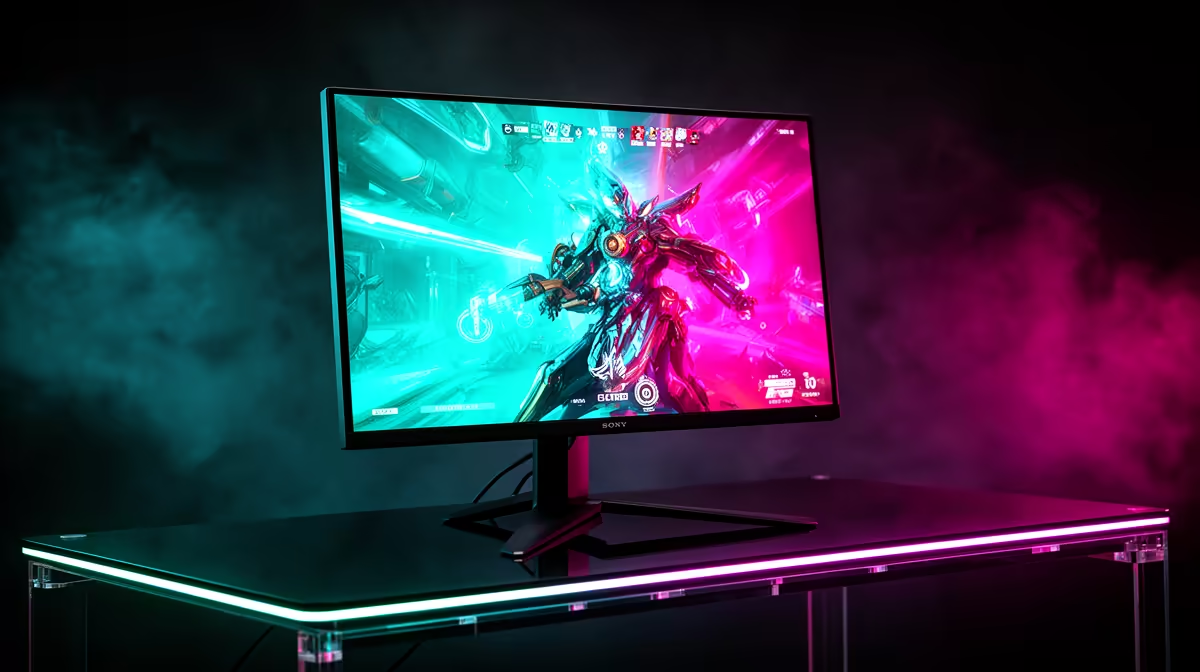
A 4K 160Hz monitor typically costs between R9,000 and R14,000 in South Africa and represents roughly 20 to 30 percent of a complete R40,000 to R50,000 high-performance gaming PC budget. Pairing it with a GPU that cannot consistently reach 100-plus fps at 4K undercuts the refresh-rate investment.
Where the 4K 160Hz Monitor Lands in a Total Build Budget 💰
A well-balanced SA gaming PC in 2026 targeting 4K high-refresh gaming might look like this: CPU (Ryzen 7 9800X3D) around R9,500, GPU (RTX 5080) around R18,000 to R22,000, motherboard R4,000 to R6,500, 32GB DDR5 RAM R3,000 to R4,500, NVMe SSD R1,200 to R2,500, case and cooling R2,500 to R4,000, PSU R2,500 to R3,500. That totals roughly R40,000 to R52,000 for the PC tower. Adding a R9,000 to R14,000 4K 160Hz monitor brings the full setup to R50,000 to R66,000. The monitor accounts for 18 to 25 percent of that figure, which is a proportionally healthy allocation for the display.
Matching GPU Horsepower to 4K 160Hz 🎮
A 4K 160Hz panel is only fully utilised when your GPU can deliver sustained framerates above 100 fps at 4K in your preferred game type. In less demanding competitive titles like Rocket League or Fortnite at medium settings, an RTX 5070 can reach 120 to 160 fps at 4K. In AAA open-world games at maximum settings, even an RTX 5080 hovers around 80 to 120 fps at 4K depending on the title. Using DLSS 4 with Multi Frame Generation on an RTX 50-series card can push frame counts well above 160 fps without the GPU needing to render each frame natively, which makes 4K 160Hz genuinely achievable on mainstream flagship GPUs.
Budget Reallocation: When to Size Down the Monitor 🔧
If the total PC tower budget is R25,000 to R35,000 and the GPU is an RTX 5060 Ti or RX 9070, a 4K 160Hz monitor is a stretch. That GPU tier sustains 60 to 80 fps at 4K natively in demanding titles, meaning the panel's 160Hz advantage is rarely reached. In this scenario, allocating R6,000 to R8,000 to a 1440p 165Hz or 1440p 240Hz IPS monitor gives a better experience because the GPU can consistently fill the refresh cycle. Save the upgrade to 4K 160Hz for when the GPU tier rises.
DisplayPort Version Matters at 160Hz ⚡
4K at 160Hz requires DisplayPort 1.4 with Display Stream Compression or DisplayPort 2.1 without it. Confirm your GPU outputs DP 1.4 or higher before buying a 4K 160Hz monitor. RTX 30-series and later and RX 6000-series and later all support DP 1.4 at minimum, so most current-gen cards are covered.
FAQ
Can I add the monitor now and upgrade the GPU later?
Yes, and this is a sensible strategy. A 4K 160Hz IPS monitor will run at 4K 60Hz or 4K 120Hz on a mid-range GPU and grow into its full refresh-rate spec as you upgrade the GPU in future. The monitor itself will not be the bottleneck.
What is the minimum GPU recommended for 4K 160Hz in 2026?
The RTX 5080 or RX 9080 (when available) are the realistic minimum for native 4K 160Hz in demanding AAA titles without upscaling. With DLSS 4 Multi Frame Generation or FSR 4, an RTX 5070 or RX 9070 XT can reach effective frame outputs above 160 fps at 4K in supported games.
How does a 4K 160Hz monitor affect power draw in a SA context?
A 32-inch IPS 4K monitor at 160Hz typically draws 35 to 55 watts at full brightness. This is modest and has a negligible effect on monthly electricity costs compared to the GPU, which can draw 200 to 450 watts under load.
Planning a high-refresh 4K setup?
Evetech stocks the monitors, GPUs, and full PC components to build your 4K gaming rig. Visit Evetech to spec out the complete package.