Quick Answer
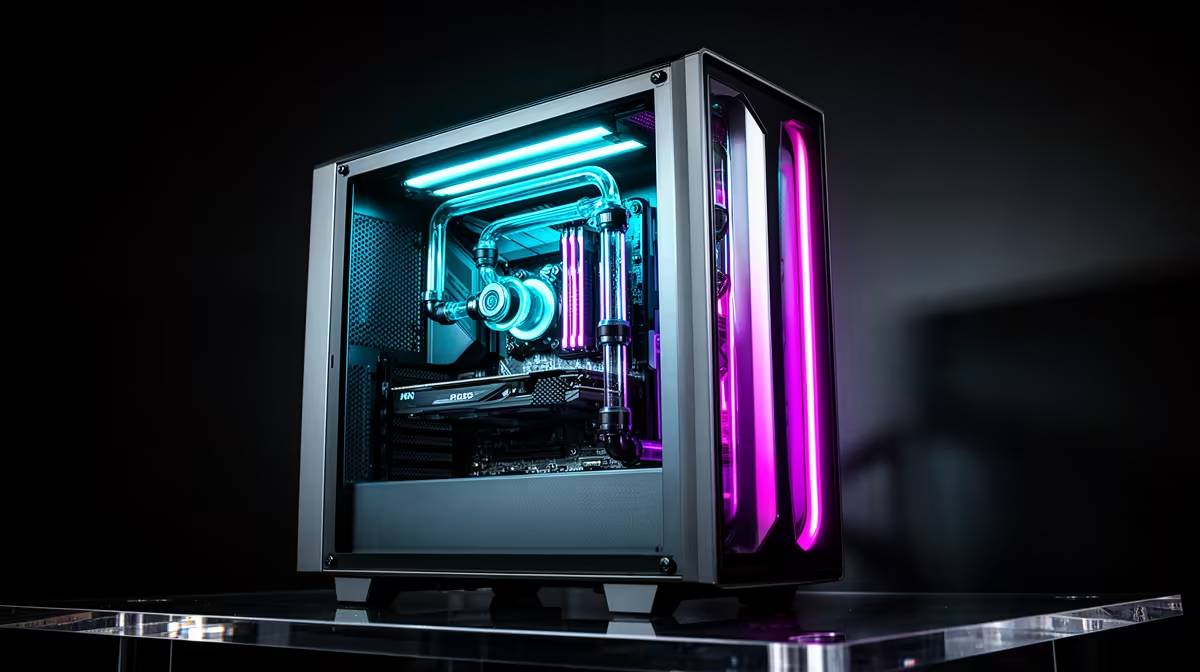
For a liquid-cooled gaming PC the case features that matter most are: front or top 360mm radiator mounting support with at least 55mm clearance, a dedicated cable management compartment, sufficient GPU clearance of 380mm or more, and a tempered glass side panel for monitoring the system visually. Dust filters on all intake points are also essential for SA conditions.
Radiator Mounting: The Non-Negotiable Spec 💧
A case that does not properly support your intended radiator size is the single most common liquid cooling compatibility mistake. Front-mount 360mm support is the ideal configuration because it uses the largest available panel area, creates positive pressure intake, and positions the radiator for maximum airflow from ambient cool air. The critical measurement is clearance between the radiator plane and the nearest obstruction, which must be at least 55mm to fit a standard 360mm radiator plus 25mm fans. Cases that list 360mm support but have obstructions like drive cages or motherboard standoffs within 50mm of the front panel will force you to use thinner radiators, limiting your AIO options to specific models only.
Dust Filtration and Access for Maintenance 🔧
Liquid-cooled builds with front radiators accumulate dust on the radiator fins significantly faster than the same fans in a free-air intake position, because the fins act as an additional filter layer. Dust-clogged radiator fins reduce heat dissipation and raise CPU temperatures by five to ten degrees Celsius over six to twelve months without cleaning. The case must have removable front dust filters that can be removed from outside the case without opening the side panel. Magnetic clip-on filters are the easiest to work with for monthly cleaning. In South African homes with ceiling fans running in warm months, dust accumulation is accelerated and monthly filter cleaning is a realistic maintenance schedule.
GPU Clearance and Layout Flexibility 📐
Liquid-cooled builds are often high-end, which means the GPU is also large and power-hungry. A case that supports a 360mm front radiator must also leave adequate GPU clearance in the same layout. Cases that achieve this do so by maximising the front-to-rear chassis depth. Look for 380mm or more of effective GPU clearance measured with front fans installed, not the bare-case maximum. The interior cable routing space behind the motherboard tray should be at least 25mm deep to accommodate the thicker modular PSU cable bundles that high-end builds require. Both measurements are in the product spec sheet and are worth verifying before purchase.
Run the Radiator as Front Intake, Not Top Exhaust ⚡
For most gaming PC layouts, mounting a 360mm radiator at the front as an intake produces lower CPU temperatures than mounting it at the top as exhaust. Front intake delivers cool ambient air to the radiator directly, while top exhaust draws already-warm air from inside the case across the radiator. The difference is two to six degrees Celsius at full gaming load.
FAQ
Does a liquid-cooled PC need more or fewer case fans than an air-cooled build?
The AIO radiator provides its own three fans, so the case itself needs fewer additional fans.
Should I choose a case with a mesh front or glass front for a liquid-cooled build?
A mesh front allows more airflow volume through the radiator, which improves thermal performance by two to four degrees Celsius under sustained load. A glass front looks more impressive but restricts intake airflow. The choice depends on whether the build is a daily thermal workhorse or a showcase machine.
What is the minimum case depth for a 360mm front radiator build?
Most 360mm-compatible ATX cases are at least 420mm deep from front panel to rear panel. Cases shallower than 400mm rarely provide adequate clearance for both a 360mm front radiator and a large GPU simultaneously.
Building a liquid-cooled gaming PC and need the right chassis?
Browse gaming cases at Evetech with confirmed 360mm radiator support and GPU clearance specs to find your ideal foundation.