Quick Answer
For smooth 3840x1080 gaming at 144Hz you need at minimum a Ryzen 5 7600X or Intel Core i5-13600K paired with an RTX 4070 or RX 7800 XT, 32 GB of DDR5 RAM, and an NVMe SSD. This configuration will sustain 100 to 144 fps in most modern titles at high settings, keeping pace with the monitor's refresh rate.
CPU Requirements for 3840x1080 at 144Hz 🔧
3840x1080 gaming is GPU-bound rather than CPU-bound in virtually all game genres. A modern mid-range CPU like the Ryzen 5 7600X (6 cores, boosting to 5.3 GHz) or the Core i5-14600K is more than sufficient to avoid CPU bottlenecking at this resolution. You do not need a Ryzen 9 or Core i9 processor for this use case. Spending over R6,000 on a CPU when the resolution is 3840x1080 is unbalanced; allocate that budget toward the GPU instead. Pair the CPU with a B650 or B760 motherboard and 32 GB of DDR5-6000 RAM for a cost-effective platform that remains upgrade-ready.
GPU Selection: The Make-or-Break Component 🎮
The RTX 4070 is the recommended starting point for 3840x1080 at 144Hz. It delivers 100 to 130 fps in demanding titles like Cyberpunk 2077 and Alan Wake 2 at high settings, and well above 144 fps in less demanding games. The RX 7800 XT is a strong alternative at a similar price point, particularly if you pair it with a FreeSync-certified ultrawide monitor. Stepping up to an RTX 4070 Super or RTX 4070 Ti Super adds meaningful headroom and enables consistent 144 fps targets in most titles with settings at ultra. For South African gamers, these GPUs currently range from around R9,000 to R14,000 at Evetech. An RTX 5070 is the next-generation option for future-proofing.
Storage, RAM and the Full System Picture 💡
For a 3840x1080 gaming rig targeting 144Hz, 32 GB of DDR5 RAM is recommended rather than 16 GB, because the ultrawide resolution combined with background applications can push RAM usage above 18 GB in modern open-world games. An NVMe Gen 4 SSD with at least 1 TB capacity ensures fast shader compilation and texture streaming that prevents stuttering in large open worlds. A 750 W to 850 W 80 Plus Gold PSU provides clean power headroom for the GPU during peak load. In total, expect to budget R18,000 to R28,000 for a complete mid-to-high-end build in South Africa that targets 3840x1080 at 144Hz comfortably.
Enable Resizable BAR (SAM) for Ultrawide Gaming ⚡
Both AMD and NVIDIA GPUs benefit from Resizable BAR (called Smart Access Memory on AMD). Enable it in your UEFI BIOS under PCI settings. At ultrawide resolutions the additional GPU VRAM bandwidth access can add 5 to 15 percent frame rate in open-world titles, essentially a free performance boost.
FAQ
How much VRAM do I need for 3840x1080 gaming?
At least 8 GB is required, with 12 GB recommended for comfortable high-texture gaming without VRAM overflow stuttering. 16 GB VRAM future-proofs the system for titles that load large ultrawide texture assets. The RTX 4070 (12 GB) and RX 7800 XT (16 GB) both meet this comfortably.
Is 3840x1080 at 144Hz more demanding than 4K at 60Hz?
No. 3840x1080 at 144Hz has roughly 4.1 million pixels at varying refresh rates, while 4K at 60Hz has 8.3 million pixels per frame. 4K at 60Hz is more GPU-intensive per frame. However, sustaining 144 fps at 3840x1080 requires consistent GPU throughput that a 60 fps 4K target does not.
Do I need a special case or cooling for an ultrawide gaming build?
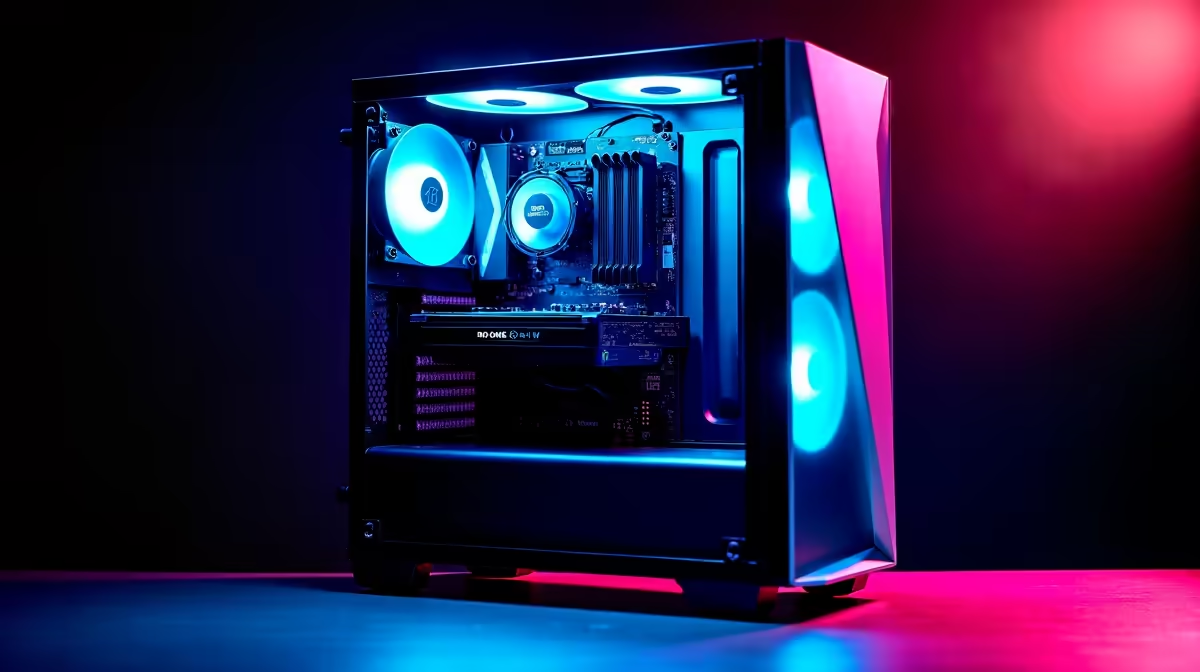
No special case is required. Standard mid-tower ATX cases accommodate the GPU sizes needed for this resolution tier. Ensure adequate airflow with at least three intake and two exhaust fans, as the RTX 4070-class GPUs generate meaningful heat under sustained ultrawide gaming load.
Building a PC for your new ultrawide monitor?
Evetech stocks the GPUs, CPUs, and complete gaming rigs needed to drive 3840x1080 at 144Hz, shop the range online or visit the Evetech store.