Quick Answer
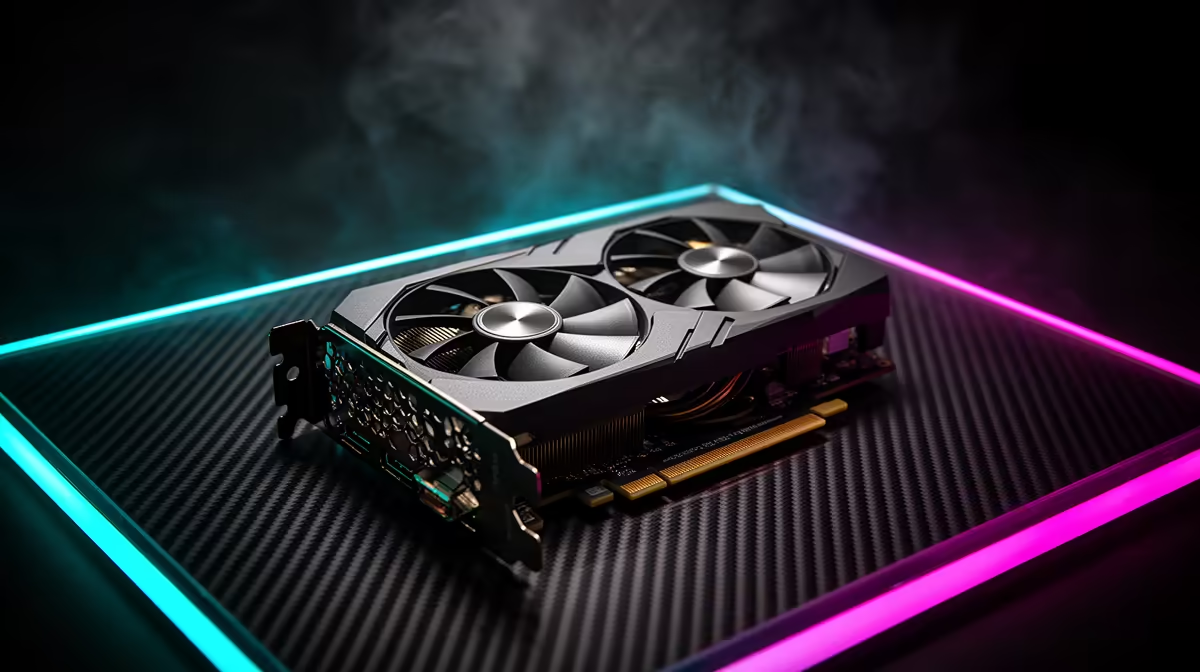
For SA budget builds, the RTX 5060 features that deliver the most real-world value are DLSS 4 Multi Frame Generation, GDDR7 memory bandwidth, and the Blackwell efficiency gains that reduce power draw. DLSS 4 alone can double effective frame rates on a modest system, making a 144 Hz monitor achievable without a more expensive GPU.
DLSS 4 Is the Budget Multiplier 🎮
DLSS 4 Multi Frame Generation generates up to three additional frames for every natively rendered frame, meaning an RTX 5060 achieving 60 fps natively at 1440p Medium can present 180 to 200 fps to the display. For budget SA builds targeting a 144 Hz panel, this is transformative: rather than spending an extra R4,000 to R6,000 on a higher-tier GPU, the RTX 5060 compensates through AI-generated frames. The trade-off is added latency, but DLSS 4 also includes Reflex integration that partially offsets this. In competitive esports titles where frame generation is not needed, the Blackwell rasterisation improvements still deliver a 10 to 15 percent native fps boost over the RTX 4060 at the same settings.
GDDR7 Bandwidth and Why It Changes Texture Performance 🔧
The RTX 5060 ships with GDDR7 memory, offering substantially higher bandwidth than the GDDR6 on older 8GB cards. In open-world and texture-heavy titles, this means fewer hitches and stutter as assets stream into the 8GB frame buffer. SA gamers running titles like Elden Ring: Nightreign or the Cyberpunk 2077 expansion at 1440p Medium-High textures notice the difference particularly when panning across dense scenes. The bandwidth advantage also benefits video editing and GPU-accelerated creative tasks, which is useful for SA students and content creators running a combined work-and-play budget build.
Power Efficiency and Budget Build Compatibility 💡
The RTX 5060 has a TDP of around 150 to 175 watts depending on the specific board partner variant. That means a 550W or 650W power supply, which many SA mid-range builds already have, is sufficient without an upgrade. The lower power draw also translates to reduced heat output, making budget cases with two intake fans and one exhaust adequate for stable thermals. Priced around R9,500 to R11,000 at Evetech, the RTX 5060 fits into complete budget builds targeting a total system cost of R18,000 to R22,000, leaving room for a Ryzen 7000-series CPU, 16GB DDR5, and a 500GB NVMe SSD.
Enable DLSS 4 Manually in Settings ⚡
DLSS 4 Multi Frame Generation is not always enabled by default in game menus. Navigate to the graphics settings in each supported title, look for the DLSS option, set it to Quality or Balanced, then separately enable Frame Generation. This two-step process is easily missed and skipping it leaves significant performance on the table for RTX 5060 owners.
FAQ
Does the RTX 5060 support ray tracing at playable frame rates?
Yes, at 1080p with DLSS 4 Quality mode. Native ray tracing at 1080p targets around 45 to 60 fps in demanding titles, but DLSS 4 pushes the effective output well above 100 fps in most cases, making ray tracing genuinely usable on a budget.
Is 8GB VRAM enough for a budget build in 2026?
For 1080p and 1440p gaming at High settings, yes. The GDDR7 bandwidth on the RTX 5060 means the 8GB buffer is used more efficiently than on older cards, and most current titles stay under 8GB at these settings when textures are set to High rather than Ultra.
What CPU pairs best with the RTX 5060 in a SA budget build?
A Ryzen 5 7600X or Ryzen 7 7700 keeps the CPU from bottlenecking the GPU in CPU-heavy titles without pushing the total build cost beyond R22,000. Both are currently stocked at Evetech and represent the clearest pairing for a balanced budget gaming PC.
Building a budget PC around the RTX 5060?
Browse RTX 5060 options and matched CPU and memory kits currently stocked at Evetech to complete your build without overspending.